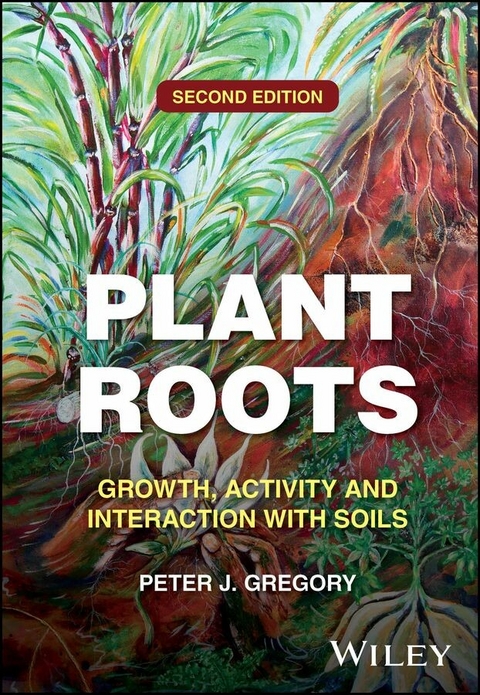
Plant Roots (eBook)
920 Seiten
Wiley (Verlag)
978-1-118-97060-7 (ISBN)
An updated overview of plant root systems, covering their development, growth, interactions with soil, breeding and management
Plant Roots draws together information from plant and soil literature to illustrate how roots interact with soil, both to modify it and to obtain from it the resources required for the whole plant to grow. Emphasis is placed on whole plants and root systems, with appropriate references to the growing body of literature on plant molecular and cellular levels.
This newly revised and updated Second Edition maintains its balance between introducing the founding ideas and science underlying the topic while covering the most recent updates underpinned by new scientific methods and understanding. The author reviews recent advances in genomics, phenomics, other -omics technologies, computer modelling, and the study of 'model plants' such as Arabidopsis thaliana and rice which have led to major advances in understanding how roots grow and function. New crop varieties contributing to increased crop production, especially in nutrient poor and/or water-limited soils, are described together with new ways of managing root systems to improve crop performance and efficiency of resource use.
Sample topics discussed in Plant Roots include:
- The anatomy and growth of primary roots
- The development and properties of the rhizosphere
- Heterogeneity of structure, nutrient availability, and microbial communities experienced in field soils
- Differences in anatomy and morphology between different types (classes) of root and their consequences for activity as absorbers of water and nutrients
- How crops, forests, natural plant communities and the resources supporting them might be managed more effectively
Plant Roots is an essential source of reference aimed at students and professionals who already have some background knowledge of soils and plants and are seeking to understand cutting-edge updates in the field.
Peter J. Gregory Professor Emeritus, University of Reading, UK, is internationally known and respected for his work on roots and is the recipient of a Lifetime Achievement Award from the International Society of Root Research.
An updated overview of plant root systems, covering their development, growth, interactions with soil, breeding and management Plant Roots draws together information from plant and soil literature to illustrate how roots interact with soil, both to modify it and to obtain from it the resources required for the whole plant to grow. Emphasis is placed on whole plants and root systems, with appropriate references to the growing body of literature on plant molecular and cellular levels. This newly revised and updated Second Edition maintains its balance between introducing the founding ideas and science underlying the topic while covering the most recent updates underpinned by new scientific methods and understanding. The author reviews recent advances in genomics, phenomics, other -omics technologies, computer modelling, and the study of model plants such as Arabidopsis thaliana and rice which have led to major advances in understanding how roots grow and function. New crop varieties contributing to increased crop production, especially in nutrient poor and/or water-limited soils, are described together with new ways of managing root systems to improve crop performance and efficiency of resource use. Sample topics discussed in Plant Roots include: The anatomy and growth of primary rootsThe development and properties of the rhizosphereHeterogeneity of structure, nutrient availability, and microbial communities experienced in field soilsDifferences in anatomy and morphology between different types (classes) of root and their consequences for activity as absorbers of water and nutrientsHow crops, forests, natural plant communities and the resources supporting them might be managed more effectively Plant Roots is an essential source of reference aimed at students and professionals who already have some background knowledge of soils and plants and are seeking to understand cutting-edge updates in the field.
1
Plants, Roots and the Soil
This book focuses on the roots of vascular plants and their interactions with soils. It has long been appreciated that plants influence the properties of soils and that soil type can, in turn, influence the type of plant that grows. This knowledge of plant–soil interactions has been applied by humans in their agriculture and horticulture. For example, Pliny the Elder quotes Cato as writing ‘The danewort or the wild plum or the bramble, the small‐bulb, trefoil, meadow grass, oak, wild pears and wild apple are indications of a soil fit for corn, as also is black or ash‐coloured earth. All chalk land will scorch the crop unless it is extremely thin soil, and so will sand unless it is extremely fine; and the same soils answer much better for plantations on level ground than for those on a slope’ (Rackham, 1950). Similarly, long before the nitrogen‐fixing abilities of Rhizobia were documented scientifically, Pliny the Elder noted that lupin ‘has so little need for manure that it serves instead of manure of the best quality’ and that ‘the only kinds of soil it positively dislikes are chalky and muddy soils, and in these it comes to nothing’ (Rackham, 1950).
This close association of soils and plants has led to an ongoing debate as to the role of plants in soil formation. Joffe (1936) wrote that ‘without plants, no soil can form’ but others such as Jenny (1941, reprinted 1994) demonstrated that vegetation can act as both a dependent and an independent variable in relation to being a soil‐forming factor. Ecologists find it useful to work with vegetation types and plant associations comprising many individual plant species; these associations are frequently linked to soil associations, and in this regard, at this scale, vegetation is not an independent soil‐forming factor. However, it is also appreciated that within a vegetation type, different plant species may have effects which lead to local variations in soil properties and where plants do act as a soil‐forming factor. For example, in mixed temperate forests, the pH of litter extracts of different species may range from 5.8 to 7.4 leading to different types of humus associated with those species and hence different rates of mineral leaching. Similarly, in the proteaceous shrub‐heaths and open woodlands and eucalypt‐dominated open woodlands of South West Western Australia, local bioengineering by roots and associated microbes results in localised soil types and niches for specific types of vegetation (Verboom and Pate, 2006).
Although much of the focus of plant and soil science has been on the return of leaves to the soil both as a stock of carbon (C) in the soil and as a substrate for soil organisms, root returns to soil are larger than shoot returns in several regions. For example, early work by ecologists such as Weaver in the United States demonstrated that several grasses produced more organic matter belowground than aboveground (Weaver et al., 1935). This interest in carbon inputs to soils has been reignited with the current debate over the sequestration of C by vegetation in an attempt to mitigate the greenhouse effect induced by the rising carbon dioxide (CO2) concentration of the atmosphere. Deep rooting has been advocated as a means of increasing the quantity of carbon stored in a soil profile (e.g. by Kell, 2011) with deep‐rooted grasses introduced into the grasslands of South America shown to sequester substantial amounts of carbon (100–500 Mt C a–1 at two sites in Colombia) mostly below the cultivated layer (Fisher et al., 1994).
This chapter examines the evolution of rooting structures and the emergence of roots of vascular plants. It describes features that distinguish roots from shoots, the close connection between the root and shoot systems and what is known about the coordination of activities between the two systems. It also describes some of the main features of the interaction between roots and soils as a prelude to their more detailed examination in later chapters.
1.1 Evolution of Roots
Roots, as we understand them today, appeared in land plants during the Devonian Period, 416 to 360 million years ago (Raven and Edwards, 2001), a period in which forest ecosystems evolved from the herbaceous vegetation of small leafless plants (typically <20 cm high) with rhizoid‐based rooting systems (RBRS) but lacking a vascular system (Kenrick and Strullu‐Derrien, 2014). Rhizoids form from tip‐growing cells at the plant–soil interface and both anchor the thallus (shoot) to the substrate and take up water and nutrients. Pre‐Devonian non‐vascular plants such as bryophytes, liverworts, hornworts and mosses had RBRS, and these structures are still evident in their modern counterparts found, for example, in cryptogamic ground covers (Mitchell et al., 2021). The evolution from RBRS to roots was congruent with the emergence of vascular plants for which the Rhynie Chert provides a unique paleobotanical window (Strullu‐Derrien et al., 2019). This deposit formed about 407 million years ago early in the Devonian period as hydrothermal water rich in silicates inundated and entombed terrestrial plants, fungi and animals living on sandy substrates in shallow ephemeral pools and their land margins.
Many early land plants of the Rhynie Chert had unicellular, smooth‐walled rhizoids that typically developed on prostrate rhizomatous axes that were often lying on the surface or shallowly subterranean (Fig. 1.1). Rhizoids showed variation in form and origin with some being short and present on all surfaces, whereas others were longer and located on ridges of tissue (e.g. Fig. 1.1f). In some plant species, rhizoids were associated with the differentiation of other tissues such as transfusion tissues and vascular parenchyma linking them to the vascular system, indicating that they had a role in the absorption and transportation of water and nutrients (Kenrick and Strullu‐Derrien, 2014). A major difference between RBRS and roots of extant plants is the presence of a self‐renewing structure (the root meristem) covered by a root cap (Groff and Kaplan, 1988; Raven and Edwards, 2001).
The fossilised remains of many early land plants are fragmentary and delicate structures such as root caps are frequently not preserved so that evolutionary sequences are often difficult to date with certainty. However, it is evident that roots of extant plant species have evolved at least twice independently among vascular plants (Raven and Edwards, 2001; Hetherington and Dolan, 2018). One line of evidence to support this hypothesis is that roots of extant lycophytes (including clubmosses and quillworts) and euphyllophytes (including seed plants) branch in different ways (Hetherington and Dolan, 2019). All lycophyte roots branch by the apical meristem splitting to form two equal‐sized meristems (see Fig. 1.1a and d), while, in contrast, euphyllophyte roots branch some distance behind the apical meristem to produce lateral roots that develop endogenously from internal tissues. A second example of different evolutionary pathways is that while extant lycophytes and euphyllophytes all develop roots with a root cap, the now‐extinct lycophyte Asteroxylon mackiei (Fig. 1.1a) present in the Rhynie Chert developed a continuous epidermis over the surface of the root meristem rather than forming a root cap (Hetherington and Dolan, 2018). Therefore, the root cap in lycophytes evolved after the evolution of the root meristem and rooting axis, suggesting that lycophyte roots acquired traits in a stepwise manner and that the present similarities between lycophyte and euphyllophyte roots are a consequence of convergent evolution (Hetherington and Dolan, 2018).
Fig. 1.1 Early land plants from the Lower Devonian Rhynie Chert. Reconstructions of (a) Asteroxylon mackiei, (b) Horneophyton lignieri, and (c) Nothia aphylla. Rooting structures are (d) longitudinal section of the rooting system of A. mackiei showing dichotomised branching, (e) transverse section of a corm bearing rhizoids of H. lignieri, and (f) transverse section of a rhizome of N. aphylla showing a ridge on the ventral surface that bears the rhizoids. The scale bars are (a) 4 cm, (b and c) 3 cm, (d) 1 mm, (e) 0.45 mm and (f) 1.5 mm. Original sources are cited by Kenrick and Strullu‐Derrien, 2014.
(Reproduced with permission from Kenrick and Strullu-Derrien (2014)/Oxford University Press.)
The Rhynie Chert also provides the earliest direct evidence for plant–fungal interactions (Strullu‐Derrien et al., 2018). Fungal spores and hyphae of glomeromycotan origin were found in sediments from the Ordovician period (460 million years ago) but were not directly associated with plants (Redecker et al., 2000). In fossils of the Rhynie Chert, though, diverse endomycorrhizal associations have been documented including the intercellular production of vesicles, spores and arbuscules in the rhizoids and aerial axes of various plants. These early fungal associations in plants without true roots are sometimes termed mycorrhiza‐like or paramycorrhizas. Although the mutualistic nature of these plant–fungal...
| Erscheint lt. Verlag | 29.8.2025 |
|---|---|
| Sprache | englisch |
| Themenwelt | Naturwissenschaften ► Biologie ► Botanik |
| Schlagworte | plant anatomy • plant literature • Plant morphology • Plant Systems • root anatomy • root function • root genomics • root literature • Root morphology • root structure • root systems • Soil • soil literature • soil modification • water roots |
| ISBN-10 | 1-118-97060-8 / 1118970608 |
| ISBN-13 | 978-1-118-97060-7 / 9781118970607 |
| Informationen gemäß Produktsicherheitsverordnung (GPSR) | |
| Haben Sie eine Frage zum Produkt? |
 EPUB (Adobe DRM)
Kopierschutz: Adobe-DRM
Adobe-DRM ist ein Kopierschutz, der das eBook vor Mißbrauch schützen soll. Dabei wird das eBook bereits beim Download auf Ihre persönliche Adobe-ID autorisiert. Lesen können Sie das eBook dann nur auf den Geräten, welche ebenfalls auf Ihre Adobe-ID registriert sind.
Details zum Adobe-DRM
Dateiformat: EPUB (Electronic Publication)
EPUB ist ein offener Standard für eBooks und eignet sich besonders zur Darstellung von Belletristik und Sachbüchern. Der Fließtext wird dynamisch an die Display- und Schriftgröße angepasst. Auch für mobile Lesegeräte ist EPUB daher gut geeignet.
Systemvoraussetzungen:
PC/Mac: Mit einem PC oder Mac können Sie dieses eBook lesen. Sie benötigen eine
eReader: Dieses eBook kann mit (fast) allen eBook-Readern gelesen werden. Mit dem amazon-Kindle ist es aber nicht kompatibel.
Smartphone/Tablet: Egal ob Apple oder Android, dieses eBook können Sie lesen. Sie benötigen eine
Geräteliste und zusätzliche Hinweise
Buying eBooks from abroad
For tax law reasons we can sell eBooks just within Germany and Switzerland. Regrettably we cannot fulfill eBook-orders from other countries.
aus dem Bereich