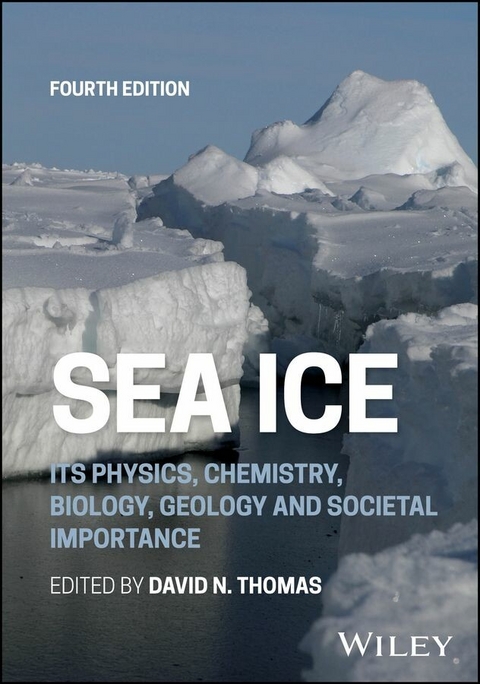
Sea Ice (eBook)
2053 Seiten
Wiley (Verlag)
978-1-394-21375-7 (ISBN)
New edition of the leading resource on the Arctic and Southern Oceans with contributions from the world's experts on sea ice
Sea Ice delivers insights into the very latest understanding of sea ice dynamics, how we measure (and model) its extent, the ecosystems that depend on sea ice, and the effect of climate change on its distribution. The book also discusses how sea ice influences the oceanography of underlying waters and the influence that sea ice has on the world's climate.
This newly revised and updated Fourth Edition looks at ice-based food webs and the impact on global geopolitics as well as changes in human activity in the Arctic.
Written by a team of more than 80 of the world's leading experts from 13 countries, Sea Ice includes information on:
- Sea ice thickness distribution and snow and surface processes on sea ice
- The short-term and long-term dynamics of Arctic versus Antarctic Sea ice
- Current methods of satellite remote sensing of sea ice
- The ecology of sea ice, from microbes to mammals to marine birds
- The cycling of contaminants across the ocean-sea ice-atmosphere interface
In its new edition, Sea Ice remains the leading multidisciplinary resource on the subject for all policy makers, researchers, and students with an interest in the polar regions and their role in the world's oceanic systems.
David N. Thomas is based at the University of Helsinki where he is the Professor of Arctic Ecosystem Research in the Faculty of Biological and Environmental Sciences. Previously (1996 to 2020) he was at Bangor University, U.K., where from 2006 he held the Chair of Marine Biology in the School of Ocean Sciences. From 2009 to 2013 he also held an Academy of Finland Distinguished Professorship at the Finnish Environment Institute (SYKE).
New edition of the leading resource on the Arctic and Southern Oceans with contributions from the world s experts on sea ice Sea Ice delivers insights into the very latest understanding of sea ice dynamics, how we measure (and model) its extent, the ecosystems that depend on sea ice, and the effect of climate change on its distribution. The book also discusses how sea ice influences the oceanography of underlying waters and the influence that sea ice has on the world s climate. This newly revised and updated Fourth Edition looks at ice-based food webs and the impact on global geopolitics as well as changes in human activity in the Arctic. Written by a team of more than 80 of the world s leading experts from 13 countries, Sea Ice includes information on: Sea ice thickness distribution and snow and surface processes on sea iceThe short-term and long-term dynamics of Arctic versus Antarctic Sea iceCurrent methods of satellite remote sensing of sea iceThe ecology of sea ice, from microbes to mammals to marine birdsThe cycling of contaminants across the ocean-sea ice-atmosphere interface In its new edition, Sea Ice remains the leading multidisciplinary resource on the subject for all policy makers, researchers, and students with an interest in the polar regions and their role in the world s oceanic systems.
Contributors
David Ainley
H.T. Harvey & Associates, 983 University Avenue, Bldg D, Los Gatos, CA 95032, USA
Luisa von Albedyll
Alfred Wegener Institute, Helmholtz Center for Polar and Marine Research, Klußmannstraße 3d, 27570 Bremerhaven, Germany
Stefanie Arndt
Alfred Wegener Institute, Helmholtz Center for Polar and Marine Research, Am Handelshafen 12, 27570 Bremerhaven, Germany
&
Institute of Oceanography, University of Hamburg, Bundesstraße 53, 20146 Hamburg, Germany
Kevin R. Arrigo
Department of Environmental Earth System Science, 473 Via Ortega, Stanford University, Stanford, CA 9430, USA
Cecilia M. Bitz
Atmospheric Sciences, Box 351640, University of Washington, Seattle, WA 98195-1640, USA
Angela C. Bliss
NASA Goddard Space Flight Center, Greenbelt, Maryland, USA
Kristina A. Brown
Centre for Earth Observation Science, Department of Environment and Geography, University of Manitoba, Winnipeg, MB R3T 2N2, Canada
Karley Campbell
Department of Arctic & Marine Biology, UiT The Arctic University of Norway, Tromsø, Norway
Courtney Carothers
College of Fisheries & Ocean Sciences, 1007 West 3rd Avenue, Anchorage, AK 99501-1936, USA
Giulia Castellani
Institute of Environmental Physics (IUP), University of Bremen, Otto-Hahn-Allee 1, 28359 Bremen, Germany
R. Eric Collins
Centre for Earth Observation Science, Department of Environment and Geography, University of Manitoba, Winnipeg, MB R3T 2N2, Canada
Finlo Cottier
Formerly: Scottish Association for Marine Science, Oban, Argyll, PA37 1QA, UK and UiT, The Arctic University of Norway, Tromsø, Norway
Odile Crabeck
Astrophysics, Geophysics and Oceanography Department, Université de Liège, Allée du 6 Août, 4000 Liège, Belgium
Alex Crawford
Centre for Earth Observation Science, Department of Environment and Geography, University of Manitoba, Winnipeg, MB R3T 2N2, Canada
Malin Daase
Department of Arctic & Marine Biology, UiT The Arctic University of Norway, Tromsø, Norway
&
The University Centre in Svalbard, Longyearbyen, Norway
Bruno Delille
Astrophysics, Geophysics and Oceanography Department, Université de Liège, Allée du 6 Août, 4000 Liège, Belgium
Jody W. Deming
School of Oceanography, College of the Environment, University of Washington, Seattle, WA 98185, USA
George Divoky
Cooper Island Arctic Research, 652 32nd Avenue East, Seattle, Washington 98112, USA
Klaus Dodds
Department of Geography, Royal Holloway, University of London, Egham Surrey, TW20 0E, UK
Eeva Eronen-Rasimus
Finnish Environment Institute (SYKE), Agnes Sjöbergin katu 2, Viikki Campus, 00790 Helsinki, Finland
Zachary Espinosa
Department of Atmospheric Sciences, University of Washington, Seattle, WA 98195-1640, USA
François Fripiat
Department Geosciences, Environment and Society, Université Libre de Bruxelles, Av. F.D. Roosevelt, 50, CP160/03, 1050 Brussels, Belgium
Zhiyuan Gao
Centre for Earth Observation Science, Department of Environment and Geography, University of Manitoba, Winnipeg, MB R3T 2N2, Canada
Craig George
Barrow, AK, USA
Christian Haas
Alfred Wegener Institute, Helmholtz Center for Polar and Marine Research, Klußmannstraße 3d, 27570 Bremerhaven, Germany
&
University of Bremen, Bremen, Germany
F. Alexander Haumann
Alfred Wegener Institute, Helmholtz Center for Polar and Marine Research, Klußmannstraße 3d, 27570 Bremerhaven, Germany
&
Ludwig Maximilian University of Munich, Munich, Germany
Donna D.W. Hauser
The International Arctic Research Center, University of Alaska Fairbanks, PO Box 757340, Fairbanks, AK 99775-7340, USA
Hayo Hendrikse
Department of Hydraulic Engineering, Delft University of Technology, PO Box 5048, 2600 GA Delft, The Netherlands
Henry P. Huntington
Ocean Conservancy, 23834 The Clearing Drive, Eagle River, AK 99577, USA
Polona Itkin
Department of Physics and Technology, UiT The Arctic University of Norway, Tromsø, Norway
Hermanni Kaartokallio
Finnish Environment Institute (SYKE), Agnes Sjöbergin katu 2, Viikki Campus, 00790 Helsinki, Finland
Alex Kaleak Sr.
Barrow, AK, USA
Diedre Kaleak
Barrow, AK, USA
Nina Karnovsky
Department of Biology, Pomona College, R. C. Seaver Biology Building, 175 W Sixth Street, Claremont, CA 91711, USA
Stefan Kern
Center for Marine and Atmospheric Science, Institute of Oceanography, Bundesstrasse 53, D-20146 Hamburg, Germany
Erin H. Kunisch
Norwegian University of Science and Technology, Postboks 8900, NO-7491 Trondheim, Torgarden, Norway
Kristin L. Laidre
Polar Science Center, Applied Physics Lab, University of Washington, 1013 NE 40th Street, Seattle, WA 98105, USA
Delphine Lannuzel
Institute for Marine and Antarctic Studies, University of Tasmania, IMAS Hobart, Tasmania, Australia
Rémy Lapere
University of Grenoble Alpes, CNRS, INRAE, IRD, Grenoble INP, IGE, 38000 Grenoble, France
Yueng-Djern Lenn
School of Ocean Sciences, Bangor University, Menai Bridge, Anglesey LL59 5AB, UK
Eva Leu
Akvaplan-Niva AS, CIENS, Gaustadalleen 21, 0349 Tromsø, Norway
Joe Mello Leavitt
Barrow, AK, USA
Amy Leventer
Geology Department, Colgate University, Hamilton, NY 13346, USA
Bonnie Light
Polar Science Center, Applied Physics Laboratory, University of Washington, 1013 NE 40th Street, Seattle, WA 98105-6698, USA
Stephanie M. Lim
Department of Environmental Earth System Science, 473 Via Ortega, Stanford University, Stanford, CA 9430, USA
Camille Lique
University of Brest, CNRS, Ifremer, IRD, Laboratoire d’Océanographie Physique et Spatiale (LOPS), IUEM, F29280, Plouzané, France
Ted Maksym
Applied Ocean Physics & Engineering, Woods Hole Oceanographic Institution, 266 Woods Hole Rd., Mailstop 12, Woods Hole, MA 02543-1050, USA
Louis Marelle
Sorbonne Université-LATMOS, Tour 45-46, 4, Plas Jussieu, 75252 Paris Cedex 5, France
Robert A. Massom
Australian Antarctic Division, Private Bag 80, c/o University of Tasmania, Sandy Bay, Tasmania 7001, Australia
&
The Australian Antarctic Program Partnership & ARC Australian Centre for Excellence in Antarctic Science at the Institute for Marine and Antarctic Studies, 20 Castray Esplanade, Battery Point, Tasmania 7004, Australia
Walter N. Meier
National Snow and Ice Data Center, University of Colorado, UCB 449, Boulder, CO 80309, USA
Klaus M. Meiners
Australian Antarctic Division, Private Bag 80, c/o University of Tasmania, Sandy Bay, Tasmania 7001, Australia
Michael P. Meredith
British Antarctic Survey, High Cross, Madingley Road, Cambridge CB3 0ET, UK
Sebastien Moreau
Norwegian Polar Institute, Fram Centre, Tromsø, Norway
C.J. Mundy
Centre for Earth Observation Science, Department of Environment and Geography, University of Manitoba, Winnipeg, MB, R3T 2N2, Canada
Marcel Nicolaus
Alfred Wegener Institute, Helmholtz Center for Polar and Marine Research, Klußmannstraße 3d, 27570 Bremerhaven, Germany
Daiki Nomura
School of Fisheries Sciences, 3-1-1 Minato-cho, Hokkaido University, Hakodate, Hokkaido, Japan
Dirk Notz
Max Planck Institute for Meteorology, Bundesstr. 53, D-20146 Hamburg, Germany
Don Perovich
Engineer Research & Development Center, Cold Regions Research and Engineering Laboratory, 72 Lyme Road, Hanover, NH 03755, USA
Pauline Pic
Department of Geography, Université Laval, Québec, Canada
Jennifer Pike
School of Earth &...
| Erscheint lt. Verlag | 27.8.2025 |
|---|---|
| Sprache | englisch |
| Themenwelt | Naturwissenschaften ► Biologie ► Ökologie / Naturschutz |
| Schlagworte | alaska ice • antarctica ice • antarctic mammals • arctic atmosphere • arctic ice • arctic industrialization • arctic marine ecology • human activity arctic • ice based food webs • satellite sea ice • sea ice nutrients • sea ice water cycle |
| ISBN-10 | 1-394-21375-1 / 1394213751 |
| ISBN-13 | 978-1-394-21375-7 / 9781394213757 |
| Informationen gemäß Produktsicherheitsverordnung (GPSR) | |
| Haben Sie eine Frage zum Produkt? |
 EPUB (Adobe DRM)
Kopierschutz: Adobe-DRM
Adobe-DRM ist ein Kopierschutz, der das eBook vor Mißbrauch schützen soll. Dabei wird das eBook bereits beim Download auf Ihre persönliche Adobe-ID autorisiert. Lesen können Sie das eBook dann nur auf den Geräten, welche ebenfalls auf Ihre Adobe-ID registriert sind.
Details zum Adobe-DRM
Dateiformat: EPUB (Electronic Publication)
EPUB ist ein offener Standard für eBooks und eignet sich besonders zur Darstellung von Belletristik und Sachbüchern. Der Fließtext wird dynamisch an die Display- und Schriftgröße angepasst. Auch für mobile Lesegeräte ist EPUB daher gut geeignet.
Systemvoraussetzungen:
PC/Mac: Mit einem PC oder Mac können Sie dieses eBook lesen. Sie benötigen eine
eReader: Dieses eBook kann mit (fast) allen eBook-Readern gelesen werden. Mit dem amazon-Kindle ist es aber nicht kompatibel.
Smartphone/Tablet: Egal ob Apple oder Android, dieses eBook können Sie lesen. Sie benötigen eine
Geräteliste und zusätzliche Hinweise
Buying eBooks from abroad
For tax law reasons we can sell eBooks just within Germany and Switzerland. Regrettably we cannot fulfill eBook-orders from other countries.
aus dem Bereich