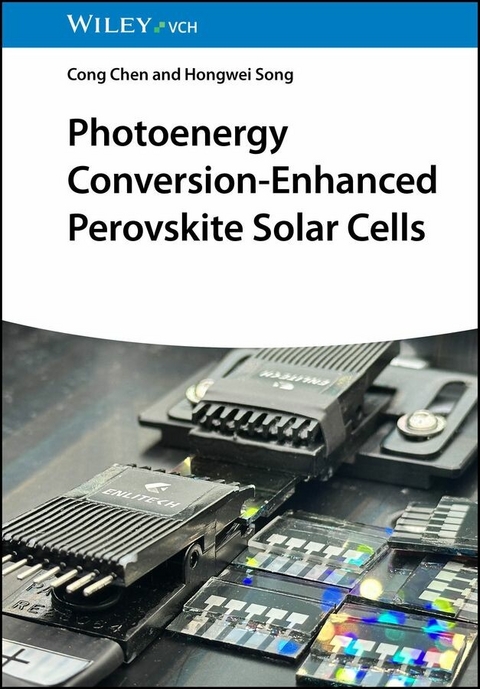
Photoenergy Conversion-Enhanced Perovskite Solar Cells (eBook)
371 Seiten
Wiley-VCH (Verlag)
978-3-527-83817-2 (ISBN)
Comprehensive presentation of upconversion luminescent materials, from fundamental theory to photovoltaic, photocatalytic, and biological applications
Photoenergy Conversion-Enhanced Perovskite Solar Cells is a thorough guide to the synthesis and properties of lanthanide-based and triplet-triplet annihilation-based upconversion nanomaterials. The book reviews their diverse applications in the fields of photovoltaics, luminescent solar concentrator, photodetectors, photocatalysis, lasing, light-emitting diodes, high-resolution bioimaging, photothermal therapy, photoelectrochemical biosensors, optical temperature sensing, ion detection, anti-counterfeiting, förster resonant energy transfer, volumetric full-color displays, photonic quantum logic gates, and other optical fields.
Photoenergy Conversion-Enhanced Perovskite Solar Cells explores sample topics including:
- Challenges in spectral response and photon management of perovskite photovoltaics (PVs)
- Down-conversion and down-shifting for high-energy uv utilization, with information on semiconductor oxides and carbon materials
- Surface plasmon resonance for light-harvesting, covering basic mechanisms as well as metal alloys and nanostructures
- Texturing for light-trapping, discussing electron transport layers with periodic nanostructures and texturing on glass or a transparent conductive oxide
- Luminescent solar concentrators for light concentration, reviewing both Pb-based and Pb-free nanocrystals
Photoenergy Conversion-Enhanced Perovskite Solar Cells is an essential reference for scientists, engineers, industrial experts, and advanced students to solve fundamental and applied problems of upconversion luminescent materials and think of new innovative ideas in the field of application of phosphor materials.
Cong Chen, PhD, is a Full Professor at Hebei University of Technology (HEBUT), China. He is the youngest special-term 'Yuanguang scholar' in HEBUT. His main research interest is the design of solar cells with high efficiency.
Hongwei Song, PhD, is a Full Professor at Jilin University, China. He has published over 300 scientific papers and two book chapters. His research interests focus on spectral physics and applications of rare earth ions and optoelectronics.
1
Photon Energy Conversion Enhances Perovskite Photovoltaics
1.1 The Growing Global Energy Crisis and the Role of PVs
The global energy landscape is undergoing a significant transformation, driven by escalating energy demands, environmental concerns, and technological advancements. Photovoltaic (PV) technology, which converts sunlight directly into electricity, has emerged as a pivotal player in this transition. This section delves into the current global energy crisis and examines the critical role of PVs in addressing these challenges [1].
1.1.1 The Global Energy Crisis
As of 2024, the world is grappling with an unprecedented energy crisis characterized by soaring demand, supply constraints, and environmental degradation [2]. Global energy consumption has reached record levels, propelled by population growth, industrialization, and urbanization, particularly in emerging economies. This surge in demand has strained existing energy infrastructures and heightened competition for finite fossil fuel resources. Concurrently, the environmental ramifications of fossil fuel dependence have become increasingly apparent. The International Energy Agency (IEA) reports that carbon dioxide emissions from energy reached an all‐time high in 2023, exacerbating climate change and its associated impacts, such as extreme weather events and rising sea levels [1, 3, 4]. The urgency to transition to sustainable energy sources has never been more pronounced.
1.1.2 The Role of PVs
PV technology has experienced unprecedented growth and innovation, cementing its position as a cornerstone of renewable energy solutions [5–7]. The remarkable progress in this field highlights its critical role in addressing the global energy crisis and transitioning toward a sustainable energy future. One of the most notable achievements of PV technology is its rapid global deployment. In 2024, global PV installations are expected to exceed 500 gigawatts (GW), reflecting a substantial increase from previous years. This remarkable growth has been driven by advancements in manufacturing techniques, such as automation and improved material utilization, which have lowered production costs and increased scalability. As a result, PV technology is now able to meet rising energy demands in a more efficient and timely manner, making it an essential part of global energy strategies.
A significant factor contributing to the widespread adoption of PV systems is their cost competitiveness. Over the past decade, the cost of solar PV has declined dramatically, transforming it into one of the most affordable sources of electricity. This cost reduction is largely attributed to economies of scale, technological improvements, and increased market competition. In many regions, the cost of electricity generated by solar PV is now lower than that of conventional fossil fuels, such as coal and natural gas. This affordability has not only accelerated adoption in industrialized nations but also opened opportunities for developing countries to enhance their energy security and provide access to electricity in underserved communities.
The environmental benefits of PV technology further underscore its importance in global energy transitions. Unlike fossil fuels, solar PV systems generate electricity without emitting greenhouse gases during operation. This characteristic makes them a vital tool in combating climate change and reducing the environmental footprint of energy production. The widespread deployment of PV systems has already led to significant reductions in carbon dioxide emissions, aligning with international climate goals such as the Paris Agreement. Additionally, solar energy systems contribute to reduced air and water pollution, further enhancing their environmental credentials.
Technological advancements have also played a pivotal role in the evolution and adoption of PV technology. Ongoing research and development efforts have yielded continuous improvements in solar cell efficiency, with modern cells achieving conversion rates that were previously unattainable. At the same time, innovative applications, such as building‐integrated photovoltaics (BIPVs) and flexible solar panels [8–13], have expanded the versatility and appeal of solar energy systems. These advancements enable PV technology to be seamlessly integrated into urban environments, agricultural systems, and transportation networks, demonstrating its adaptability to diverse applications and sectors.
The global embrace of PV technology is evident through substantial investments and supportive policies. For instance, the United States is expected to add a record 36.4 GW of utility‐scale solar capacity in 2024, nearly doubling the previous year's additions. Similarly, countries such as India have mandated the use of locally manufactured solar cells in clean energy projects, starting June 2026, aiming to bolster domestic manufacturing and reduce reliance on imports.
Furthermore, international collaborations and agreements have been instrumental in promoting PV adoption. The IEA's World Energy Outlook 2024 emphasizes the critical role of solar energy in achieving net‐zero emissions by 2050, highlighting the need for continued investment and policy support to sustain the momentum of PV deployment.
PV technology has become a transformative force in the renewable energy sector, characterized by rapid deployment, cost‐effectiveness, environmental benefits, and technological versatility. Its ability to address pressing energy and climate challenges, coupled with robust policy support and global collaboration, positions PV technology as a linchpin of the sustainable energy transition. As innovation and adoption continue to accelerate, solar energy is poised to play an even greater role in shaping a cleaner, greener, and more equitable energy future.
1.1.3 Challenges and Future Outlook
Despite the promising trajectory, challenges persist in the widespread adoption of PV technology. Grid integration, energy storage solutions, and the need for advancements in PV efficiency require ongoing attention. Additionally, geopolitical factors, such as resource nationalism and trade policies, can influence the global supply chain for PV components, necessitating strategic planning and international cooperation.
Looking ahead, the role of PVs in the global energy mix is poised to expand further. Projections indicate that solar energy could account for a substantial share of global electricity generation by 2030, driven by continuous technological innovations and supportive policy frameworks. The integration of PV technology with energy storage systems and smart grid solutions will be pivotal in enhancing energy reliability and meeting the dynamic demands of the future.
Thus, PVs stand as a cornerstone in the global endeavor to address the energy crisis. Its rapid deployment, cost‐effectiveness, and environmental benefits make it an indispensable component of sustainable energy strategies worldwide. Continued investment, innovation, and policy support will be essential in harnessing the full potential of PV technology to achieve a resilient and sustainable energy future.
1.2 Emergence of Perovskite Photovoltaics
Perovskite solar cells (PSCs) have rapidly emerged as a transformative technology in the field of PVs, offering the potential for high efficiency and low‐cost solar energy conversion. This section delves into the historical development of PSCs, highlighting key technological milestones and the inherent advantages that make them a promising alternative to traditional silicon‐based solar cells.
1.2.1 Historical Development and Key Technological Milestones
The journey of perovskite materials in solar cell applications began with the discovery of the mineral perovskite (calcium titanium oxide [CaTiO3]) in 1839 by German mineralogist Gustav Rose. Named after Russian mineralogist Lev Perovski, the perovskite structure is characterized by the general formula ABX3, where “A” and “B” are cations of differing sizes, and “X” is an anion, typically oxygen or a halide. This versatile crystal structure allows for a wide range of elemental compositions, enabling the tuning of various material properties.
The application of perovskite materials in PVs gained significant attention in 2009 when Tsutomu Miyasaka and colleagues reported a perovskite‐based, dye‐sensitized solar cell with a power conversion efficiency (PCE) of 3.8% [14]. However, these early devices exhibited poor stability due to the use of liquid electrolytes, leading to rapid degradation. A pivotal advancement occurred in 2012 when researchers demonstrated that replacing the liquid electrolyte with a solid‐state hole transport material significantly improved both the efficiency and the stability of PSCs. This innovation led to a PCE exceeding 10%, marking a substantial leap in performance. Until 2024, the PCEs of PSCs have reached 27%.
1.2.2 Subsequent Years Witnessed a Series of Breakthroughs
Here is a timeline of the development of PSCs from 2009 to 2024, with key milestones and important research achievements for each year:
2009: First introduction of perovskite materials for solar cells: the concept of using perovskite materials in solar cells was introduced. Tsutomu Miyasaka and coworkers discovered that organometal halide perovskites act as visible‐light sensitizers for...
| Erscheint lt. Verlag | 27.8.2025 |
|---|---|
| Sprache | englisch |
| Themenwelt | Naturwissenschaften ► Chemie ► Physikalische Chemie |
| Schlagworte | lanthanide-based nanomaterials • Light Trapping • Nanocrystals • perovskite photovoltaics research • phosphor materials • spectral response perovskite photovoltaics • triplet-triplet annihilation-based upconversion nanomaterials |
| ISBN-10 | 3-527-83817-1 / 3527838171 |
| ISBN-13 | 978-3-527-83817-2 / 9783527838172 |
| Informationen gemäß Produktsicherheitsverordnung (GPSR) | |
| Haben Sie eine Frage zum Produkt? |
 EPUB (Adobe DRM)
Kopierschutz: Adobe-DRM
Adobe-DRM ist ein Kopierschutz, der das eBook vor Mißbrauch schützen soll. Dabei wird das eBook bereits beim Download auf Ihre persönliche Adobe-ID autorisiert. Lesen können Sie das eBook dann nur auf den Geräten, welche ebenfalls auf Ihre Adobe-ID registriert sind.
Details zum Adobe-DRM
Dateiformat: EPUB (Electronic Publication)
EPUB ist ein offener Standard für eBooks und eignet sich besonders zur Darstellung von Belletristik und Sachbüchern. Der Fließtext wird dynamisch an die Display- und Schriftgröße angepasst. Auch für mobile Lesegeräte ist EPUB daher gut geeignet.
Systemvoraussetzungen:
PC/Mac: Mit einem PC oder Mac können Sie dieses eBook lesen. Sie benötigen eine
eReader: Dieses eBook kann mit (fast) allen eBook-Readern gelesen werden. Mit dem amazon-Kindle ist es aber nicht kompatibel.
Smartphone/Tablet: Egal ob Apple oder Android, dieses eBook können Sie lesen. Sie benötigen eine
Geräteliste und zusätzliche Hinweise
Buying eBooks from abroad
For tax law reasons we can sell eBooks just within Germany and Switzerland. Regrettably we cannot fulfill eBook-orders from other countries.
aus dem Bereich