


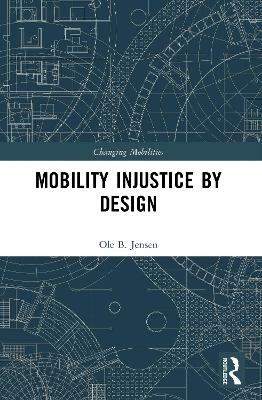
Mobility Injustice by Design
Seiten
2026
Routledge (Verlag)
978-1-032-60578-4 (ISBN)
Routledge (Verlag)
978-1-032-60578-4 (ISBN)
- Lieferbar (Termin unbekannt)
- Versandkostenfrei
- Auch auf Rechnung
- Artikel merken
Mobility Injustice by Design examines the social exclusion of vulnerable people in urban spaces, revealing how millions of citizens have their ‘right to roam’ curbed by design and planning decisions made either intentionally to facilitate immobility or social exclusion, or because of a lack of awareness of the aggregated consequences.
Ole B. Jensen’s insightful volume offers a theoretically informed framework, allowing us to ‘see’ mobility injustices more clearly, consider how new knowledge can mobilize design ethics, and think about how mobility justice can be brought about. It challenges us to reassess how choices of materials, design of spaces, and implementation of technologies afford or hinder particular mobilities. It explores a way of thinking about mobility and injustice that recognizes that everyone is assisted in their mobility practices and that human capacity for acting in the world is mediated by spaces, things, artifacts, and technologies. It examines not only the centrality of design but also the possibility that design may be working counter to the widespread cultural belief that design is in the service of ‘the good’. It locates thinking about mobility injustice between affect, experiences, and sensations on the one hand and reason, principles, and formal rules on the other. Focusing on three realms of practice, it reveals the ways in which the design of cities and urban spaces accommodates the needs of people living as unhoused, disabled, and aged and how these groups experience mobility injustice. Crucially, it provides insight into the potential to move toward a future, more mobility‑just society on a local, national, and global scale, in light of warfare, environmental, and migration crises.
Mobility Injustice by Design informs the future agenda of both critical mobilities research and the design fields and reflects on the potential for those in the arts and design to provoke public engagement in these timely issues. It is essential reading for all those concerned with the study and practice of mobilities theory, urban sociology, urban planning and design, architecture, urban geography, disability studies, and gerontology.
Ole B. Jensen’s insightful volume offers a theoretically informed framework, allowing us to ‘see’ mobility injustices more clearly, consider how new knowledge can mobilize design ethics, and think about how mobility justice can be brought about. It challenges us to reassess how choices of materials, design of spaces, and implementation of technologies afford or hinder particular mobilities. It explores a way of thinking about mobility and injustice that recognizes that everyone is assisted in their mobility practices and that human capacity for acting in the world is mediated by spaces, things, artifacts, and technologies. It examines not only the centrality of design but also the possibility that design may be working counter to the widespread cultural belief that design is in the service of ‘the good’. It locates thinking about mobility injustice between affect, experiences, and sensations on the one hand and reason, principles, and formal rules on the other. Focusing on three realms of practice, it reveals the ways in which the design of cities and urban spaces accommodates the needs of people living as unhoused, disabled, and aged and how these groups experience mobility injustice. Crucially, it provides insight into the potential to move toward a future, more mobility‑just society on a local, national, and global scale, in light of warfare, environmental, and migration crises.
Mobility Injustice by Design informs the future agenda of both critical mobilities research and the design fields and reflects on the potential for those in the arts and design to provoke public engagement in these timely issues. It is essential reading for all those concerned with the study and practice of mobilities theory, urban sociology, urban planning and design, architecture, urban geography, disability studies, and gerontology.
Ole B. Jensen is Professor of Urban Theory at the Department of Architecture, Design and Media Technology, Aalborg University, Denmark. He is the Deputy Director and Co‑Founder of the Centre for Mobilities and Urban Studies (C‑MUS). He is the author of titles including Mobilities Design. Urban Designs for Mobile Situations, and Staging Mobilities.
Part I. Positioning 1. Introduction 2. Mobility Part II. Framing 3. Bodies 4. Design 5. Injustice Part III: Practices 6. Unhoused 7. Disabilities 8. Ageing Part IV: Globalizing the matters of concern 9. Towards a mobility just society? 10. Conclusion and perspectives
| Erscheinungsdatum | 11.12.2025 |
|---|---|
| Reihe/Serie | Changing Mobilities |
| Zusatzinfo | 10 Line drawings, black and white; 10 Illustrations, black and white |
| Verlagsort | London |
| Sprache | englisch |
| Maße | 156 x 234 mm |
| Gewicht | 453 g |
| Themenwelt | Naturwissenschaften ► Geowissenschaften ► Geografie / Kartografie |
| Sozialwissenschaften ► Soziologie | |
| Technik ► Architektur | |
| ISBN-10 | 1-032-60578-2 / 1032605782 |
| ISBN-13 | 978-1-032-60578-4 / 9781032605784 |
| Zustand | Neuware |
| Informationen gemäß Produktsicherheitsverordnung (GPSR) | |
| Haben Sie eine Frage zum Produkt? |
Mehr entdecken
aus dem Bereich


aus dem Bereich
Buch | Hardcover (2024)
Schweizerbart'sche, E. (Verlag)
CHF 33,55
über eine faszinierende Welt zwischen Wasser und Land und warum sie …
Buch | Hardcover (2023)
dtv (Verlag)
CHF 33,55


