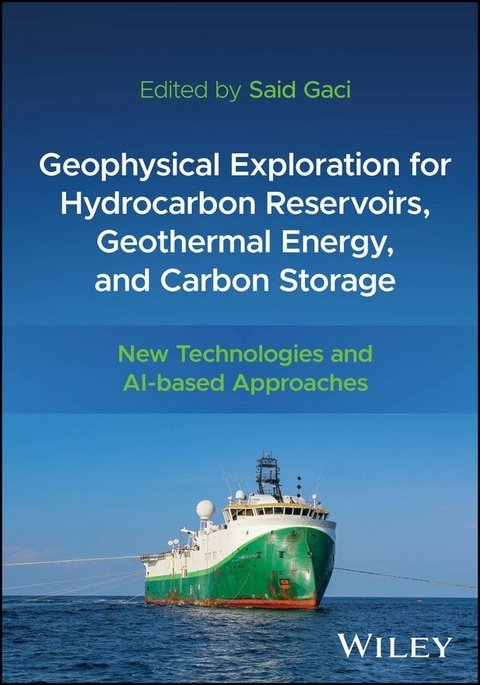
Geophysical Exploration for Hydrocarbon Reservoirs, Geothermal Energy, and Carbon Storage (eBook)
1052 Seiten
Wiley (Verlag)
978-1-394-26154-3 (ISBN)
A practical guide to the latest technologies and techniques in subsurface energy exploration
In Geophysical Exploration for Hydrocarbon Reservoirs, Geothermal Energy, and Carbon Storage: New Technologies and AI-based Approaches, distinguished researcher Said Gaci delivers a practice-oriented overview and comparison of the concepts, methods, and workflows for the geophysical characterization of hydrocarbon and geothermal reservoirs, including those reservoirs suitable for large-scale carbon sequestration.
Organized into four parts, the book begins with a summary of novel petroleum exploration technologies and discussions of illustrative case studies from around the world. It then explains how to integrate seismic and other non-invasive surveying methods for a comprehensive multiscale reservoir characterization. The third part explores the implementation of artificial intelligence tools in remote exploration, rock typing, and fluid prediction. The final part demonstrates how to apply hydrocarbon exploration methods to the exploration and development of geothermal reservoirs and underground carbon dioxide storage sites.
Readers will find:
- A multidisciplinary approach to combining conventional hydrocarbon exploration techniques with the power of artificial intelligence
- A thorough understanding of subsurface reservoir systems that links recent technical advances with new geological insights
- Practice-oriented discussions of advanced technologies for non-invasive reservoir characterization
- Selected case studies that illustrate the application of novel concepts in a real-world setting
Perfect for geologists, geoengineers, geophysicists, and fossil fuel professionals, Geophysical Exploration for Hydrocarbon Reservoirs, Geothermal Energy, and Carbon Storage will also benefit anyone aiming to remain at the forefront of subsurface energy exploration in the twenty-first century.
Said Gaci, PhD, is the Director of Scientific and Technical Support to Research at Sonatrach's Central Research and Development Directorate (DC R&D). His research interests include the application of signal processing and pattern recognition techniques in the geosciences.
A practical guide to the latest technologies and techniques in subsurface energy exploration In Geophysical Exploration for Hydrocarbon Reservoirs, Geothermal Energy, and Carbon Storage: New Technologies and AI-based Approaches, distinguished researcher Said Gaci delivers a practice-oriented overview and comparison of the concepts, methods, and workflows for the geophysical characterization of hydrocarbon and geothermal reservoirs, including those reservoirs suitable for large-scale carbon sequestration. Organized into four parts, the book begins with a summary of novel petroleum exploration technologies and discussions of illustrative case studies from around the world. It then explains how to integrate seismic and other non-invasive surveying methods for a comprehensive multiscale reservoir characterization. The third part explores the implementation of artificial intelligence tools in remote exploration, rock typing, and fluid prediction. The final part demonstrates how to apply hydrocarbon exploration methods to the exploration and development of geothermal reservoirs and underground carbon dioxide storage sites. Readers will find: A multidisciplinary approach to combining conventional hydrocarbon exploration techniques with the power of artificial intelligenceA thorough understanding of subsurface reservoir systems that links recent technical advances with new geological insights Practice-oriented discussions of advanced technologies for non-invasive reservoir characterizationSelected case studies that illustrate the application of novel concepts in a real-world setting Perfect for geologists, geoengineers, geophysicists, and fossil fuel professionals, Geophysical Exploration for Hydrocarbon Reservoirs, Geothermal Energy, and Carbon Storage will also benefit anyone aiming to remain at the forefront of subsurface energy exploration in the twenty-first century.
About the Book
by Said Gaci and Mohammed Farfour
Geophysical Exploration for Hydrocarbon Reservoirs, Geothermal Energy, and Carbon Storage: New Technologies and AI-based Approaches is an interdisciplinary book that integrates the fields of petroleum exploration, reservoir characterization, and energy transition. It also highlights the use of new geological knowledge and artificial intelligence techniques in reservoir characterization. Each topic is presented through theoretical frameworks, accompanied by recent case studies from various global contexts. This book provides practical insights into petroleum exploration, reservoir characterization, geothermal energy development, and CO2 sequestration.
Section 1. New Technologies and Insights into Petroleum Exploration
- Chapter 1. Gas Seepage in Marginal Structures as Additional Shallow and Deep Hydrocarbon Systems Indicator (Some of Recent FR Scanning Results), Valery Soloviev, Mykola Yakymchuk, and Ignat Korchagin
- Chapter 2. The Role of the LVZ and of Increased Seismicity in the Localization of Abiogenic HC in the Crystalline Crust of Transcarpathia, Valeriy Korchin and Elena Karnaukhova
- Chapter 3. Precambrian Mid-Continent Rift Potential for Hosting Numerous Helium and Hydrogen Accumulations, Central USA, Steven A. Tedesco
- Chapter 4. Production from Desmoinesian and Atokan Age Coalbed Methane and Carbonaceous Mudstone and Their Relationship to Structure and Geologic History of the Cherokee Basin, Kansas and Oklahoma, USA, Steven A. Tedesco
- Chapter 5. Geophysical Research and Monitoring Within the Framework of a Block-Layered Model with Inclusions of a Hierarchical Structure, Olga Hachay and Andrey Khachay
Chapter 1
Direct frequency-resonance (FR)-sounding technologies can identify the source and depth of gas migration in continental margins of the World Ocean (Heggland, 1998; Levashov et al., 2012; Yakymchuk et al., 2022; Yakymchuk and Korchagin, 2023). Discussed cases study taken from marginal migration centers of the Greenland shelf, Norwegian, Barents, and North Seas, and other structures of continental margins validate the impact of crust-mantle gas fluids on degassing mechanisms and support the “volcanic model” for continental margin formation in several part of the Earth. Using FR technologies, seeps can be served as supplementary indicators of hydrocarbon deposits in regions of gas release, helping in the construction of models pertaining to deep structure and abiogenic formation mechanisms. Seeps of methane and oil spills may be signs of volcanic activity and a factor in the changing worldwide climate.
References
- Heggland, R. (1998). Gas Seepage As an Indicator of Deeper Prospective Reservoirs. A Study Based on Exploration 3D Seismic Data. Marine and Petroleum Geology 15 (1), pp. 1–9.
- Levashov, S. P., Yakymchuk, N. A., & Korchagin, I. N. (2012). Frequency-Resonance Principle, Mobile Geoelectric Technology: A New Paradigm of Geophysical Investigations. Geofizicheskiy zhurnal 34 (4), pp. 166–176 (in Russian).
- Yakymchuk, M. & Korchagin, I. (2023). About the Opportunity of Direct-Prospecting Methods Application for Detection Areas of Gas and Natural Hydrogen Migration to The Surface and in The Atmosphere. Publisher.agency: Proceedings of the 2nd International Scientific Conference «Interdisciplinary Science Studies» (May 4–5, 2023). Dublin, Ireland, pp. 220–251. ISBN 978-2-6400-5011-9. https://doi.org/10.5281/zenodo.7905551
- Yakymchuk, M., Korchagin, I., Levashov, S., et al. (2022). Volcanism and Degassing Processes in the Structures of the Earth’s Polar Regions (review based on the results of frequency-resonance studies). Dodo Books Indian Ocean Ltd. And OmniScriptum S.R.L Publishing Group, p. 276 (in Ukrainian). ISBN: 978-620-0-63606-5. https://morebooks.de/shop-ui/shop/search?q=978-620-0-63606-5&page=1
Chapter 2
The deep genesis of hydrocarbons and their vertical movement along faults are becoming more and more involved in exploration efforts based on the organic hypothesis of oil origin. This means that in order to explain both local anomalies and potential for hydrocarbon exploration and production, a certain region’s deep geological structure must be meticulously modeled. The most efficient technique takes into account geothermal, seismic sections of DSS, tectonics, and the physical characteristics of rocks, namely petrophysical thermobaric modeling (PTBM) (Korchin et al., 2020; Korchin and Karnaukhova, 2021). Low velocity zones (LVZs) validate the new hypothesis of thermobaric mineral matter decompaction in the Earth’s crust at depths of 5–25 km. Exploring the deep structure of this area and, in particular, determining the location and configuration of the LVZs in the future will greatly increase the potential for finding hydrocarbon resources in Transcarpathia (Ukraine).
References
- Korchin, V. A. & Karnaukhova, O. Y. (2021). Peculiarities of Fluid Dynamics in the Seismically Active Zone of the Earth’s Crust of the Transcarpathian Depression (Ukraine). Science and education: problems, prospects and innovations. Proceedings of the 8th International Scientific and Practical Conference. CPN Publishing Group. Kyoto, Japan. pp. 45–53. ISBN: 978-4-9783419-5-2. URL: https://sci-conf.com.ua/viii-mezhdunarodnaya-nauchno-prakticheskaya-konferentsiyascience-and-education-problems-prospects-and-innovations-28-30-aprelya-2021-godakioto-yaponiya-arhiv/
- Korchin, V. A., Rusakov, O. M., Butrny, P. A., et al. (2020). The Origin of the Low Density Zones in the Crystalline Crust of the Transcarpathian Depression (Ukraine) From Petrophysical Thermobaric Modelling. Geodynamics 1 (28), рp. 81–93. https://doi.org/10.23939/jgd2020.01.081.
Chapter 3
The Mid-Continent Rift (MCR) is a 1.1-billion-year-old Precambrian feature in the central USA, known for its base metal and iron production in the northern regions. It underlies oil and gas-producing areas like as the Nemaha Ridge in Nebraska, Oklahoma, and Kansas, the Michigan Basin, Findley Arch in Ohio, and Indiana and Cincinnati Arch in Kentucky and Tennessee, though its connection to Paleozoic production is unclear. Reactivated Precambrian faults in the MCR provide structural traps and pathways for migrating helium (He), hydrogen (H), and dolomitizing fluids, enhancing Paleozoic reservoirs. Helium and hydrogen show have been reported in several wells, especially in the Kansas zone and near Babbitt, Minnesota. Helium is vital for technology and medicine, and global shortages persist, with key production centers in the USA, Canada, and other regions. Despite exploration efforts in Nebraska, Iowa, Kansas, and Michigan, significant He or H finds have yet to emerge. The scale of the MCR makes exploration challenging, with limited success so far, but the region remains a potential target for He and H resources (Tedesco, 2022; Maiga et al., 2023).
References
- Tedesco, S. A. (2022). Geology of Production of Helium and Associated Gases. Amsterdam: Elsevier, p. 394.
- Maiga, O., Deville, E., Laval, J., et al. (2023). Characterization of the Spontaneously Recharging Natural Hydrogen Reservoirs of Bourakebougou in Mali. www.nature.com/scientificreports.
Chapter 4
The Cherokee Basin, located in southeastern Kansas and northeastern Oklahoma, has been producing gas from Lower Desmoinesian and Atokan-age coalbed methane and carbonaceous mudstone (CBMCM) reservoirs since the 1920s. A major development effort in the 1990s expanded production until gas prices collapsed in 2008, halting further growth. By that time, over 6000 wells were active, with more than 1000 awaiting connection. However, as of 2023, CBMCM exploitation has not resumed, given more profitable shale gas plays across the USA. Despite low production rates, many wells continue to operate without significant decline. The basin is part of the Pennsylvanian Interior Basin, with key gas-producing coals such as the Riverton, Drywood-Rowe, Weir-Pittsburg, and Mulky coals. The most productive wells are located near the Chautauqua Arch, where heat from underlying Precambrian plutons facilitated gas generation. From 1982 to 2011, the basin produced 355 BCF of gas, about 12.6% of the USGS’s estimated 2.8 TCF. Despite earlier projections of higher reserves, actual recovery per well has been lower than expected. This study proposes an exploration model for finding similar CBMCM deposits elsewhere (Tedesco, 2014; Newell et al., 2004).
References
- Tedesco, S. A. (2014). Reservoir Characterization and Geology of the Coals and Carbonaceous Shale of the Cherokee Group in the Cherokee Basin, Kansas, Missouri and Oklahoma, U.S.A, PhD. Colorado School of Mines 2, p. 201.
- Newell, K. D., Johnson, T. A., Brown, W.M., et al. (2004). Geological and Geochemical Factors Influencing the Emerging Coalbed Gas Play in the Cherokee and Forest City Basins in Eastern Kansas, Kansas Geological Survey Open-File Report, 2004–2017, p. 12.
Chapter 5
This review discusses the development of new models of continuous media mechanics. These models are applied to the study of events occurring in permafrost under the impact of thawing processes, as well as to composite and statistically heterogeneous media, new structural materials, difficult arrays in mine and ground settings, and studying phenomena in permafrost under thawing processes (Panin et al. 1985; Goldin, 2002). The authors...
| Erscheint lt. Verlag | 25.8.2025 |
|---|---|
| Sprache | englisch |
| Themenwelt | Naturwissenschaften ► Geowissenschaften ► Geologie |
| Schlagworte | CO2 sequestration • geothermal energy development • petroleum exploration • petroleum exploration techniques • petroleum exploration technologies • Reservoir Characterization • Subsurface energy exploration • subsurface energy systems |
| ISBN-10 | 1-394-26154-3 / 1394261543 |
| ISBN-13 | 978-1-394-26154-3 / 9781394261543 |
| Informationen gemäß Produktsicherheitsverordnung (GPSR) | |
| Haben Sie eine Frage zum Produkt? |
 EPUB (Adobe DRM)
Kopierschutz: Adobe-DRM
Adobe-DRM ist ein Kopierschutz, der das eBook vor Mißbrauch schützen soll. Dabei wird das eBook bereits beim Download auf Ihre persönliche Adobe-ID autorisiert. Lesen können Sie das eBook dann nur auf den Geräten, welche ebenfalls auf Ihre Adobe-ID registriert sind.
Details zum Adobe-DRM
Dateiformat: EPUB (Electronic Publication)
EPUB ist ein offener Standard für eBooks und eignet sich besonders zur Darstellung von Belletristik und Sachbüchern. Der Fließtext wird dynamisch an die Display- und Schriftgröße angepasst. Auch für mobile Lesegeräte ist EPUB daher gut geeignet.
Systemvoraussetzungen:
PC/Mac: Mit einem PC oder Mac können Sie dieses eBook lesen. Sie benötigen eine
eReader: Dieses eBook kann mit (fast) allen eBook-Readern gelesen werden. Mit dem amazon-Kindle ist es aber nicht kompatibel.
Smartphone/Tablet: Egal ob Apple oder Android, dieses eBook können Sie lesen. Sie benötigen eine
Geräteliste und zusätzliche Hinweise
Buying eBooks from abroad
For tax law reasons we can sell eBooks just within Germany and Switzerland. Regrettably we cannot fulfill eBook-orders from other countries.
aus dem Bereich