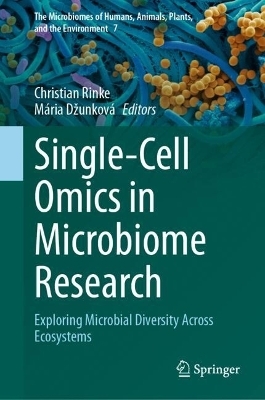
Single-Cell Omics in Microbiome Research
Springer International Publishing (Verlag)
978-3-032-07526-0 (ISBN)
This volume introduces the revolutionary field of microbial single-cell omics, a suite of cutting-edge techniques that uncover the genetic, functional, and metabolic signatures of individual microbial cells. From the discovery of new microbial lineages to decoding virus-host interactions, this book highlights the transformative impact of single-cell genomics, transcriptomics, proteomics, and metabolomics.
With expert protocols and innovative workflows, the book provides practical guidance on fluorescence-activated cell sorting (FACS), microfluidic encapsulation, and advanced genome amplification techniques. It also explores targeted methods, like FISH-FACS for recovering rare microbes, activity-based cell separation, and multi-omics approaches that integrate genomic, transcriptomic, and proteomic data. The authors discuss future developments and the immense benefits of analysing and understanding microbes one cell at a time, offering a glimpse into how this knowledge can transform microbial ecology, biomedicine, and biotechnology.
The book is aimed at researchers and students of environmental microbiology who wish to expand their knowledge of this ground-breaking approach and the underlying technology.
Christian Rinke received his PhD in Zoology from the Marine Biology Department at the University of Vienna, Austria and has since shifted his focus to the microbial world. His research interests include the phylogeny, taxonomy and ecology of free living and symbiotic Bacteria and Archaea. Thereby, he focuses on the majority of microbes which elude current culturing efforts. This so-called "Microbial Dark Matter" can only be explored with culture-independent approaches, and hence Chris has pioneered methods in high throughput single-cell genomics, the separation and sequencing of single bacterial and archaeal cells, and metagenomics, the direct sequencing of DNA from environmental samples. Currently, his lab uses a range of "omics" techniques to learn more about the phylogenetic and metabolic diversity encoded in Microbial Dark Matter.
He is also a member of the Genome Taxonomy Database (GTBD) curation team. GTDB is an initiative to establish a standardised microbial taxonomy based on genome phylogeny.
Mária Dzunková received her PhD in Biotechnology from the University of Valencia, Spain, where she focused on integrating flow cytometry with metagenomics to study the human gut microbiome. She gained further experience as a predoctoral researcher at the Czech Academy of Sciences and Harvard Medical School, and later as a postdoctoral researcher at the Australian Centre for Ecogenomics, University of Queensland (2016 2019), and the DOE Joint Genome Institute at Lawrence Berkeley National Laboratory (2019 2021). In 2021, she joined the Institute for Integrative Systems Biology (I2SysBio) at the University of Valencia, where she established the Microbial Single-Cell Genomics research group. Her work combines metagenomics and single-cell genomics to uncover novel microbial lineages and elucidate their functions without the need for cultivation. She is particularly interested in symbiotic interactions between soft-bodied marine animals and their microbes producing protective molecules, microbial life in extreme industrial environments, and horizontal gene transfer driven by phages and other mobile genetic elements.
Chapter 1: A Hitchhikers Guide to Microbial Single-Cell Omics.- Chapter 2: Overview of laboratory workflows for microbial single-cell genomics.- Chapter 3: Characterization of microbial diversity and mobile genetics elements through single-cell genomics.- Chapter 4: FISH-FACS enabled targeted recovery of genomes from uncultivated environmental microbial populations.- Chapter 5: Advancements in the application of activity-based studies for separation of microbial populations via fluorescence-activated cell sorting.- Chapter 6: Technical advancements in microbial single-cell omics analysis.- Chapter 7: Challenges and Future Perspectives for Single-Cell Multi-Omics in Prokaryotes.- Chapter 8: Single-Cell Sorting to Assess Phage Sensitivity in Heterogeneous Bacterial Populations.
| Erscheinungsdatum | 04.11.2025 |
|---|---|
| Reihe/Serie | The Microbiomes of Humans, Animals, Plants, and the Environment |
| Zusatzinfo | V, 135 p. 21 illus., 20 illus. in color. |
| Verlagsort | Cham |
| Sprache | englisch |
| Maße | 155 x 235 mm |
| Themenwelt | Naturwissenschaften ► Biologie ► Genetik / Molekularbiologie |
| Naturwissenschaften ► Biologie ► Mikrobiologie / Immunologie | |
| Schlagworte | DNA sequence processing • Environmental Microbiology • fluorescence-activated cell sorting • Metagenomics • Single-cell genomics |
| ISBN-10 | 3-032-07526-2 / 3032075262 |
| ISBN-13 | 978-3-032-07526-0 / 9783032075260 |
| Zustand | Neuware |
| Informationen gemäß Produktsicherheitsverordnung (GPSR) | |
| Haben Sie eine Frage zum Produkt? |
aus dem Bereich