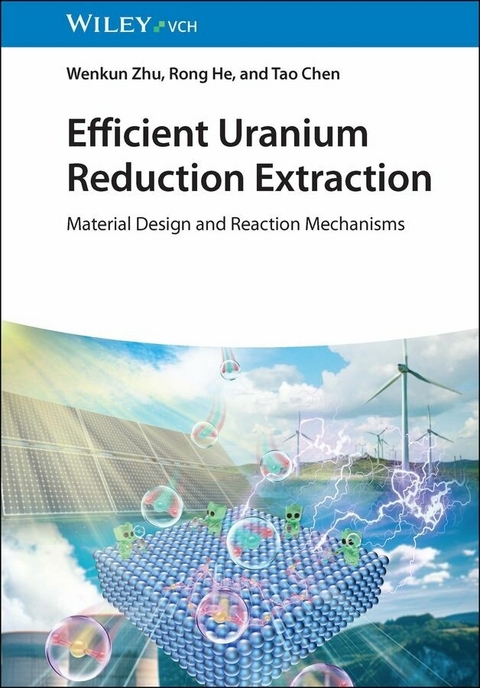
Efficient Uranium Reduction Extraction (eBook)
513 Seiten
Wiley-VCH (Verlag)
978-3-527-84823-2 (ISBN)
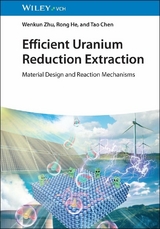
Enables readers to understand how to remove uranium from seawater and nuclear wastewater through a variety of techniques
Efficient Uranium Reduction Extraction provides experimental and theoretical knowledge on uranium reduction extraction, with information ranging from the design of extraction materials and methods to the evolution of uranium species and its reaction mechanism. Throughout the text, the authors illustrate the solution for the reductive separation of radioactive elements in complex environments and provide a new pathway for the treatment of wastewater.
Written by a team of highly qualified authors, Efficient Uranium Reduction Extraction includes information on:
- General chemical properties of uranium, including its coordination structure and valence state transformations
- Performance evaluation criteria and device integration for uranium reduction and extraction
- Methods including nano-zero-valent iron, commercial iron powder under the influence of external fields, carbon-semiconductor hybrid materials, and plasma
- Advanced techniques, such as atomic-resolved HAADF-STEM and synchrotron XAFS, which explore uranium reduction at the atomic level
Efficient Uranium Reduction Extraction delivers important and unique guidance on the subject for chemists, material scientists, and environmental scientists in universities and research institutions worldwide, along with undergraduate and postgraduate students in related programs of study.
Wenkun Zhu is the Principal Investigator in CAEA Innovation Center of Nuclear Environmental Safety Technology, Southwest University of Science and Technology (SWUST), China.
Rong He is a Professor in School of National Defense & Nuclear Science and Technology, Southwest University of Science and Technology (SWUST), China.
Tao Chen is a Professor in School of National Defense & Nuclear Science and Technology, Southwest University of Science and Technology (SWUST), China.
1
Background of Uranium Chemistry
1.1 Introduction of Uranium in Nuclear Industry
1.1.1 Importance of Uranium Resource in Nuclear Industry
Uranium is the basic material in the nuclear industry and is widely used in nuclear power generation, nuclear weapon manufacturing, and medical health fields [1–3]. As global climate change becomes a hot topic in the international community, the world's major carbon‐emitting countries have proposed emission reduction plans and advocated the development of clean and low‐carbon energy to address the pressure of energy conservation and emission reduction. Nuclear power, as an environmentally friendly, safe, and efficient source of energy, plays a significant role in improving climate change [4]. According to the International Atomic Energy Agency (IAEA, as of December 2023), 31 countries are operating nuclear reactors, with 418 reactors and a global operational power capacity of 387 GW [5]. The total reported production amounted to 2552.07 TWh, marking an increase of 2.6% compared to 2022. In 2023, the leading nations in nuclear power generation are the United States, China, and France. The United States possesses the largest nuclear fleet in the world, accounting for 31% of the total nuclear power generation with an output of 779.2 TWh. China followed with its nuclear power generation constituting 16% (406.5 TWh) of the global total. France produced 323.8 TWh, representing 13% of the worldwide. In 2023, the global nuclear reactors under construction totaled 59, with an operational power capacity of 61.1 GW. Currently, the construction of nuclear power reactors worldwide exhibits a rapid growth trend.
Uranium resources are fundamental fuel for nuclear power generation [6–8]. The development of the nuclear power industry directly influences the demand for uranium resources. In 2021, the global uranium production reached 43,731 t, meeting only 74% of the global demand for nuclear reactors [5]. This suggests that the current global uranium production is still short of fulfilling the demand for uranium, with approximately 30% of the requisite supply being met by secondary uranium resources (uranium that has been previously utilized in nuclear reactors and subsequently recovered and processed for potential reuse). In 2035, the total capacity of operational nuclear power reactors worldwide is projected to reach 683 GW, corresponding uranium demand of 104,740 t. The relationship between uranium resources and uranium demand is characterized by a mutual dependency, where an increase in uranium demand leads to a corresponding rise in uranium production. Moreover, most of the uranium‐consuming nations do not produce uranium, whereas uranium‐producing nations do not consume uranium. In light of the growing demand for resources in the global nuclear power reactor, ensuring a stable supply of uranium resources has emerged as an issue that requires urgent resolution.
1.1.2 Uranium Cycle in Nuclear Industry
The uranium cycle in the nuclear industry is a complex industrial process that includes uranium mining, purification, enrichment, chemical conversion and fuel fabrication, reactor application, and reprocessing [9–11]. The cycle commences with uranium extraction from underground mines, involving drilling and geological surveys to locate and extract raw uranium ore. Subsequently, the uranium ore undergoes crushing and chemical purification to extract uranium. After purification, uranium must be enriched to increase the proportion of 235U [12]. Uranium enrichment typically involves converting the uranium into gaseous UF6 and employing techniques such as centrifugation or diffusion to enhance the concentration of 235U, which is necessary for fabricating fuel elements for reactors [13]. The enriched uranium is further processed into fuel rods for nuclear reactors in the conversion facility. The fuel rods are installed into nuclear reactors, facilitating the controlled fission of 235U releasing thermal energy, which is then converted to generate electricity. The used fuel rods which are known as spent fuel require proper handling. Spent fuel can be reprocessed to extract the unreacted uranium and the produced plutonium [14]. The reprocessed uranium and plutonium obtained from the spent fuel can be used again as fuel in fuel fabrication [15, 16]. Alternatively, the spent fuel may also be securely packaged and stored until its radioactivity diminishes to a lower level before final disposal. Every step in the uranium cycle must strictly follow the international nuclear safety and environment protection standards to ensure the safety of the public. With the advancement of nuclear industry technology, the uranium cycle technology is gradually being optimized to achieve more efficient utilization of nuclear energy.
1.2 Coordination and Species of Uranium
1.2.1 General Chemical Properties of Uranium
Uranium (U), as one of the heaviest elements in nature, possesses a series of unique chemical properties that make it important in nuclear industry. Uranium has an atomic number of 92 and belongs to the actinide group of elements in the periodic table. The electron configuration of uranium is [Rn]5f36d17s2, which endows uranium with distinctive chemical behaviors. Uranium has multiple oxidation states, such as U(III), U(IV), U(V), and U(VI) [17, 18]. In both natural environments and nuclear industry, the common oxidation states for uranium are U(IV) and U(VI). U(VI) exists in uranium ore as the uranyl ion (UO22+). In addition, UO3 and U3O8 are also common oxides in uranium, with the latter frequently found in uranium ores [19]. Uranium is relatively stable in air, but finely powdered uranium can easily autoignite and form uranium oxide. When heated, uranium can directly react with nonmetallic elements such as oxygen, fluorine, chloride, and sulfur to form corresponding compounds. This reactivity implies that uranium can exhibit diverse chemical properties in redox reactions. Uranium is soluble in HNO3, forming UO2(NO3)2; it can also dissolve in HCl, forming UCl4. In the presence of oxidizing agents such as H2O2, HNO3, and HClO4, uranium can react with dilute H2SO4 to produce UO2SO4 [20]. Uranium does not directly react with alkaline solutions but can react with H2O2 and Na2O2 solutions to form soluble uranate salt.
The propensity of uranium to undergo hydrolysis in an aqueous solution is pronounced, especially in its higher oxidation state, resulting in the formation of stable hydroxides. This characteristic is crucial for understanding and controlling the handling of uranium in the nuclear fuel cycle. Uranium can also form various complexes involving numerous ligands, such as carbonate, phosphate, and organic acids [21, 22]. The formation of these complexes directly impacts the extraction, purification, and waste treatment of uranium.
The radioactivity of uranium is one of its most notable characteristics, which allows for a wide range of applications in medicine, nuclear power industry, and weapon manufacturing. For instance, radioactive isotopes of uranium can serve as tracers to study geological processes and environmental changes [23, 24]. The chemical properties of uranium isotopes, especially 235U and 238U during nuclear fission, make uranium a significant aspect of nuclear technology. In a nuclear reactor, 235U can undergo fission reactions by capturing thermal neutrons, thereby releasing a large amount of energy for electricity generation. 238U can undergo a series of transformation processes to become fissionable 239Pu [25]. These transformation processes make 239Pu an important nuclear fuel, particularly in regenerative nuclear energy and nuclear weapons.
In summary, the chemical properties of uranium are complex and diverse, and its behavior in nuclear industry requires precise control and monitoring. Through research into the chemical properties of uranium, scientists and engineers can better manage nuclear resources, ensuring the safety and sustainable development of nuclear industry.
1.2.2 Basic Uranium Species in the Solution‐Uranyl and Uranyl Compound
To release the uranium species in the uranium‐containing wastewater or seawater, the chemical valence state of uranium is introduced. Uranium exists in compounds with four primary valence states: hexavalent (VI) uranium, pentavalent (V) uranium, tetravalent (IV) uranium, and trivalent (III) uranium, among which U(VI) and U(VI) exhibit the most stable valence states [26, 27]. In aqueous solution systems, the most common oxidation state of uranium is uranyl ion (UO22+). In addition, U(VI) possesses a small ionic radius of 1.05 × 10⁻⁸ cm and is insoluble in solution, which typically exists in the form of UO2 or U3O8.
Under the nuclear fuel cycle, uranium fluorides such as UF4 and UF6 play a significant role in the uranium conversion process. U3O8 is first reduced to UO2, which subsequently reacts with HF to form UF4. After that, UF4 reacts with gaseous F2 to form UF6. In addition, UF4 can react with water to form uranyl fluoride and its hydrated forms. Initially, the primary product of this reaction is UO2F2. As time progresses, various uranium compounds such as U3O8, UO2, and UO3 are also formed alongside UO2F2. UF6 is a volatile compound at relatively low temperatures (about 56 °C) and is...
| Erscheint lt. Verlag | 19.8.2025 |
|---|---|
| Sprache | englisch |
| Themenwelt | Naturwissenschaften ► Chemie ► Physikalische Chemie |
| Schlagworte | carbon semiconductor hybrid materials • electrochemical uranium extraction • fluoride uranium • iron powder uranium • nano zero valent iron • plasma uranium • tri n butyl phosphate kerosene system • uranium photocatalytic extraction |
| ISBN-10 | 3-527-84823-1 / 3527848231 |
| ISBN-13 | 978-3-527-84823-2 / 9783527848232 |
| Informationen gemäß Produktsicherheitsverordnung (GPSR) | |
| Haben Sie eine Frage zum Produkt? |
 EPUB (Adobe DRM)
Kopierschutz: Adobe-DRM
Adobe-DRM ist ein Kopierschutz, der das eBook vor Mißbrauch schützen soll. Dabei wird das eBook bereits beim Download auf Ihre persönliche Adobe-ID autorisiert. Lesen können Sie das eBook dann nur auf den Geräten, welche ebenfalls auf Ihre Adobe-ID registriert sind.
Details zum Adobe-DRM
Dateiformat: EPUB (Electronic Publication)
EPUB ist ein offener Standard für eBooks und eignet sich besonders zur Darstellung von Belletristik und Sachbüchern. Der Fließtext wird dynamisch an die Display- und Schriftgröße angepasst. Auch für mobile Lesegeräte ist EPUB daher gut geeignet.
Systemvoraussetzungen:
PC/Mac: Mit einem PC oder Mac können Sie dieses eBook lesen. Sie benötigen eine
eReader: Dieses eBook kann mit (fast) allen eBook-Readern gelesen werden. Mit dem amazon-Kindle ist es aber nicht kompatibel.
Smartphone/Tablet: Egal ob Apple oder Android, dieses eBook können Sie lesen. Sie benötigen eine
Geräteliste und zusätzliche Hinweise
Buying eBooks from abroad
For tax law reasons we can sell eBooks just within Germany and Switzerland. Regrettably we cannot fulfill eBook-orders from other countries.
aus dem Bereich