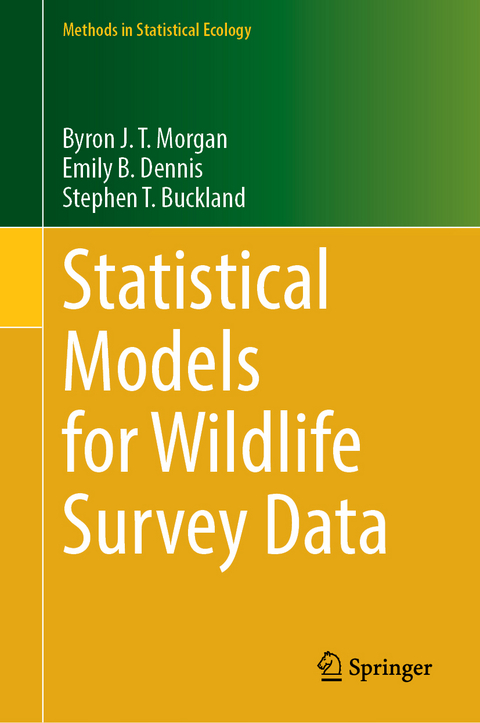
Statistical Models for Wildlife Survey Data
Springer International Publishing (Verlag)
978-3-032-06182-9 (ISBN)
- Noch nicht erschienen - erscheint am 28.05.2026
- Versandkostenfrei
- Auch auf Rechnung
- Artikel merken
This book describes a range of models for ecological data sets using both classical and Bayesian methods of inference, and illustrates their use through a varied set of real examples. These examples exhibit a range of sampling schemes, applied to various taxa and in varying environmental conditions. The book also describes pitfalls to be avoided in the design and analysis of ecological surveys.
Models may be spatial and/or temporal, and often include covariates such as measures of habitat, temperature and rainfall. Covariate selection for given problems is discussed. Other topics include the construction of individual species spatial maps, how spatial distributions change over time, models for unmarked and marked/identifiable individuals, integrated analysis, and how methods can be used to estimate biodiversity. In addition, the book reviews emerging new technologies; for instance, remote sensing and the use of drones, which result in opportunities for new methods of analysis.
This book is a source of reference for postgraduates and research scientists in statistics and ecology. It may be used for graduate-level teaching, as well as a research reference. It critically and comprehensively presents the most up-to-date statistical modeling work in the area, recommending statistical methods. There is an extensive bibliography and multiple links to computer programs written in R, BUGS and other languages, as well as relevant computer packages; computing material may be accessed via download from the book website.
Byron J.T. Morgan, Ph.D., is Emeritus Professor at the University of Kent. His research interests include applied statistics, biometry, statistical ecology, parameter redundancy, population dynamics and applications of Bayesian methods.
Emily B. Dennis, Ph.D., is a Senior Ecological Statistician at Butterfly Conservation. Her research interests include modeling species abundance and distribution, citizen science data and biodiversity indicators, in particular with application to butterflies and moths.
Stephen T. Buckland, Ph.D., is Emeritus Professor of Statistics at the University of St. Andrews. His research interests include modeling population dynamics, wildlife resource management, wildlife population assessment, distance sampling and biodiversity monitoring
Introduction.- Probability and Statistics.- Sampling Schemes.- Habitat Classification.- Pitfalls.- Abundance Indices.- Occupancy Models.- Measuring Biodiversity.- Discussion.- Appendix.- Bibliography.
| Erscheinungsdatum | 29.11.2025 |
|---|---|
| Reihe/Serie | Methods in Statistical Ecology |
| Zusatzinfo | Approx. 300 p. 50 illus. in color. |
| Verlagsort | Cham |
| Sprache | englisch |
| Maße | 155 x 235 mm |
| Themenwelt | Mathematik / Informatik ► Mathematik ► Statistik |
| Mathematik / Informatik ► Mathematik ► Wahrscheinlichkeit / Kombinatorik | |
| Naturwissenschaften ► Biologie ► Ökologie / Naturschutz | |
| Schlagworte | Bayes • biodiversity indicators • biodiversity target • Bootstrap • Butterflies • Capture-recapture models • correlated auto-regression • Covariate • Distance sampling • Dynamic Models • Generalised abundance index • habitat classification • hidden Markov models • Hidden process models • Integrated modelling • Integrated models for animal survey data • Maximum Likelihood • model-selection procedure • Models for citizen science data • Models for count data • Models for insect data • Models for presence/absence data • Models for presence-only data • n-mixture models • Occupancy models • occupanyc models • regional variation • Sampling schemes • State-space Models • Statistical Ecology • UK Common Bird Census • US Breeding Bird Survey |
| ISBN-10 | 3-032-06182-2 / 3032061822 |
| ISBN-13 | 978-3-032-06182-9 / 9783032061829 |
| Zustand | Neuware |
| Informationen gemäß Produktsicherheitsverordnung (GPSR) | |
| Haben Sie eine Frage zum Produkt? |
aus dem Bereich