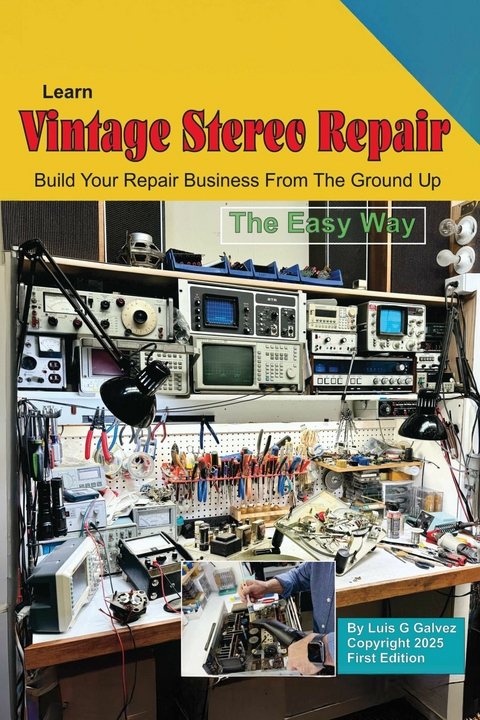
Learn Vintage Stereo Repair (eBook)
260 Seiten
Bookbaby (Verlag)
9798317807351 (ISBN)
Luis G. Galvez is a seasoned expert in high-end vintage stereo systems, with over 50 years of experience servicing, restoring, and enhancing classic audio equipment. Initially trained in electronic engineering in Lima, Peru, Mr. Galvez honed his technical skills and deep understanding of analog sound systems before establishing himself in the San Francisco Bay Area and Central Valley, where he has been a respected name in the industry for decades. Throughout his career, Mr. Galvez has developed a mastery in repairing and optimizing Reel-to-Reel Tape players, Turntables, Amplifiers, Cassette Decks, and Receivers-regardless of make or model. His extensive training and hands-on expertise allow him to restore vintage audio equipment to pristine working condition, preserving their authenticity while enhancing performance to meet modern standards. In addition to repairs, he specializes in custom designs and modifications, tailoring stereo systems to meet the unique preferences and technical demands of collectors, audiophiles, and industry professionals. With a reputation for precision, innovation, and unwavering commitment to quality, Mr. Galvez remains a trusted resource for those seeking expert craftsmanship in vintage audio restoration.
Learn Vintage Stereo Repair is a comprehensive and practical guide for audio enthusiasts, technicians, and collectors who seek to restore and maintain classic hi-fi equipment. Drawing on over 50 years of hands-on experience, Luis G. Galvez shares his extensive knowledge of troubleshooting, servicing, and enhancing vintage audio systems-helping readers master the art of repairing Reel-to-Reel Tape players, Turntables, Amplifiers, Cassette Decks, and Receivers across a wide range of makes and models. Vintage audio equipment holds a special place in the hearts of audiophiles, collectors, and music lovers. These machines were built with craftsmanship and quality that modern mass-produced devices often lack, delivering a warm, authentic sound that is difficult to replicate. However, as time passes, these devices inevitably experience wear and deterioration. Components fail, belts wear out, capacitors degrade, and mechanical parts become misaligned. Knowing how to diagnose, repair, and optimize vintage stereo systems is an invaluable skill for those passionate about preserving these audio treasures. This book explains essential repair techniques clearly and provides step-by-step guidance. Whether you are tackling electrical issues, mechanical repairs, or fine-tuning audio output, the detailed instructions and insider knowledge will empower both beginners and experienced technicians. Beyond standard repair techniques, Learn Vintage Stereo Repair explores advanced topics such as:- Circuit analysis to understand the inner workings of vintage stereo components. - Sourcing and replacing obsolete parts to maintain authenticity. - Calibration and fine-tuning to achieve optimal audio quality. - Common pitfalls and troubleshooting strategies for long-term reliability. In addition to technical insights, this book offers valuable industry wisdom on maintaining a repair business, identifying high-value restoration projects, and navigating the niche world of vintage audio repair. Whether restoring classic stereo equipment for personal enjoyment or seeking to build a reputation as a trusted repair specialist, this book is a vital resource. With a passion for vintage audio and a meticulous approach to craftsmanship, Luis G. Galvez provides the ultimate roadmap for enthusiasts who want to preserve the past and rediscover the magic of analog sound.
Chapter 1
Fundamental Theory
Five fundamental laws apply to electronic circuits, which are essential for troubleshooting. Although detailed explanations of these laws are beyond the scope of this book, extensive online resources are available. All these laws pertain to the general law of conservation of energy.
Ohm’s Law
The voltage (V, in volts) on a device is equal to the current (I, in amperes) flowing through it multiplied by its internal resistance (R, in ohms):
V = I × R
In Figure 1, the current, I, is 12 volts (V) divided by 100 ohms (Ω), which equals 0.12 amperes (A) or 120 milliamperes (mA).
Figure 1-1
For example, in Figure 1-2, we can use Ohm’s law to calculate the resistance of a resistor that reduces the 12 V of the power supply to the 6 V needed in a circuit that takes 1 A from the power supply. The circuit will be as follows:
Figure 1-2
To obtain the 6V required to operate the added circuit, we will need to add a 6-Ω resistor in series with the circuit.
What should the resistor’s wattage be? There are different sizes of 6-Ω resistors, ranging from very small to large ones. Some may require a heat sink or a metallic heat dissipation enclosure.
Calculation of Power Dissipation in Resistors
To calculate the power dissipation needed in the resistor, we multiply the voltage across the resistor terminals by the current flowing through it as follows:
Power (P, in watts) equals voltage (V, at the resistor’s terminals, in volts) multiplied by current (I, that is, the current flowing through it, in amperes):
P = V × I
Resistors come in different power-handling capacities:
Figure 1-3
The power dissipation for the resistor is calculated as follows:
P = 6 V × 1 A = 6 W resistor
To prevent overheating, use a resistor with a 25 percent to 50 percent higher power rating than the calculated power dissipation.
We selected a resistor with a power rating of 10 W to ensure safe operation and maintain a low temperature.
In the example, we will need a 12-Volt power supply that provides a current of 1 amp to operate the circuit.
Kirchhoff’s Current Law (KCL)
The total current entering any junction equals the total current leaving it.
Figure1-4
Kirchhoff’s Voltage Law (KVL)
The algebraic sum of all voltages in a closed loop is zero. Power-supplying elements have signs that are opposite to those of power-consuming elements.
In Figure 1-5, the algebraic sum is as follows:
VBatt − V1 − V2 − V3 = 0 or VBatt = V1 + V2 + V3
Figure 1-5
Thévenin’s Theorem
Any linear circuit can be represented as a single voltage source in series with a single resistance.
To calculate Thévenin voltage (open-circuit voltage), find the open-circuit voltage across the terminals where the load resistor is connected. This voltage is your Thévenin voltage (VTh).
To calculate Thévenin resistance, replace all voltage sources with short circuits and all current sources with open circuits.
To calculate the equivalent resistance, measure the resistance from the open terminals after deactivating all independent sources by removing them and replacing them with a shorting wire. This resistance is your Thévenin resistance (RTh).
Figure 1-6
Thevenin’s theorem only applies to linear circuits and should not be used with nonlinear components such as transistors, field-effect transistors (FETs), and diodes. While it can be applied to alternating current (AC) circuits, impedance is used instead of resistance.
Norton’s Theorem
Any linear circuit can be represented as a single current source and a resistance in parallel.
To calculate Norton current (IN; short-circuit current), find the short-circuit current across the terminals where the load resistor is connected.
To calculate Norton resistance (RN):
- Zero the independent sources: Replace all independent voltage sources with short circuits and all independent current sources with open circuits.
- Calculate equivalent resistance: The equivalent resistance seen from the open terminals. This resistance is your RN.
Figure 1-7
It is easy to find the Thevenin voltage and resistance in practical circuits; there are formulae to convert the Thevenin voltage and resistance into the Norton current source value.
Norton’s and Thevenin’s theorems will not be used very often. Still, they will help you understand the behavior of multiple power supplies applied to a single circuit or a single power supply applied to various circuits, which will help you troubleshoot more complex circuits.
Electronic Components
There are two types of electronic components: passive and active.
Passive components do not require an external power source to operate. They are essential for shaping and filtering signals within the receiver. The following are some standard passive components:
- Resistors are used to limit current and divide voltages.
- Capacitors store and release electrical energy and are typically used to filter and couple signals.
- Inductors store energy in a magnetic field and are primarily used in filtering and tuning circuits.
- Transformers transfer electrical energy between circuits through electromagnetic induction.
- Potentiometers are variable resistors used to adjust levels like volume and tone.
- Switches are used to route signals and power within the receiver.
- Connectors and jacks provide physical connections for input and output signals.
Active components require an external power source to operate and can amplify, modify, or switch electronic signals. Here are some standard active components:
- Transistors are components used for amplification and switching.
- Integrated circuits (ICs) contain multiple transistors and other components to perform complex functions.
- Vacuum tubes are devices used in older vintage receivers for amplification, and some companies are using them again.
- Diodes allow the current to flow in one direction and are used in rectification and signal demodulation.
- Light-emitting diodes (LEDs) are used for indicators and displays.
Passive Components
Resistors
An electronic resistor is a passive two-terminal component that implements electrical resistance as a circuit element. In electronic circuits, resistors are used to:
- Reduce current flow to avoid burning another element by overpowering it.
- Adjust signal levels to reduce the voltage and drive another circuit component properly.
- Divide voltages (to split voltages so we can extract the needed value).
- Bias active elements (set the working environment to include standby voltage or current).
- Terminate transmission lines (match two circuits to obtain maximum power or avoid excess signal to start oscillations)
Resistors are essential components of almost all electronic devices. They help control electric current flow and protect sensitive components from damage. They come in several different packages.
Associated Formulas for Resistors in Series
When resistors are connected in series, the total or equivalent resistance is the sum of the individual resistances. In the special case where R1 = R2, RTotal = ٢ × R1 or 2 × R2, this is often used to distribute the power dissipation equally on both resistors. (You will learn more about power dissipation in the Resistors Section.)
This...
| Erscheint lt. Verlag | 9.8.2025 |
|---|---|
| Sprache | englisch |
| Themenwelt | Naturwissenschaften ► Physik / Astronomie |
| ISBN-13 | 9798317807351 / 9798317807351 |
| Informationen gemäß Produktsicherheitsverordnung (GPSR) | |
| Haben Sie eine Frage zum Produkt? |
 EPUB (Ohne DRM)
Größe: 5,0 MB
Digital Rights Management: ohne DRM
Dieses eBook enthält kein DRM oder Kopierschutz. Eine Weitergabe an Dritte ist jedoch rechtlich nicht zulässig, weil Sie beim Kauf nur die Rechte an der persönlichen Nutzung erwerben.
Dateiformat: EPUB (Electronic Publication)
EPUB ist ein offener Standard für eBooks und eignet sich besonders zur Darstellung von Belletristik und Sachbüchern. Der Fließtext wird dynamisch an die Display- und Schriftgröße angepasst. Auch für mobile Lesegeräte ist EPUB daher gut geeignet.
Systemvoraussetzungen:
PC/Mac: Mit einem PC oder Mac können Sie dieses eBook lesen. Sie benötigen dafür die kostenlose Software Adobe Digital Editions.
eReader: Dieses eBook kann mit (fast) allen eBook-Readern gelesen werden. Mit dem amazon-Kindle ist es aber nicht kompatibel.
Smartphone/Tablet: Egal ob Apple oder Android, dieses eBook können Sie lesen. Sie benötigen dafür eine kostenlose App.
Geräteliste und zusätzliche Hinweise
Buying eBooks from abroad
For tax law reasons we can sell eBooks just within Germany and Switzerland. Regrettably we cannot fulfill eBook-orders from other countries.
aus dem Bereich