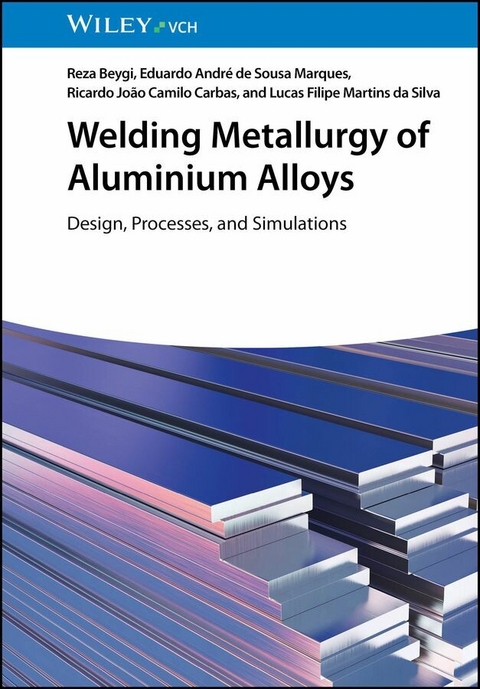
Welding Metallurgy of Aluminium Alloys (eBook)
397 Seiten
Wiley-VCH (Verlag)
978-3-527-84536-1 (ISBN)
A must-have guide to welding aluminium alloys for optimized performance and precision
Aluminium alloys, widely used across industries due to their high specific strength and corrosion resistance, require precise joining methods to maintain their structural integrity. Welding Metallurgy of Aluminium Alloys: Design, Processes, and Simulations provides a detailed exploration of aluminium alloy welding, addressing the science, technology, and applications behind this essential process. Integrating essential theory and real-world practice, this comprehensive volume equips readers with the knowledge to analyze, optimize, and execute welding processes while preventing common defects that compromise weld quality.
Presenting insights rooted in over 450 research articles, an experienced team of researchers and practitioners examines microstructural evolution, thermal dynamics, defect mechanisms, and more. Detailed chapters cover various welding methods, including arc, beam, resistance, and solid-state welding, while providing clear guidance on topics ranging from mitigating hot cracking and porosity to simulating temperature distributions and residual stress.
Providing the knowledge to tackle an array of welding challenges, Welding Metallurgy of Aluminium Alloys:
- Features in-depth case studies and simulation methodologies that enable practical application and innovation in diverse industries
- Explores mechanisms behind welding defects and presents strategies for prevention and mitigation
- Discusses simulations for temperature distribution, thermal history, residual stress, and material flow during welding processes
- Highlights microstructural changes and metallurgical transformations unique to each welding process covered
- Includes extensive reference material, such as equations for heat conductivity analysis and defect prediction tailored to aluminium welding
An indispensable resource for designing robust, high-performance welds, Welding Metallurgy of Aluminium Alloys: Design, Processes, and Simulations is ideal for undergraduate and graduate courses in materials science, mechanical engineering, and welding technology, as well as a must-have reference for welding specialists, materials scientists, and construction engineers. It is also a vital addition to any technical library supporting professional development and academic programs focused on advanced joining processes.
Reza Beygi is an Associate Professor at Arak University, Iran, specializing in welding metallurgy of dissimilar materials, with a focus on process, microstructure, and mechanical properties. As principal investigator in the Advanced Joining Processes (AJP) group at the University of Porto under the supervision of Professor Lucas F.M. da Silva for three years, he has driven innovations in joining dissimilar metals, resulting in numerous high-impact publications and books.
Eduardo André de Sousa Marques is an Associate Professor at the University of Porto and an investigator at INEGI. His research focuses on mechanical behavior, extreme condition testing, and numerical modeling of welded and bonded joints. With over 230 published articles and books, his contributions to materials science and joining technologies are widely recognized.
Ricardo João Camilo Carbas is a Post-doctoral Researcher at INEGI specializing in adhesively bonded joints, welding and joining by forming. He has published 245 articles and holds six patents in material joining. A member of several editorial boards, he consults for major companies and organizes international conferences on materials and advanced joining processes.
Lucas Filipe Martins da Silva is a Full Professor in Mechanical Engineering at the University of Porto, Portugal. He has established and leads the Advanced Joining Processes Unit of INEGI, carrying out fundamental and applied research on multiple joining technologies. He has published over 400 research articles and 43 books. He is the Editor-in-Chief of multiple academic journals and has organized international conferences on advanced joining technologies.
1
Aluminum Alloys: Fundamentals of Welding Metallurgy
1.1 Introduction
Aluminum (Al) alloys have been used traditionally for structural parts of aircrafts. At the beginning of the twenty-first century, the leading aircraft companies started to use composite materials due to their advantages such as low weight. Nonetheless, the usage of Al in structural parts still continues due to better recyclability of these materials and satisfying the weight reduction of the structure [1]. Al is a light alloy with a density of 2.7 g/cm3, is nonmagnetic, has an FCC crystal structure, has high formability and low-temperature toughness, and has a relatively high corrosion resistance depending on the alloying elements [2]. Al alloys are also easily processible with casting, machining, and extrusion. Some Al alloys capable of precipitation hardening have strengths comparable to steels [2]. In contrast to carbon and low-alloy steels, Al does not possess any polymorph; therefore, only the solidification behavior determines the properties of the weld zone in the fusion welding [3]. Cooling of the solidified weld zone does not have a prominent effect on the microstructure of the weld due to absence of any polymorph transformation in Al alloys.
Al alloys are classified based on their mechanical properties, manufacturing process, and alloying elements. Wrought Al alloys are determined by the degree of cold work and chemical composition. Cast Al alloys are determined by the casting process and chemical composition. Other mechanisms such as precipitation hardening and solid-solution hardening may also contribute to the strength of Al alloys [2]. The alloying elements that promote precipitation hardening in Al are Cu, Cu—Mg, Cu—Li, Cu—Si, Zn, Zn—Mg, Zn—Mg—Cu, and Li—Cu—Mg [2]. The alloying elements that promote solid-solution hardening are Mn, Si, Zn, Mg, and Cu [2].
The designation system for wrought Al alloys in the European standard system is a four-digit numeric. Figure 1.1 shows the designation system according to the European standard. There is also a supplementary designation system whose basis is a chemical symbol. The applications of some Al alloys are provided in Table 1.1.
Along with austenitic stainless steel and Ni alloys, Al alloys are good candidates for the construction of LNG cargo containment, as Al possesses a high toughness due to its FCC structure [11]. The usage of Al alloys as structural materials requires their joining in various joint designs. Mechanical joining methods such as riveting have been used in lap configuration, which adds to the weight of the structure. An example is the stringer–skin connection used in the fuselage of the aircraft (Figure 1.2a), where additional adhesive is used to seal the joint. Welding technologies help to reduce the weight by eliminating the overlap region and the sealant and while maintaining the same performance (Figure 1.2b) [12]. In Tee-joining, the high heat conductivity of Al causes a high thermal gradient to form between the weld pool and base material. Lap joining also adds to the weight of the structure and hence is used for thin sheets less than 1 mm, where welding processes such as resistance welding are to be used. Regarding the weld design, fillet welds are usually avoided in the structural parts under fatigue due to crack initiation from the root of the weld [13]. The joint design also affects the residual stress during welding. For instance, the Tee-joints cause a higher residual stress during welding than lap joints due to higher heat sink effect in the Tee-joints, which causes a higher cooling rate [14].
Figure 1.1 Designation system for wrought aluminum alloys according to the European standard.
Table 1.1 The applications of some Al alloys.
| Alloy | Application |
|---|
| AA2xxx | Propellant cabin of launch vehicles [4] |
| AA5xxx | Shipbuilding [5] |
| AA6xxx | Car body [6], battery tray [7] |
| AA7xxx | Bicycle frame [8], panel structure of launcher [9], underframe in high-speed trains [10] |
The Al alloys that are heat-treatable (HTA) need to undergo specific sequences during forming and assembling to obtain desired mechanical properties. For example, in the car body, the Al sheets are welded in a solution-treated or hot-formed state. The final aging treatment, which is connected to the paint bake cycle, is performed after welding [15]. Figure 1.3 shows the schematic workflow of Al alloy used in the car body. Hot forming of Al alloy is performed in the solid-solution state, which is quenched subsequently to preserve the solid-solution state. The joining methods are performed after this stage, and then a paint bake cycle is carried out to regain the strength through aging treatment.
Figure 1.2 Joining of a stringer–skin aluminum part used in the fuselage of the aircraft made by (a) riveting and (b) welding.
Source: Ref. [12]/with permission of Elsevier.
Figure 1.3 The forming, solution treatment, welding, and age hardening while paint baking of Al alloys used in the car body.
There are some challenges during welding of Al alloys, and understanding their mechanisms helps to avoid them and hence obtain the optimum performance of the welded structure. Some issues that exist during welding steel are not present during welding Al due to its physical properties. For instance, Al is a nonmagnetic material and therefore the problems of arc blowing will not occur during arc welding processes. Instead, other issues are pronounced during welding Al. The thermal conductivity of Al is six times that of steel and therefore the welding processes with high power density need to be used for Al. Though the melting point of Al is low, due to high specific heat of Al the heat sources need to have high intensity. Due to the high heat conductivity of Al, the use of welding processes with low heat intensity for wrought alloys and precipitation-hardened alloys produces a wide heat-affected zone (HAZ) with lower strength (due to softening) and distortion. In precipitation-hardened alloys, it is also probable that the precipitates in the HAZ dissolve and reprecipitate, which leads to brittleness [2]. The thermal expansion coefficient of Al is twice that of steel. This along with its low Young's modulus causes a high distortion, especially in thin structures, making it difficult to maintain the tolerances [16]. To keep the distortion within the limits of tolerance, the components need to be tightly clamped and often tack-welded. The welding sequence also needs to be planned carefully [2].
A significant difference between steel and Al arises from metallurgical aspects. Structural steels encounter phase transformation during cooling; the most important one is the austenite to ferrite transformation. While the strength of structural steels increases in the HAZ during welding, Al alloys lose their strength in the HAZ. A higher number of issues exist while welding Al alloys that are heat-treatable, which means their strength is increased by precipitation. Other Al alloys get their strength by other mechanisms such as solution hardening and work hardening. Three main series of heat-treatable Al alloys are introduced in the following.
1.1.1 Aluminum–Copper Alloys
Al—Cu alloys known as 2xxx family are mainly used in the structure of the airframes and possess high fatigue strength. The precipitation hardening is the main mechanism of strengthening in these alloys. From the supersaturated state, a series of phases form by the increase in temperature:
GP phases are coherent phases and differ in the size and the lattice strain they induce. θ′ and θ are semi-coherent and incoherent, respectively, the latter being the equilibrium phase, whose contribution to the strength is the lowest compared to the other phases.
1.1.2 Aluminum–Zinc–Magnesium Alloys
MgZn2 is the main precipitate in this group of Al alloy. These Al alloys are less sensitive to quenching, and thus a supersaturated condition can be obtained even after air cooling. Natural aging can occur in these alloys after a couple of months to recover their initial hardness, making these alloys to have a self-hardening effect [17]. So, these alloys do not need a post-weld heat treatment (PWHT) to recover their hardness. However, these alloys are susceptible to solidification cracking (SC) in the fusion zone (FZ) and liquidation cracking in HAZ. Evaporation of Mg and Zn due to their low boiling point can cause pore formation during welding [18].
1.1.3 Aluminum–Magnesium–Silicium
The strength in the HAZ of these alloys is only partially restored by subsequent aging, as explained in Figure 1.28. The degree of strength lost in the HAZ depends on the heat and the time it receives this heat. It means that the welding process and its parameters determine the degree of strength lost in the HAZ. A lower heat input favors a narrower HAZ region that is less softened.
Figure 1.4 Schematic representation of mechanical properties of Al—Li—Cu alloys in...
| Erscheint lt. Verlag | 8.8.2025 |
|---|---|
| Sprache | englisch |
| Themenwelt | Naturwissenschaften ► Chemie |
| Schlagworte | Advanced joining processes • Arc Welding • beam welding • Friction Stir Welding • heat conductivity analysis • simulation techniques • solid-state welding • welding • welding aluminium • welding defect analysis • welding design principles • Welding Processes |
| ISBN-10 | 3-527-84536-4 / 3527845364 |
| ISBN-13 | 978-3-527-84536-1 / 9783527845361 |
| Informationen gemäß Produktsicherheitsverordnung (GPSR) | |
| Haben Sie eine Frage zum Produkt? |
 EPUB (Adobe DRM)
Kopierschutz: Adobe-DRM
Adobe-DRM ist ein Kopierschutz, der das eBook vor Mißbrauch schützen soll. Dabei wird das eBook bereits beim Download auf Ihre persönliche Adobe-ID autorisiert. Lesen können Sie das eBook dann nur auf den Geräten, welche ebenfalls auf Ihre Adobe-ID registriert sind.
Details zum Adobe-DRM
Dateiformat: EPUB (Electronic Publication)
EPUB ist ein offener Standard für eBooks und eignet sich besonders zur Darstellung von Belletristik und Sachbüchern. Der Fließtext wird dynamisch an die Display- und Schriftgröße angepasst. Auch für mobile Lesegeräte ist EPUB daher gut geeignet.
Systemvoraussetzungen:
PC/Mac: Mit einem PC oder Mac können Sie dieses eBook lesen. Sie benötigen eine
eReader: Dieses eBook kann mit (fast) allen eBook-Readern gelesen werden. Mit dem amazon-Kindle ist es aber nicht kompatibel.
Smartphone/Tablet: Egal ob Apple oder Android, dieses eBook können Sie lesen. Sie benötigen eine
Geräteliste und zusätzliche Hinweise
Buying eBooks from abroad
For tax law reasons we can sell eBooks just within Germany and Switzerland. Regrettably we cannot fulfill eBook-orders from other countries.
aus dem Bereich