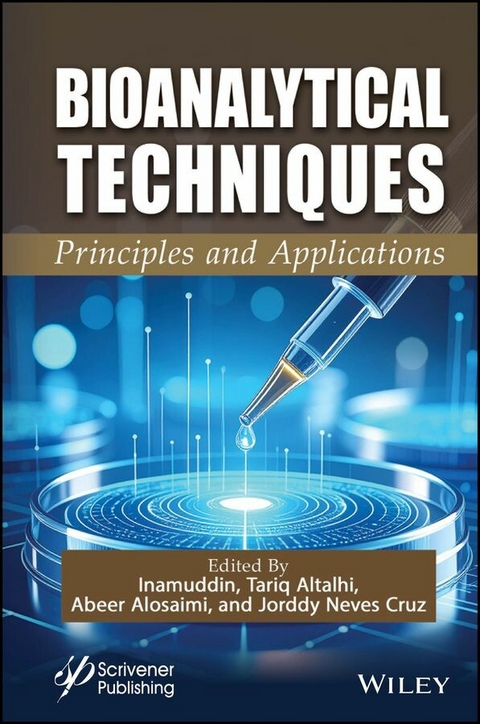
Bioanalytical Techniques (eBook)
1033 Seiten
Wiley-Scrivener (Verlag)
978-1-394-31411-9 (ISBN)
The book provides a comprehensive guide that covers the fundamental principles and methodologies of essential bioanalytical techniques.
Bioanalytical Techniques: Principles and Applications is a comprehensive and authoritative book that explores the principles, methodologies, and applications of bioanalytical techniques in the field of life sciences. The book covers a wide range of analytical techniques used for the characterization, quantification, and analysis of biological samples, including proteins, nucleic acids, metabolites, and biomarkers. Using a multidisciplinary approach by integrating concepts from biochemistry, molecular biology, analytical chemistry, and biotechnology, this book provides a solid foundation in the fundamental principles underlying various bioanalytical techniques, such as spectroscopy, chromatography, electrophoresis, immunoassays, mass spectrometry, and biosensors. Each technique is explained in detail, including its working principles, instrumentation, data analysis, and practical considerations. The book incorporates case studies, examples, and practical tips to illustrate how these techniques are used to solve biological problems and address research questions. It also discusses emerging trends and technologies in bioanalytical techniques, such as microfluidics, nanotechnology, and omics approaches.
Readers will find the book:
- Offers comprehensive coverage of bioanalytical techniques, encompassing a wide range of methodologies, instruments, and applications through real-world case studies;
- Adopts a multidisciplinary approach, integrating concepts from biochemistry, molecular biology, analytical chemistry, and biotechnology;
- Explores emerging trends and technologies in bioanalytical techniques, such as microfluidics, nanotechnology, omics approaches, and bioinformatics;
- Includes practical guidance, troubleshooting tips, and common challenges in bioanalysis, equipping readers with valuable insights and strategies for successful experimentation and data interpretation;
- Features contributions from renowned experts and leaders in the field, ensuring the content is authoritative, up-to-date, and reflects the latest advancements in bioanalytical techniques.
Audience
Biochemists, biologists, chemists, and medical and pharmaceutical professionals interested in biomolecules, enzymology, and biochemical pathways.
The book provides a comprehensive guide that covers the fundamental principles and methodologies of essential bioanalytical techniques. Bioanalytical Techniques: Principles and Applications is a comprehensive and authoritative book that explores the principles, methodologies, and applications of bioanalytical techniques in the field of life sciences. The book covers a wide range of analytical techniques used for the characterization, quantification, and analysis of biological samples, including proteins, nucleic acids, metabolites, and biomarkers. Using a multidisciplinary approach by integrating concepts from biochemistry, molecular biology, analytical chemistry, and biotechnology, this book provides a solid foundation in the fundamental principles underlying various bioanalytical techniques, such as spectroscopy, chromatography, electrophoresis, immunoassays, mass spectrometry, and biosensors. Each technique is explained in detail, including its working principles, instrumentation, data analysis, and practical considerations. The book incorporates case studies, examples, and practical tips to illustrate how these techniques are used to solve biological problems and address research questions. It also discusses emerging trends and technologies in bioanalytical techniques, such as microfluidics, nanotechnology, and omics approaches. Readers will find the book: Offers comprehensive coverage of bioanalytical techniques, encompassing a wide range of methodologies, instruments, and applications through real-world case studies; Adopts a multidisciplinary approach, integrating concepts from biochemistry, molecular biology, analytical chemistry, and biotechnology; Explores emerging trends and technologies in bioanalytical techniques, such as microfluidics, nanotechnology, omics approaches, and bioinformatics; Includes practical guidance, troubleshooting tips, and common challenges in bioanalysis, equipping readers with valuable insights and strategies for successful experimentation and data interpretation; Features contributions from renowned experts and leaders in the field, ensuring the content is authoritative, up-to-date, and reflects the latest advancements in bioanalytical techniques. Audience Biochemists, biologists, chemists, and medical and pharmaceutical professionals interested in biomolecules, enzymology, and biochemical pathways.
1
Point-of-Care Diagnostics for Rapid Disease Detection
Nabil H. Bhuiyan1,2,3 and M. Khalid Hossain4*
1China Spallation Neutron Source, Dongguan, China
2Institute of High Energy Physics, Chinese Academy of Sciences, Beijing, China
3Department of Electronic Convergence Engineering, KwangWoon University, Seoul, South Korea
4Institute of Electronics, Atomic Energy Research Establishment, Bangladesh Atomic Energy Commission, Dhaka, Bangladesh
Abstract
This chapter discusses the revolutionary potential of emerging technologies in the evolution of point-of-care (POC) diagnostics. A thorough analysis was conducted to show how miniature POC devices can be incorporated into routine clinical procedures for the evolution of contemporary healthcare and to revolutionize clinical practices. The chapter discusses the various advantages offered by these diagnostic tools, highlighting how they can enhance patient outcomes and decision-making processes while enhancing patient-centered care. Additionally, this chapter describes how sensitivity and specificity are significantly improved by advanced sensing technologies in POC diagnostics. Microfluidic systems, lab-ona-chips, biosensors, smartphone-based diagnostics, portable spectrometers, and other biosensing technologies have the potential to simplify sample processing and enhance the overall efficacy of disease diagnosis, thereby emphasizing the significant impact of POC diagnostics.
Keywords: Point-of-care, lab-on-a-chip, microfluidic, biosensor, spectrometer, diagnosis
1.1 Introduction
In the modern world, the importance of early disease detection cannot be overlooked. It is essential to preserve the general population's health, advance medical research, and reduce the spread of infectious diseases. Early intervention is possible by rapid disease detection, which is the most effective way to treat many illnesses. Early diagnosis enables medical professionals to start treatment as soon as possible, improving the likelihood of a positive result and reducing the severity of symptoms [1, 2].
Infectious disease outbreaks must be detected and contained quickly. Consequently, rapid disease detection is crucial [3–8]. With the advantage of rapid disease detection, health officials can quickly identify cases, place isolation measures in place, track down contacts, and use targeted vaccination or quarantine techniques to stop the spread of the disease [9–11]. Early detection also makes it easier to monitor the prevalence of diseases within communities. Health organizations can more effectively allocate resources, create focused prevention and control measures, track outbreaks, and spot emerging trends [9, 11, 12]. In addition, early diagnosis can lessen the financial burden of medical expenses, lost productivity, and public health interventions. Epidemics and pandemics have a significant economic impact but can be reduced by quickly identifying and controlling diseases. Moreover, rapid disease detection accelerates scientific endeavors by supplying vital information to comprehend disease mechanisms and pathogenesis [12, 13]. This information is essential for the development of vaccines and design of efficient treatment plans. In summary, the importance of early disease detection extends beyond concerns regarding personal health and has broad societal ramifications. It gives healthcare systems the ability to respond to health threats efficiently, safeguard populations, and ultimately save lives, while promoting a healthier and more prosperous society.
The remarkable journey of point-of-care (POC) diagnostics toward the evolution of healthcare has been characterized by constant innovation and technological advancements. Over the years, this field has made significant strides in revolutionizing healthcare in various ways. The concept of POC diagnostics has a long history, beginning with early techniques, such as visual inspection, palpation, and auscultation. The creation of simple hand tools, such as thermometers and microscopes, however, marked the start of the true evolution. These tools provide medical professionals with insight into illnesses and infections at the patient's bedside [14, 15]. With the development of rapid diagnostic tests (RDTs), the 20th century saw a significant turning point. Dipstick tests, such as glucose and urine pregnancy tests, allowed for quick, on-the-spot analysis. These tests serve as building blocks for more complex POC diagnostics [16, 17]. Portable analyzers with a range of test capabilities began appearing in the 1980s. In critical care settings, instruments like blood gas analyzers, which measure variables like pH and oxygen levels, have become indispensable tools [17–19]. Although relatively heavy, these early POC instruments represent significant advancements in the field. With the advent of microfluidic technology, the 21st century has undergone profound transformation. For precise sample handling and analysis, microfluidic devices use tiny channels to manipulate microscale fluids. These tools have facilitated the miniaturization of diagnostic assays, thereby increasing the portability, affordability, and accessibility of POC testing [20, 21]. POC imaging technologies have evolved along with improvements in microfluidics. Healthcare providers can now conduct real-time imaging at the patient's bedside using portable ultrasound machines, handheld ophthalmoscopes, and smartphone-based dermatoscopes [22–24]. Rapid diagnosis and treatment choices are made possible using these imaging tools.
This chapter provides insights into the applications of POC diagnostics across various medical disciplines, highlighting its critical role, technological innovations, and obstacles, and emphasizing how they have a revolutionary effect on the provision of healthcare. In addition, this chapter discusses regulatory issues and future directions for POC diagnostics.
1.2 Fundamentals of Point-of-Care Diagnostics
POC diagnostics is the term used to describe medical tests or assays carried out by the patient or nearby, providing quick, approachable, and convenient diagnostic solutions that facilitate prompt clinical decisions by healthcare professionals [14]. From early disease detection to monitoring and management, diagnostics are essential in many facets of healthcare.
Various technologies have been used for POC diagnostics, including handheld healthcare devices [25, 26], lab-on-a-chip (LOC) systems [27], microfluidics [28, 29], biosensors [30], and artificial intelligence (AI) [31, 32]. They provide a high level of adaptability and advantages to fit the needs of certain healthcare environments. POC tests are frequently made simple to use and do not require specialized equipment or training. Consequently, a variety of healthcare professionals, including those working in settings with limited resources, can access them. They produce quick results, frequently in minutes or hours, allowing healthcare professionals to make decisions about their patients immediately [9, 28, 33]. This speed is essential for urgent situations and critical circumstances. In addition, compared with conventional lab-based tests, POC tests generally require smaller sample sizes (e.g., one drop of blood, urine, or saliva) [9, 28, 34, 35]. Thus, the risk of infection and patient discomfort is reduced. POC diagnostic platforms are generally suitable for use in unconventional healthcare facilities such as field hospitals, ambulances, or patient homes in remote or underserved areas, which is a prerogative for global health initiatives [9, 36]. In circumstances where patients need to swiftly receive medical attention such as heart attacks, or strokes, POC diagnostics allow clinicians to jump to judgments based on findings from test results and take initiatives for proper treatment. Medical professionals use POC diagnostics for a variety of purposes, including the diagnosis of infectious diseases, monitoring the course of chronic illnesses, detecting pregnancy, and observing cardiac indicators [14, 21].
1.3 Technologies Driving Point-of-Care Diagnostics
1.3.1 Lateral Flow Assay (LFA)
LFAs are widely used because of their affordability, speed, ease of use, robustness, consistency, sensitivity, and specificity. The LFA is at the apex of the POC diagnostics. These tests are incredibly user-friendly and do not require expensive equipment or highly skilled personnel, making them a perfect option for environments with limited resources. Pregnancy tests, infectious disease screening, and drug testing are among the applications of LFA that provide quick, qualitative results in minutes, greatly reducing the turnaround time for diagnostics [16, 37]. Antibodies are used in LFAs, particularly lateral flow immunoassays (LFiAs), as biorecognition components. LFAs rely on capillary force for sample flow and consist of sample and conjugate pads, absorbent pads, and nitrocellulose membranes, with test and control lines. The pads should be in direct contact with each other to allow the solutions to flow through the pads driven by the capillary force. Nanoparticles are frequently used in colorimetric signal output to provide concentrated detection antibodies on small surfaces [38]. Figure 1.1 shows the basic structure of the LFiA test kit.
The...
| Erscheint lt. Verlag | 8.8.2025 |
|---|---|
| Sprache | englisch |
| Themenwelt | Naturwissenschaften ► Chemie |
| ISBN-10 | 1-394-31411-6 / 1394314116 |
| ISBN-13 | 978-1-394-31411-9 / 9781394314119 |
| Informationen gemäß Produktsicherheitsverordnung (GPSR) | |
| Haben Sie eine Frage zum Produkt? |
 EPUB (Adobe DRM)
Kopierschutz: Adobe-DRM
Adobe-DRM ist ein Kopierschutz, der das eBook vor Mißbrauch schützen soll. Dabei wird das eBook bereits beim Download auf Ihre persönliche Adobe-ID autorisiert. Lesen können Sie das eBook dann nur auf den Geräten, welche ebenfalls auf Ihre Adobe-ID registriert sind.
Details zum Adobe-DRM
Dateiformat: EPUB (Electronic Publication)
EPUB ist ein offener Standard für eBooks und eignet sich besonders zur Darstellung von Belletristik und Sachbüchern. Der Fließtext wird dynamisch an die Display- und Schriftgröße angepasst. Auch für mobile Lesegeräte ist EPUB daher gut geeignet.
Systemvoraussetzungen:
PC/Mac: Mit einem PC oder Mac können Sie dieses eBook lesen. Sie benötigen eine
eReader: Dieses eBook kann mit (fast) allen eBook-Readern gelesen werden. Mit dem amazon-Kindle ist es aber nicht kompatibel.
Smartphone/Tablet: Egal ob Apple oder Android, dieses eBook können Sie lesen. Sie benötigen eine
Geräteliste und zusätzliche Hinweise
Buying eBooks from abroad
For tax law reasons we can sell eBooks just within Germany and Switzerland. Regrettably we cannot fulfill eBook-orders from other countries.
aus dem Bereich