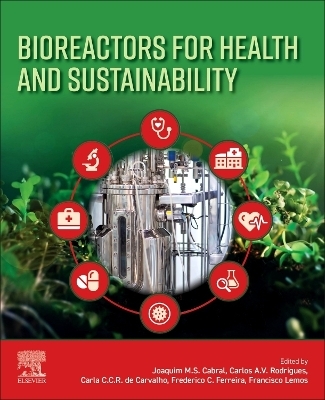
Bioreactors for Health and Sustainability
Elsevier - Health Sciences Division (Verlag)
978-0-443-36330-6 (ISBN)
- Noch nicht erschienen (ca. Juli 2026)
- Versandkostenfrei
- Auch auf Rechnung
- Artikel merken
Dr Joaquim M. S. Cabral is Professor of Biological Engineering, in the Department of Bioengineering at Instituto Superior Técnico (IST), Technical University of Lisbon, Portugal. He was the founder and current Head of Department of Bioengineering, and the Director of the Institute for Biotechnology and Bioengineering, a Research Laboratory Associated to the Ministry of Science, Technology and Higher Education in Portugal. His research aims at contributing to biochemical engineering science through novel developments in Bioprocess Engineering and Stem Cell Bioengineering. Carlos A.V. Rodrigues completed a MSc in Biological Engineering in 2007 from Universidade de Lisboa, Instituto Superior Técnico and a PhD (Doutoramento) in Bioengineering (Bioengenharia) in 2011 from Universidade de Lisboa, Instituto Superior Técnico. Currently is a Senior Researcher at Universidade de Lisboa, Instituto de Bioengenharia e Biociências (iBB). He published 36 articles in journals and 11 book chapters. He received 2 awards or honors, participates or participated as Principal investigator in 3 projects and as Researcher in 9 projects. He works in the area(s) of Medical and Health Sciences, with emphasis on Medical Biotechnology, and on Biomaterials. Carla C.C.R. de Carvalho is currently Associate Professor at IST, Portugal. She has a 5-year Diploma degree in Chemical Engineering, a MSc and a Ph.D. in Biotechnology from the Universidade Técnica de Lisboa (Portugal; currently Universidade de Lisboa). After 2 post-doctoral grants (at IST, Portugal, and UFZ-Leipzig, Germany), she was hired as Assistant Researcher (2008-2013), Principal Investigator (2014-2019), and Assistant Professor (2019-2023) at IST. She has been doing research in the field of biomolecular and bioprocess engineering, using a multidisciplinary approach involving e.g. bacteriology, lipidomics, culturomics, microscopy and image analysis. She has supervised several post-doc research fellows, PhD and MSc students. She co-authored more than 100 manuscripts and 14 book chapters , she received several awards, and has been included in the “World’s Top 2% Scientists list since 2017. She has been responsible for research teams in several European and national projects. Frederico C. Ferreira completed his Ph.D. in 2004 Chemical Engineering, from Imperial College London (IC), followed by an industrial post-doc with IC and GlaxoSmithKline (2004-2006). He also holds a MBA from New University of Lisbon (2006-2008) and was visiting scholar at Massachusetts Institute of Technology (MIT) Set-Dec 2009, the L'Institut Européen des Membranes, Montpellier in the summer 2007 and at Politecnico di Milano during his Sabbatical (Feb to Ago 2017). +Frederico C. Ferreira is an Associate Professor at Department of Bioengineering of Instituto Superior Técnico, member of the Institute for Bioengineering and Bioscience and Associate Laboratory, Institute for Health and Bioeconomy. He has published c.a. 120 SCI papers, c.a 2500 citations, and co-authored 7 patents applications and 5 book chapters. He has received 5 awards and/or honours. Frederico Ferreira current research interests are focused on Tissue engineering, Sustainable separations and biorefineries, and Cellular Agriculture. Francisco Lemos has a Habilitation in Chemical Engineering in 1997 from the Technical University of Lisbon, Instituto Superior Técnico, PhD in Chemical Engineering in 1989 from the Technical University of Lisbon, Instituto Superior Técnico, Master's degree in Chemistry of Catalytic Processes in 1984 from the Technical University of Lisbon, Instituto Superior Técnico and Degree in Chemical Engineering in 1981 from the Technical University of Lisbon, Instituto Superior Técnico. He is a Full Professor at the University of Lisbon, Instituto Superior Técnico. Published 118 articles in specialized journals. In his Ciência Vitae curriculum, the most frequent terms in the context of scientific and technological production are: Zeolites; Waste Recovery; Tertiary Recycling; Fuels; Circular Economy; Molecular Modeling; Polymerization; Copolymerization; Kinetic Modeling; Process Modeling; Systems Dynamics; Process Control.
1. Chemical and Biochemical Kinetics Basic concepts of chemical kinetics, enzyme kinetics and cell culture growth
2. Chemical Reactors Basic concepts of chemical reaction engineering and reactors design, ideal reactors, homogeneous and heterogeneous reactors. Type of reactors: BSTR, PFR and CSTR. Project design of real reactors, mass transfer and hydrodynamics aspects, axial dispersion in column reactors.
3. Enzyme Reactors Enzyme immobilization, immobilized enzyme kinetics, mass transfer effects, BSTR, Packed and Fluidized Bed Reactors. Intracellular enzyme reactors, Immobilized Death Cell Reactors. Multienzyme reactors
4. Microbial Reactors Microbial cell growth kinetics, fermentation, oxygen transfer coefficient, oxygen uptake rate, cell growth rate, specific cell productivity, growth-associated and non-growth linked products. Sterilization. Cultivation modes: Batch, Fed-batch and Continuous. Bubble column and air-lift reactors are described. Applications to pharmaceutical and biotechnology industry are analyzed.
5. Plant Cell Culture and Reactors Plant cell and tissue culture to produce commercially valuable secondary metabolites. Effects of mixing, oxygen transfer, cell aggregation and adhesion are analyzed as well as various bioreactors, according to the dynamics of growth and product formation. Criteria for choosing a bioreactor type for optimal growth and metabolite production are also discussed. Bioreactors for plant micropropagation.
6. Photobioreactors Cultivation systems for growing photoautotrophic organisms, namely microalgae and cyanobacteria, for production of bioactive compounds, biofuels, pharmaceuticals, and other industrial applications. Description of closed systems using artificial light sources. Open systems using solar light to facilitate photosynthesis.
7. Animal Cell Reactors for Biopharmaceuticals and Vaccines (TBC) Animal Cell characteristics, culture media selection, growth kinetics. Selection of immortalized cell lines. Type of bioreactors. Biopharmaceuticals, vaccine production and gene therapy.
8. Reactors for Stem Cell Culture Definition of stem cells, different types of stem cells, pluripotent and embryonic and adult stem cells. Types of stem cells (hematopoietic, mesenchymal/stromal, neural osteochondral, etc..). Type of bioreactor for stem cells expansion and differentiation. Perfusion bioreactors.
9. Reactors for Tissue and Organ Engineering 3D-constructs, scaffolds for stem cell expansion and differentiation and tissues. Mass transfer issues, oxygen, and nutrients limitations. Shear stress, mechanical and electric stimuli, mechano-transduction and cellular signaling, stretch/compression. Decellularization, cell seeding, organ engineering. Bioartificial organs.
10. Microbioreactors Introduction of MicroBioReactors (MBR) from microfluidics (microliter scale) and simple miniaturized enzyme and cell cultivations microdevices (i.e., in the milliliter scale) to highly complex and automated small-scale microreactors for early-stage bioprocess development, fermentation, drug screening, toxicology tests and tissue engineering
11. Reactors for Cellular Agriculture Products History of cultured meat, cell sources and methods used for the purpose of in vitro meat production, with particular focus on the role of bioreactors and edible scaffolds. Type of bioreactors, scaffolds and microcarriers for in vitro meat and fish production.
12. Bioreactors for Waste-Water Treatment Biological wastewater treatment process. Stirred bioreactors for aerobic and anaerobic treatment. Packed and fluidized bed biofilm and slurry reactors
| Erscheint lt. Verlag | 1.7.2026 |
|---|---|
| Verlagsort | Philadelphia |
| Sprache | englisch |
| Maße | 191 x 235 mm |
| Themenwelt | Naturwissenschaften ► Chemie ► Technische Chemie |
| Technik ► Umwelttechnik / Biotechnologie | |
| ISBN-10 | 0-443-36330-7 / 0443363307 |
| ISBN-13 | 978-0-443-36330-6 / 9780443363306 |
| Zustand | Neuware |
| Informationen gemäß Produktsicherheitsverordnung (GPSR) | |
| Haben Sie eine Frage zum Produkt? |
aus dem Bereich