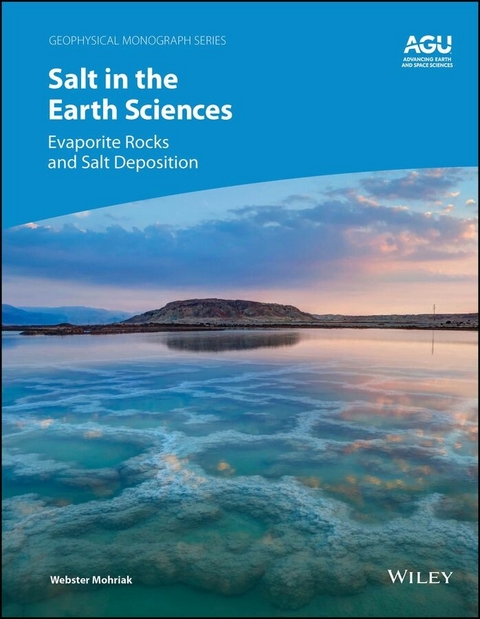
Salt in the Earth Sciences (eBook)
1558 Seiten
American Geophysical Union (Verlag)
978-1-119-40523-8 (ISBN)
A comprehensive review of salt deposition in sedimentary environments worldwide
Salt is formed when water rich in evaporite minerals accumulates on the Earth's surface and then evaporates. Over time, pressure and tectonics change the structure and shape of salt layers. Recent technological advances have improved the interpretation and modeling of subsurface salt structures.
Salt in the Earth Sciences: Evaporite Rocks and Salt Deposition presents a global overview of salt deposition and deformation in sedimentary basins, synthesizing data analysis, observations, theories, and modeling.
Volume highlights include:
- Overview of salt use by humans from prehistoric times to the modern industrial world
- Chemical and physical principles of evaporite deposition in sedimentary basins
- Effects of gravity and tectonic forces on rock salt deformation
- Development of salt structures in orogenic belts and deep basins
- Seismic interpretation methods for identification of subsurface salt structures
- Key sedimentological models for evaporite deposition in continental and marine environments
- Global examples ranging from modern hypersaline rift lakes to ancient marine salt basins
Browse the other volume in this set, Salt in the Earth Sciences: Basin Analysis and Salt Tectonics.
The American Geophysical Union promotes discovery in Earth and space science for the benefit of humanity. Its publications disseminate scientific knowledge and provide resources for researchers, students, and professionals.
Webster Mohriak, Rio de Janeiro State University, Brazil
1
A Brief History of Salt and Its Influence on Civilization
ABSTRACT
Humans have used salt, a chemical compound that forms evaporite minerals in sedimentary basins, since prehistoric times, and it is essential to modern societies. Salt production and trading contributed to the wealth of nations in medieval and industrial times. In the industrialized world, salt exploitation is an economic asset contributing to the food, agricultural, fertilizer, and chemical industries. Evaporite basins are often associated with petroleum provinces, as salt layers deform and create hydrocarbon accumulation traps.
1.1. INTRODUCTION
Salt is a naturally occurring chemical compound that forms various types of evaporite minerals, which are precipitated in aqueous environments such as shallow seas and lakes. The most common salt in nature is the mineral halite, composed of sodium chloride (NaCl). This chemical precipitate is characterized by a weak ionic bond, forming a substance that easily dissolves in water. Salt is a vital component of life, particularly potassium salt, which is widely used in the agricultural industry as an essential chemical compound in fertilizers.
Salt has the power to change the physical properties of liquids, making it useful in various industries. For example, when mixed with water, salt can significantly reduce freezing or melting points, making it essential for the manufacture of explosives, chlorine gas, soda products, soft drinks and cleaners, plastics, pharmaceuticals, and several chemical compounds used for medical purposes.
Salt minerals can be obtained by harvesting the precipitated minerals from evaporated salt pans. This process dates back to prehistoric times. During the Neolithic period, nomadic tribes sourced salt from raw meat, fish, and seafood. As agriculture developed, fireplaces were used to cook grains and meat, necessitating more salt for food preparation (Salt Association, 2020). Salt has also been used as a preservative for meat and fish conservation, making it a staple in diets in northern Africa, Southern Europe, Southern China, Scandinavia, and other regions. This preservative enabled Europeans to embark on sea exploration during the Middle Ages, sailing around the African continent to find new routes to India.
Salt was commonly obtained from natural evaporative ponds in arid regions like the Saharan region in northern Africa and many other places worldwide. In many regions, such as the Danakil Depression or Assal Lake in Djibouti, rainfall is scarce and the solar heat causes halite to precipitate when seawater has concentrated into brine with about 10 times the salinity of normal seawater.
Salt can also be extracted from sedimentary basins as brine from deep aquifers or reservoirs enriched with salt minerals. Salt minerals are mined from ancient evaporite beds that occur in the subsurface or outcrop as huge mountainous features known as “salt diapirs.” In the modern world, less than 10% of the total salt produced is used in food preparation, while more than 90% goes to industrial applications, particularly agriculture and chemical plants, and mainly salting roads in wintertime.
Due to the fact that some evaporites are valuable economic resources, surface pits and subsurface salt mines frequently exploit bedded salt and salt diapirs. Conventional mining uses open pits to excavate and extract the salt minerals, while solution mining uses wells that inject water to dissolve the salt layers in the subsurface. Concentrated brines are then pumped back to the surface, where natural or artificial solar ponds are employed to speed up the evaporation process to obtain pure salt crystals and other economically important compounds.
These direct uses of salt minerals are important for the mining industry, as many mineral deposits are associated with evaporite sediments. Igneous intrusions into salt structures are relatively frequent. As a result, magmatism contributes to mineralizing brines and salt bodies provide seals for the flow of hydrothermal fluids. Ore deposits in northeastern Mexico’s Sabinas Basin were formed due to the Cenozoic Laramide tectono‐magmatic event, which mobilized basinal brines and resulted in the enrichment of valuable metals. These minerals were precipitated through hydrothermal fluid interaction with Mesozoic carbonate and evaporite sediments (González‐Sánchez et al., 2009).
Evaporites are directly or indirectly associated with many petroleum accumulations in the most prolific petroleum provinces worldwide, such as the Middle East, the North Sea, the South Atlantic, and the Gulf of Mexico. In this century, giant hydrocarbon accumulations in the South Atlantic salt basins have become one of the main targets for the petroleum industry (see Chapter 3 in Mohriak, 2025).
1.2. HISTORICAL AND ARCHAEOLOGICAL ASPECTS OF SALT USAGE
Salt has a rich history in modern society, with various branches of science focusing on its minerals, including geology, chemistry, physics, engineering, biology, archaeology, and anthropology. The use of salt has been linked to life, death, health, religion, economics, rebellions, war, piracy, and magical powers. Ancient philosophers considered salt to be the fifth element, complementing the other four vital elements (earth, water, wind, and fire). Homer considered salt a divine substance, and Plato described it as a magical substance. Pythagoras (580 BCE–500 BCE, where BCE corresponds to Before Common Era) wrote, “Salt is born of the purest of parents: the sun and the sea.” Chinese proverbs also considered salt one of the “seven necessities of life.”
Several civilizations in different parts of the planet have considered salt a symbol of fertility and used it in religious ceremonies and covenants with their gods. Pliny the Elder, a renowned naturalist and philosopher who lived in the 1st century of the Common Era (CE), wrote Naturalis Historia, one of the first encyclopedic works in the world (Jones, 1938). Pliny is frequently quoted for his famous saying “A civilized life is impossible without salt”. Hippocrates, the father of medicine, encouraged his fellow doctors in ancient Greece to use salt water to heal various ailments and diseases. Salt is known as a cheap and easily available antibiotic in medicine and has been used to sterilize wounds since prehistoric times.
During the pharaohs’ times in the ancient Egyptian Empire (between the 16th and 11th centuries BCE), salt had the property of delaying the body’s tissues from putrefying and decomposing after death. A mixture of halite (sodium chloride) and trona (sodium carbonate), known as “natron,” was commonly employed in the mummification process. Natron, a drying substance that absorbs water and destroys grease and fat in the human body, hinders the rotting and decaying of body tissues. Archaeologists have found evidence indicating that natron has been mined from lakes and quarries in several localities in North Africa for thousands of years. Large amounts of natron are found in the sedimentary beds of several Egyptian lakes in the region known as the Natron Valley (or Wadi El Natrun) in northern Egypt, near the Nile Valley. Priests in ancient Egypt used aggregates based on natron during medical procedures, believing that the chemical substances present in the mud of the salty lakes contained preservative substances that deterred the decomposition of human and animal flesh after death.
In modern biology, microorganisms are thought to be the cause of flesh decay. The antimicrobial properties of salt solutions are linked to their ability to lower water activity, which in turn lowers the amount of bacteria that get into organic tissues. The ancient Egyptians considered the substances in salty mud to act miraculously and started using natron to anoint the corpses of their dead pharaohs, hoping its magical powers might halt nature’s destructive processes after death. The pharaohs’ corpses were embalmed in the process of creating mummies, which were buried together with all necessary material goods for life after resurrection, including treasures, food, and furnishing. Some of the mummies were also impregnated with natural asphalt or bitumen collected along the Dead Sea shores (Wijnker et al., 2006).
Archaeologists have found evidence indicating that natron has been mined from lakes and quarries in several localities in North Africa for thousands of years. Large amounts of natron are found in the sedimentary beds of several Egyptian lakes in the region known as the Natron Valley (or Wadi El Natrun) in northern Egypt, near the Nile Valley (Lucas, 1932). The ancient Egyptians believed salty mud substances to be miraculous and began using natron to anoint the corpses of their dead pharaohs. Mummies were buried with necessary material goods for life after resurrection, including treasures, food, and furnishings. The Egyptians correctly inferred that the chemical substances present in the mud of the salty lakes contained preservative substances that deterred the decomposition of human and animal flesh after death.
Some mummies were impregnated with natural asphalt or bitumen collected along the Dead Sea shores. The Dead Sea, located to the east of the Sinai Peninsula, was part of the Egyptian Empire at that time. This tradition continued even after the New Kingdom’s last periods (circa 750 BCE) and during Roman colonization (Clark et al., 2016). Modern biological sciences interpret flesh decay as caused by microorganisms, with anaerobic bacteria...
| Erscheint lt. Verlag | 6.8.2025 |
|---|---|
| Reihe/Serie | Geophysical Monograph Series |
| Sprache | englisch |
| Themenwelt | Naturwissenschaften ► Geowissenschaften ► Geologie |
| ISBN-10 | 1-119-40523-8 / 1119405238 |
| ISBN-13 | 978-1-119-40523-8 / 9781119405238 |
| Informationen gemäß Produktsicherheitsverordnung (GPSR) | |
| Haben Sie eine Frage zum Produkt? |
 EPUB (Adobe DRM)
Kopierschutz: Adobe-DRM
Adobe-DRM ist ein Kopierschutz, der das eBook vor Mißbrauch schützen soll. Dabei wird das eBook bereits beim Download auf Ihre persönliche Adobe-ID autorisiert. Lesen können Sie das eBook dann nur auf den Geräten, welche ebenfalls auf Ihre Adobe-ID registriert sind.
Details zum Adobe-DRM
Dateiformat: EPUB (Electronic Publication)
EPUB ist ein offener Standard für eBooks und eignet sich besonders zur Darstellung von Belletristik und Sachbüchern. Der Fließtext wird dynamisch an die Display- und Schriftgröße angepasst. Auch für mobile Lesegeräte ist EPUB daher gut geeignet.
Systemvoraussetzungen:
PC/Mac: Mit einem PC oder Mac können Sie dieses eBook lesen. Sie benötigen eine
eReader: Dieses eBook kann mit (fast) allen eBook-Readern gelesen werden. Mit dem amazon-Kindle ist es aber nicht kompatibel.
Smartphone/Tablet: Egal ob Apple oder Android, dieses eBook können Sie lesen. Sie benötigen eine
Geräteliste und zusätzliche Hinweise
Buying eBooks from abroad
For tax law reasons we can sell eBooks just within Germany and Switzerland. Regrettably we cannot fulfill eBook-orders from other countries.
aus dem Bereich