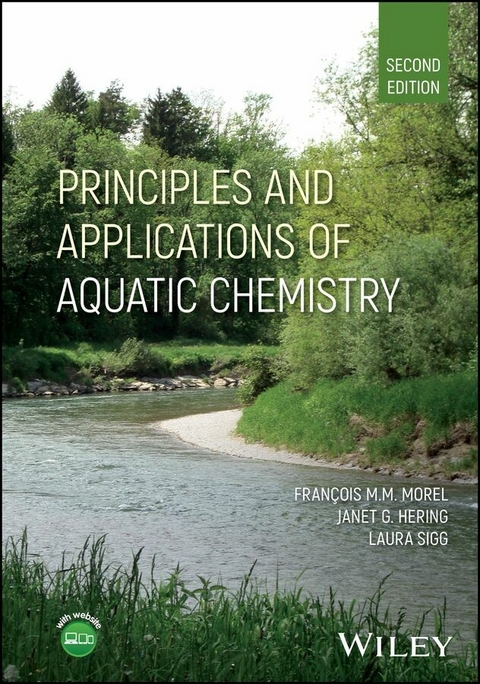
Principles and Applications of Aquatic Chemistry (eBook)
832 Seiten
Wiley-Interscience (Verlag)
978-1-119-80238-9 (ISBN)

The definitive text for water chemistry professionals and students worldwide.
Principles and Applications of Aquatic Chemistry provides a solid foundation for understanding the chemistry of lakes, oceans, rivers, estuaries, and other natural waters. Acclaimed for its user-friendly pedagogy, this classic textbook explains aquatic chemistry through the powerful application of the 'tableau system,' which provides a systematic way to organize complex chemical equilibrium problems.
Now in its second edition, this title contains an entirely new introductory chapter and new coverage of ocean acidification, advances in dissolution kinetics, bioavailability of trace metals, redox kinetics, and updated thermodynamic data. The use of computer programs to calculate chemical equilibrium in natural waters is illustrated. Throughout this edition, revised and streamlined material is supported by new real-world examples and full-color illustrations.
Accessible to those with diverse backgrounds in the sciences and engineering, this essential textbook
- Covers the fundamentals of aquatic science, including chemical thermodynamics, acid-base, precipitation-dissolution, coordination, reduction-oxidation and adsorption reactions
- Explains the use of equilibrium calculations, essential tools for understanding the chemical composition of aquatic systems and the fate of inorganic pollutants
- Provides quantitative treatments of the kinetics of chemical reactions in natural waters
- Features new and updated content that reflects advances in understanding the chemistry of natural waters
- Includes new end-of-chapter questions of various levels of difficulty and a solutions manual
This comprehensive guide remains the perfect textbook for advanced students in chemistry, environmental science and engineering, marine science, geochemistry, oceanography, geology, fisheries, forestry, and environmental policy and management. It is also a valuable reference text for industry professionals, academic researchers, policymakers, and college and university instructors in relevant fields.
François M.M. Morel is the Albert G. Blanke, Jr. Professor of Geosciences Emeritus at Princeton University.
Janet G. Hering is Director Emerita of the Swiss Federal Institute of Aquatic Science and Technology and Professor Emerita of Environmental Biogeochemistry at ETH Zurich and of Environmental Chemistry at the École Polytechnique Fédérale de Lausanne.
Laura Sigg is an internationally renowned expert in the aquatic geochemistry and ecotoxicology of trace metals. She is a former researcher at EAWAG, the Swiss Federal Institute of Aquatic Science and Technology, and Adjunct Professor at the Department of Environmental Systems Science of ETH Zurich.
The definitive text for water chemistry professionals and students worldwide. Principles and Applications of Aquatic Chemistry provides a solid foundation for understanding the chemistry of lakes, oceans, rivers, estuaries, and other natural waters. Acclaimed for its user-friendly pedagogy, this classic textbook explains aquatic chemistry through the powerful application of the tableau system, which provides a systematic way to organize complex chemical equilibrium problems. Now in its second edition, this title contains an entirely new introductory chapter and new coverage of ocean acidification, advances in dissolution kinetics, bioavailability of trace metals, redox kinetics, and updated thermodynamic data. The use of computer programs to calculate chemical equilibrium in natural waters is illustrated. Throughout this edition, revised and streamlined material is supported by new real-world examples and full-color illustrations. Accessible to those with diverse backgrounds in the sciences and engineering, this essential textbook Covers the fundamentals of aquatic science, including chemical thermodynamics, acid-base, precipitation-dissolution, coordination, reduction-oxidation and adsorption reactionsExplains the use of equilibrium calculations, essential tools for understanding the chemical composition of aquatic systems and the fate of inorganic pollutantsProvides quantitative treatments of the kinetics of chemical reactions in natural watersFeatures new and updated content that reflects advances in understanding the chemistry of natural watersIncludes new end-of-chapter questions of various levels of difficulty and a solutions manual This comprehensive guide remains the perfect textbook for advanced students in chemistry, environmental science and engineering, marine science, geochemistry, oceanography, geology, fisheries, forestry, and environmental policy and management. It is also a valuable reference text for industry professionals, academic researchers, policymakers, and college and university instructors in relevant fields.
1
Introduction to the Chemistry of Natural Waters
The topic of Aquatic Chemistry (an expression coined by Werner Stumm and Jim Morgan1 ca 1970 [1]) concerns the processes that control the composition of natural waters—oceans, lakes, rivers, wetlands, groundwaters, and atmospheric water. It focuses on chemical reactions at the earth surface but also necessarily deals with some geological, physical, biological, and ecological processes. In this introductory chapter, we provide an overview of some of the principal reactions and processes that will be examined in detail in the following chapters. But first we focus on the central character in this textbook, the water molecule, and examine its unusual properties and its cycling at the earth surface.
1.1 Water: Its Properties and Global Cycle
The properties of water have profound consequences for life on Earth. Water is very nearly a universal solvent and effectively transports dissolved chemical substances in the environment as well as within the cells and tissues of living organisms. Unlike most substances, water is denser as a liquid than as a solid, making ice float on the surface of lakes and oceans. The extremely high heat of vaporization of water allows the massive transport of latent heat to northern regions, making them habitable. The environmental relevance of the unusual properties of water is summarized in Table 1.1; the molecular basis of these properties is detailed in Section 1.1.1.
1.1.1 Physical and Chemical Properties of Water
A liter of liquid water was used to define the kilogram in the original metric system at the end of the eighteenth century. Definitions have changed, but 1 kg is the mass of 1 L of water at a temperature of 4 °C and a pressure of 1 atm. This liter contains 55.51 mol (=3.34 × 1025 molecules) of H2O, which has a molecular mass of 18.015 g. The covalent bonds resulting from the sharing of the lone electrons from H atoms and the unpaired electrons from O make the water molecule very stable. It has a tetrahedral shape with the two bonding and the two non-bonding electron pairs from O at each corner and a mean HOH angle slightly above 100° (Figure 1.1). As the shared electrons are pulled toward the oxygen nucleus (which has +8 charges compared with +1 in the hydrogen nucleus) this geometry leads to a separation of electrical charge—i.e., the formation of an electrical dipole with a partial negative charge on the oxygen and a partial positive charge on the hydrogens (Figure 1.1). The attractive dipole–dipole interactions among water molecules, which are known as hydrogen bonds, are much weaker than covalent bonds (23.3 kJ mol−1 vs. 470 kJ mol−1) but strong enough to organize water molecules in liquid water and even more so in ice (Figure 1.2). The net result is the unusual properties of water listed in Table 1.1, which are critical to geochemical cycles and life on our planet.
Table 1.1 Physical Properties of Liquid Water.
Source: Modified from [2] and [3].
| Property | Comparison with Other Liquids | Environmental Relevance |
|---|
| Density | Maximum at 4 °C, decreases upon freezing | Prevents freezing of deep water and causes seasonal stratification |
| Melting and Boiling Point | Exceptionally high | Water exists in liquid form at the earth surface |
| Heat Capacity | Highest heat capacity of all liquids with exception of NH3 | Moderates temperature extremes |
| Heat of Vaporization | Extremely high | Moderates temperature extremes |
| Surface Tension | High | Drop formation in clouds and rain |
| Light Absorption | High in infrared and UV range, moderate in visible range | Clouds can block sunlight from the Sun, and cool the earth but they can also trap heat and warm the earth |
| Solvent Properties | Because of dipolar properties excellent solvent for salts (ions) and polar molecules | Transport of dissolved substances in hydrological cycle and in biological systems |
Figure 1.1 Shape of the water molecule with an H-O-H angle of 104.5° and the dipole moment with partial negative charge on O and partial positive charge on H.
Source: A-Level. Biology/alevelbiology.co.uk.
Figure 1.2 Water molecules in ice, water, and vapor.
Source: from Encyclopedia Britannica [4] with permission.
Hydrogen bonds are the reason ice floats at the surface of water bodies during the winter at high latitudes, allowing the survival of aquatic life and the spring thaw. The structure of liquid water is controlled by a balance between thermal motion, which makes individual molecules occupy an average volume that increases with temperature and H-bonding that links them to each other. At room temperature, water molecules are moving in all directions, constantly breaking and making new H-bonds (Figure 1.2). As the temperature cools, thermal motion decreases, and the density of water increases like that of other liquids. At 4 °C, water molecules are bound in large dense clusters, and there are on average 33.4 water molecules per nm3. In ice the thermal motion of water molecules becomes negligible, and the structure is completely and rigidly determined by H-bonding. The ordinary ice crystal on earth (known as Ih ice) is composed of crinkled planes of hexagonal rings of oxygen (Figure 1.2) with each water molecule H-bonded with three other water molecules in the same plane and one in an adjacent plane. The result is a relatively open structure with only 30.7 water molecules per nm3 and a density of 0.92 g cm−3, nearly 10% lighter than 4 °C water. Between 4 °C and 0 °C the formation of an increasing number of ice-like hexagonal rings of H-bonded water molecules leads to a very small increase in volume and a corresponding decrease in the density of liquid water (Figure 1.3). Both liquid water and ice equilibrate with water vapor (Figure 1.4). At atmospheric pressure and a comfortable ambient temperature of 25 °C liquid water is at equilibrium with a partial pressure of about 3 × 10⁻² atm of water vapor (point A on Figure 1.4) while at the less comfortable temperature of −20 °C ice is at equilibrium with only 10−3 atm of water vapor (point B on Figure 1.4). Air is usually undersaturated with water and vapor pressure is traditionally reported as relative humidity, the ratio of the ambient vapor pressure to that at equilibrium with liquid water or ice at the ambient temperature.
As a result of their electrical dipole properties, water molecules organize themselves around electrically charged molecules—O toward cations and H toward anions—dramatically decreasing their electrostatic interactions with other charged molecules. This makes water an excellent solvent for ionic solids. For example, in dilute solution, the sum of the electrostatic interactions between water molecules and the ions Na+ and Cl− ends up being stronger than that between Na+ and Cl− in solid NaCl, resulting in the dissolution of the salt. In dilute solutions, many ions have six water molecules in their inner coordination sphere, (Figure 1.5) or while some like silver have only four, . The number of water molecules in the inner coordination sphere of complex ions such as sulfate is poorly known, . The abbreviated notation Na+, Cl−, Ca2+, Ag+, and implicitly comprises the coordinated water molecules. In addition to those that are effectively bonded to the central ion, up to dozens of more distant water molecules are organized around it as a result of electrostatic interactions. For the same reason, water is also a good solvent for organic compounds that contain electrically charged moieties such as amino acids and nucleic acids and their polymers, even when they have no net charge. Polar molecules, which have an uneven distribution of electrons between covalently bonded atoms, are also soluble in water.
Figure 1.3 Water density (at 1 atm) as a function of temperature.
Source: Adapted from [5].
Figure 1.4 Vapor pressure (p, atm) over ice and over water as a function of temperature.
Source: Adapted from [6].
Figure 1.5 Hydrated divalent cation and anion.
In liquid water, H2O molecules are very stable as a result of hydrogen bonding. Nonetheless, at any point in time a very small number of them (about two in a billion in pure water) become hydroxide ions, OH−, by losing the nucleus of one of their hydrogen atoms which is captured by another water molecule to become a hydronium ion, H3O+:
As will be seen this dissociation of water (also called self-ionization of water) is a fundamental aspect of all aqueous solutions including natural waters. For simplicity in this text we omit the water in the formula of the hydronium ion and...
| Erscheint lt. Verlag | 1.8.2025 |
|---|---|
| Sprache | englisch |
| Themenwelt | Naturwissenschaften ► Chemie |
| Schlagworte | aquatic chemistry applications • aquatic chemistry conservation • aquatic chemistry equilibrium equations • aquatic chemistry fundamentals • aquatic chemistry principles • aquatic chemistry textbook • aquatic science fundamentals • Aquatic Science Textbook |
| ISBN-10 | 1-119-80238-5 / 1119802385 |
| ISBN-13 | 978-1-119-80238-9 / 9781119802389 |
| Informationen gemäß Produktsicherheitsverordnung (GPSR) | |
| Haben Sie eine Frage zum Produkt? |
 EPUB (Adobe DRM)
Kopierschutz: Adobe-DRM
Adobe-DRM ist ein Kopierschutz, der das eBook vor Mißbrauch schützen soll. Dabei wird das eBook bereits beim Download auf Ihre persönliche Adobe-ID autorisiert. Lesen können Sie das eBook dann nur auf den Geräten, welche ebenfalls auf Ihre Adobe-ID registriert sind.
Details zum Adobe-DRM
Dateiformat: EPUB (Electronic Publication)
EPUB ist ein offener Standard für eBooks und eignet sich besonders zur Darstellung von Belletristik und Sachbüchern. Der Fließtext wird dynamisch an die Display- und Schriftgröße angepasst. Auch für mobile Lesegeräte ist EPUB daher gut geeignet.
Systemvoraussetzungen:
PC/Mac: Mit einem PC oder Mac können Sie dieses eBook lesen. Sie benötigen eine
eReader: Dieses eBook kann mit (fast) allen eBook-Readern gelesen werden. Mit dem amazon-Kindle ist es aber nicht kompatibel.
Smartphone/Tablet: Egal ob Apple oder Android, dieses eBook können Sie lesen. Sie benötigen eine
Geräteliste und zusätzliche Hinweise
Buying eBooks from abroad
For tax law reasons we can sell eBooks just within Germany and Switzerland. Regrettably we cannot fulfill eBook-orders from other countries.
aus dem Bereich