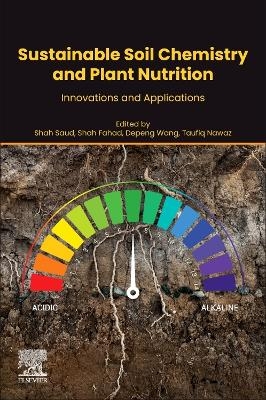
Sustainable Soil Chemistry and Plant Nutrition
Elsevier - Health Sciences Division (Verlag)
978-0-443-40584-6 (ISBN)
In the detailed Table of Contents, readers will find a wealth of information covering topics such as macronutrient deficiencies, sustainable soil chemistry practices, plant uptake of soil nutrients, and the effects of soil pH on nutrient availability. Chapters also explore the role of micronutrients, redox reactions, soil minerals, and soil texture on plant nutrient accessibility, as well as strategies for manipulating soil fertility chemistry to enhance nutrient availability.
Dr. Shah Saud is Associate Professor in Linyi University’s College of Life Science. He obtained his PhD in Horticulture from Northeast Agricultural University, China. Dr. Saud specializes in studying sustainable agriculture, soil, and water conservation in the context of climate change. Within this focal area, he has published extensively on the role of cyanobacteria in sustainable agriculture and the risks harmful cyanobacterial blooms pose to aquatic systems. Dr. Saud has edited three volumes with Elsevier. Dr. Shah Fahad is Assistant Professor in the Department of Agronomy at Abdul Wali Khan University. He obtained his PhD in Agronomy from Huazhong Agricultural University, China. He specializes in studying the effects of climate change and anthropogenic impacts on environmental health, agriculture, and food production. Within this focal area, he has published extensively on the role of cyanobacteria in sustainable agriculture and the risks harmful cyanobacterial blooms pose to aquatic systems. He has edited 17 books, including four titles with Elsevier. Dr. Depeng Wang obtained a Ph.D. in Agronomy and Crop Physiology from Huazhong Agriculture University, Wuhan, China, in 2016. He is currently a professor at the College of Life Science, Linyi University, Linyi, China. He is the principal investigator of the Crop Genetic Improvement, Physiology & Ecology Center at Linyi University. His current research focuses on agronomy and crop ecology and physiology, including characteristics associated with high-yield crops, the effect of temperature on crop grain yield and solar radiation utilization, morphological plasticity to agronomic manipulation in leaf dispersion and orientation, and optimal integrated crop management practices for maximizing crop grain yield. Dr. Wang has published more than thirty-six papers in reputed journals. He has edited one book and written four book chapters on important aspects of crop physiology, environmental stress, and crop quality formation. According to Google Scholar Citation, his publications have received more than 100 citations. He is a reviewer for five peer-reviewed international journals. Dr. Wang is a provincial crop expert in green, high-quality, and efficient technology, and has participated in six national projects with more than $4 million in research funding. Edit Dr. Taufiq Nawaz is currently pursuing his PhD in molecular biology and biotechnology from South Dakota State University. His research focuses on the application of synthetic biology to cyanobacteria, which a specific focus on utilizing sunlight and nitrogen gas to create high-quality nutritional protein powder for human consumption. He seeks to pioneer innovative methods for biofuel production and the synthesis of high-value compounds. Dr. Nawaz has published extensively on the biology and ecology of cyanobacteria.
1. Introduction to soil chemistry and nutrient availability
2. Macronutrient deficiencies and their impact on crop health
3. Sustainable practices in soil chemistry for enhanced plant nutrition
4. Plant uptake and migration of soil nutrients
5. Alkaline and acidic soils pose problems for nutrient availability
6. Role of nitrogen, phosphorus, and sulfur ions in soil nutrient cycling
7. Micronutrient stress and soil-plant interactions
8. Redox reactions and their influence on the nutrient availability of plants
9. Soil minerals and their influence on the accessibility of plant nutrients
10. Effects of soil texture and structure on nutrient chemistry and plant uptake
11. Manipulation of soil fertility chemistry to improve nutrient availability
12. Soil-borne stress factors and their influence on nutrient dynamics
13. Effect of soil amendments on the availability of nutrients for plants
14. Environmental dynamics and future horizons: Optimizing soil chemistry for sustainable plant nutrition
15. New frontiers in soil chemistry research innovations and discoveries
| Erscheinungsdatum | 13.12.2025 |
|---|---|
| Verlagsort | Philadelphia |
| Sprache | englisch |
| Maße | 191 x 235 mm |
| Gewicht | 450 g |
| Themenwelt | Naturwissenschaften ► Biologie ► Ökologie / Naturschutz |
| ISBN-10 | 0-443-40584-0 / 0443405840 |
| ISBN-13 | 978-0-443-40584-6 / 9780443405846 |
| Zustand | Neuware |
| Informationen gemäß Produktsicherheitsverordnung (GPSR) | |
| Haben Sie eine Frage zum Produkt? |
aus dem Bereich