


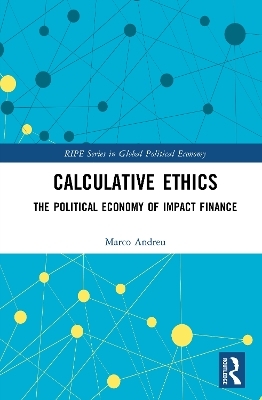
Calculative Ethics
The Ambiguous Politics of Impact Finance
Seiten
2026
Routledge (Verlag)
978-1-032-97080-6 (ISBN)
Routledge (Verlag)
978-1-032-97080-6 (ISBN)
- Noch nicht erschienen (ca. Februar 2026)
- Versandkostenfrei
- Auch auf Rechnung
- Artikel merken
Calculative Ethics examines social and development impact bonds as a form of ethical finance that adopts a fact-centred approach to addressing social ills. Impact bonds are shown to recast benevolent investing through evidence-based governing.
Calculative Ethics examines social and development impact bonds as a form of ethical finance that adopts a fact-centred approach to addressing social ills. Impact bonds are shown to recast benevolent investing through evidence-based governing, tying investor returns to demonstrated positive social outcomes in domains such as health and education. The book argues that this logic of fact-based financing is increasingly institutionalised, reshaping investment and donor practices across ethical and development finance.
Drawing on three case studies—addressing homelessness and chronic illness in the UK, and educational outcomes for girls and boys in India—Calculative Ethics traces how impact bonds bring together financial tools, scientific evaluation methods (such as randomised controlled trials), and performance management into programmatic responses to poverty-related issues. Rather than simply advancing financial interests under an ethical banner, impact bonds are shown to reconfigure both finance and ethics. They give rise to a calculative reasoning in which investments are organised around numerical evidence of improved well-being of vulnerable populations. The book argues that this reveals more complex power configurations than marketisation accounts typically suggest, while also interrogating the conceptual and political issues that emerge when ‘facts’ become the organising principle of ethical investing.
Calculative Ethics will appeal to scholars and students of international political economy— particularly those studying ethical finance and the financialisation of welfare and development—as well as researchers in economic sociology, public policy, development studies, and human geography.
Calculative Ethics examines social and development impact bonds as a form of ethical finance that adopts a fact-centred approach to addressing social ills. Impact bonds are shown to recast benevolent investing through evidence-based governing, tying investor returns to demonstrated positive social outcomes in domains such as health and education. The book argues that this logic of fact-based financing is increasingly institutionalised, reshaping investment and donor practices across ethical and development finance.
Drawing on three case studies—addressing homelessness and chronic illness in the UK, and educational outcomes for girls and boys in India—Calculative Ethics traces how impact bonds bring together financial tools, scientific evaluation methods (such as randomised controlled trials), and performance management into programmatic responses to poverty-related issues. Rather than simply advancing financial interests under an ethical banner, impact bonds are shown to reconfigure both finance and ethics. They give rise to a calculative reasoning in which investments are organised around numerical evidence of improved well-being of vulnerable populations. The book argues that this reveals more complex power configurations than marketisation accounts typically suggest, while also interrogating the conceptual and political issues that emerge when ‘facts’ become the organising principle of ethical investing.
Calculative Ethics will appeal to scholars and students of international political economy— particularly those studying ethical finance and the financialisation of welfare and development—as well as researchers in economic sociology, public policy, development studies, and human geography.
Dr Marco Andreu is the Deputy Head of International Cooperation at the Representative Office of Switzerland in the Occupied Palestinian Territory and an Honorary Research Fellow at the University of Warwick.
Introduction: Impact Bonds and the Financialisation of Social Programmes 1. The Social Turn of Finance and the Financialisation of Welfare 2. From Technologies of Power to an Experimental Investigation: A Governmentality Method 3. The Emergence of Impact Bonds to Finance Welfare and Development 4. Factivist Finance: A New Repertoire for Public Action 5. The Perpetuation of Testing 6. The Politics of Life Conclusion: The Ambiguous Politics of Factivist Finance
| Erscheint lt. Verlag | 19.2.2026 |
|---|---|
| Reihe/Serie | RIPE Series in Global Political Economy |
| Zusatzinfo | 1 Tables, black and white; 4 Line drawings, black and white; 4 Illustrations, black and white |
| Verlagsort | London |
| Sprache | englisch |
| Maße | 156 x 234 mm |
| Gewicht | 453 g |
| Themenwelt | Naturwissenschaften ► Geowissenschaften ► Geografie / Kartografie |
| Wirtschaft ► Betriebswirtschaft / Management | |
| Wirtschaft ► Volkswirtschaftslehre ► Wirtschaftspolitik | |
| ISBN-10 | 1-032-97080-4 / 1032970804 |
| ISBN-13 | 978-1-032-97080-6 / 9781032970806 |
| Zustand | Neuware |
| Informationen gemäß Produktsicherheitsverordnung (GPSR) | |
| Haben Sie eine Frage zum Produkt? |
Mehr entdecken
aus dem Bereich


aus dem Bereich
Buch | Hardcover (2024)
Schweizerbart'sche, E. (Verlag)
CHF 33,55
Sammlung vermessungstechnischer Aufgaben mit ausführlichen Lösungen
Buch | Softcover (2025)
Wichmann, H (Verlag)
CHF 37,80
über eine faszinierende Welt zwischen Wasser und Land und warum sie …
Buch | Hardcover (2023)
dtv (Verlag)
CHF 33,55


