


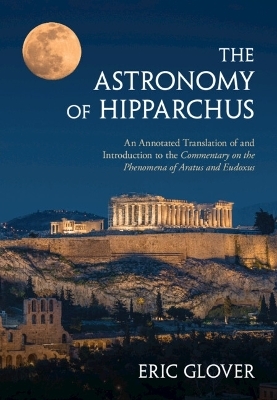
The Astronomy of Hipparchus
An Annotated Translation of and Introduction to the Commentary on the Phenomena of Aratus and Eudoxus
Seiten
2026
Cambridge University Press (Verlag)
978-1-009-60753-7 (ISBN)
Cambridge University Press (Verlag)
978-1-009-60753-7 (ISBN)
- Noch nicht erschienen (ca. April 2026)
- Versandkostenfrei
- Auch auf Rechnung
- Artikel merken
A thorough introduction to the most important ancient Greek astronomer, Hipparchus. Features a translation and analysis of his only surviving work, the Commentary on the Phenomena of Aratus and Eudoxus, and reconstructs his catalogue of the stars, which has not survived, using a modern precession model.
Hipparchus was the most important astronomer of the ancient Greek world. This volume provides a comprehensive introduction to almost everything that can be known or reasonably surmised about his life and work. Hipparchus was the first to apply an effective geometric model to the cosmos, which enabled him to predict the positions of the Sun, Moon and stars more reliably than before. He was also the first to catalogue most of the stars that were visible in the northern hemisphere, giving a detailed account of their risings, settings and culminations. His most important discovery was the long-term movement of the sky, known as precession. Crucially, this study provides a translation and analysis of Hipparchus' only surviving work, the Commentary on the Phenomena of Aratus and Eudoxus, and reconstructs his catalogue of the stars, which has not survived, using a modern precession model.
Hipparchus was the most important astronomer of the ancient Greek world. This volume provides a comprehensive introduction to almost everything that can be known or reasonably surmised about his life and work. Hipparchus was the first to apply an effective geometric model to the cosmos, which enabled him to predict the positions of the Sun, Moon and stars more reliably than before. He was also the first to catalogue most of the stars that were visible in the northern hemisphere, giving a detailed account of their risings, settings and culminations. His most important discovery was the long-term movement of the sky, known as precession. Crucially, this study provides a translation and analysis of Hipparchus' only surviving work, the Commentary on the Phenomena of Aratus and Eudoxus, and reconstructs his catalogue of the stars, which has not survived, using a modern precession model.
ERIC GLOVER is an independent researcher living in London with an academic background in classics, ancient history, mathematics and computer science, and a lifelong practical interest in astronomy.
Part I. Introduction: 1. Life and times; 2. Reputation and sources; 3. Works and achievements; Part II. The Astronomy of Hipparchus: 4. The influence of the Near East; 5. The mathematics of Hipparchus; 6. The cosmology of Hipparchus; 7. Instrumentation and measurement; Part III. The CPAE: 8. Overview and translations; Part IV. The Star Catalogue of Hipparchus: 9. The star catalogue; 10. Constellation tables; Appendices.
| Erscheint lt. Verlag | 30.4.2026 |
|---|---|
| Zusatzinfo | Worked examples or Exercises; 10 Tables, black and white; 1 Maps; 5 Halftones, black and white; 10 Line drawings, black and white |
| Verlagsort | Cambridge |
| Sprache | englisch |
| Gewicht | 500 g |
| Themenwelt | Naturwissenschaften ► Physik / Astronomie ► Astronomie / Astrophysik |
| ISBN-10 | 1-009-60753-7 / 1009607537 |
| ISBN-13 | 978-1-009-60753-7 / 9781009607537 |
| Zustand | Neuware |
| Informationen gemäß Produktsicherheitsverordnung (GPSR) | |
| Haben Sie eine Frage zum Produkt? |
Mehr entdecken
aus dem Bereich



aus dem Bereich
Kompendium & Nachschlagewerk in 3 Bänden
Buch | Hardcover (2025)
Eigenverlag Dr. Erik Wischnewski
CHF 179,95


