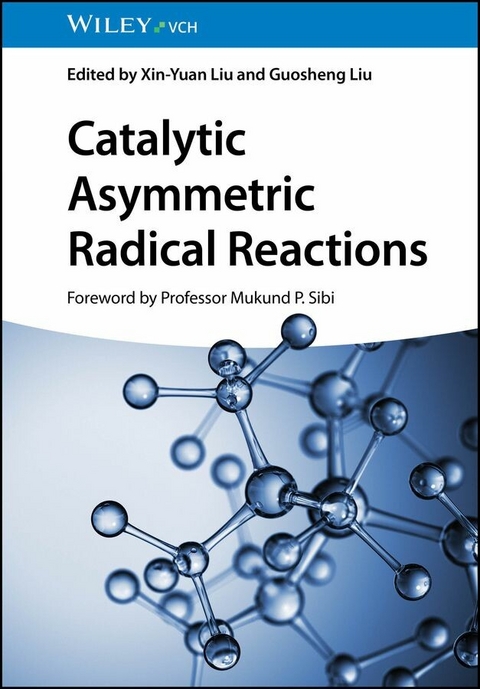
Catalytic Asymmetric Radical Reactions (eBook)
1026 Seiten
Wiley-VCH (Verlag)
978-3-527-83665-9 (ISBN)
Strategies to develop catalytic asymmetric radical reactions, from metal-based methods to organocatalytic systems
Catalytic Asymmetric Radical Reactions systematically and comprehensively summarizes the development of different strategies to realize asymmetric radical reactions, from metal-based methods to organocatalytic systems.
The book starts with the background introduction of this topic and emphasizes the significance and challenge of the stereocontrol over the radical intermediates. Subsequently, it describes the detailed strategies to realize the asymmetric radical reactions, demonstrating how the design of chiral catalysts and substrates helps to achieve the asymmetric induction. Finally, it summarizes the developed strategies and presents a perspective in future development of asymmetric radical reactions.
Catalytic Asymmetric Radical Reactions includes information on:
- Earth-abundant transition metal (e.g., iron, cobalt, nickel, copper, and manganese)-catalyzed asymmetric radical reactions
- Photoredox/earth-abundant metal-catalyzed asymmetric radical reactions and precious transition metal-catalyzed asymmetric radical reactions
- Chiral Lewis acid-catalyzed asymmetric radical transformations and chiral-at-metal complex-catalyzed asymmetric radical reactions
- Organocatalysis via covalent bonds and hydrogen bonding for asymmetric radical transformations
- Covalent interaction (S/Sn/B-centered radical)-induced asymmetric radical reactions
Catalytic Asymmetric Radical Reactions is a timely reference for researchers in academia and industry working in the fields of organic synthesis, drug discovery, and materials science.
Xin-Yuan Liu is a Chair Professor in the Department of Chemistry at Southern University of Science and Technology, China. He focuses on developing novel chiral anionic ligands in realizing the copper-catalyzed asymmetric radical reactions Currently, he is an associated editor of Synthesis. He has received numerous scientific awards, including the National Distinguished Young Scholar (NSFC), XPLORER prize, Boehringer Ingelheim Lectureship (Boston College), CAPA Distinguished Faculty Award, the Distinguished Lectureship Award from the Chemical Society of Japan, and The 12th CCS-BASF Youth Knowledge Innovation Award.
Guosheng Liu is a Professor in Shanghai Institute of Organic Chemistry (SIOC), Chinese Academy of Sciences (CAS), China. His research focuses on the highly selective functionalization of alkenes and alkanes, particularly on the site- and enantioselective sp3 C-H functionalization via metal-catalyzed radical relay. Currently, he is an associated editor of Organic Letters. He has received many scientific awards, including the National Distinguished Young Scholar (NSFC), New Cornerstone Investigator Program, Friedrich Wilhelm Bessel Research Award (Alexander von Humboldt Foundation), and The 9th CCS-BASF Youth Knowledge Innovation Award.
Preface
Asymmetric synthesis is of great importance in the field of organic chemistry as it allows for the direct synthesis of valuable enantiomerically enriched molecules. Radical species, characterized by unpaired electrons, serve as highly reactive intermediates that are integral to a wide range of chemical transformations, such as organic synthesis, polymerization, and biological processes. In contrast to ionic reactions, radical reactions usually have high reactivity, good functional group tolerance, and less sensitivity to steric crowding. Therefore, the development of catalytic asymmetric radical reactions should be highly appealing but has been less recognized in the history of organic synthesis. The lag might stem from a long‐standing misconception that radicals are highly reactive and uncontrollable species, which renders the enantiocontrol challenging. Over the past two decades, however, there has been an extraordinary surge in the development of numerous catalytic asymmetric radical reactions, driven by innovations in chiral Lewis acid catalysis, organocatalysis, transition metal catalysis, and enzymatic catalysis, with the rapid advancement of photo‐ and electrocatalysis further accelerating progress in the field. Meanwhile, our interest in this field dates back to before 2016, when both the editors of this book published their first publication of the topic independently, drawing on their expertise in transition metal catalysis. Since then, we have devoted sustainable effort to developing chiral copper catalysis for the asymmetric radical transformations of simple chemical feedstocks, including C—H functionalization, difunctionalization of alkenes, and cross‐coupling of alkyl halides. Concurrently, a growing array of innovative strategies has emerged in this field, promoting a recognition of the need for a comprehensive summary that encompasses the diverse methodologies developed to date. At this moment, we were honored to receive an invitation from Wiley Publishing to contribute a book dedicated to catalytic asymmetric radical reactions. This opportunity provided the impetus for the creation of the present book.
The content of this book is organized into 3 main parts, encompassing 15 chapters in total. Chapters 1 through 9 provide a comprehensive overview of transition metal‐catalyzed asymmetric radical reactions, encompassing both earth‐abundant 3d transition metal catalysts – such as iron, cobalt, nickel, copper, and manganese, and precious metal catalysts, including palladium, rhodium, and iridium. Chapter 1 summarizes iron‐catalyzed radical asymmetric reactions, utilizing various chiral ligands to facilitate the construction of chiral C—C and C—X bonds in reactions such as C—H functionalization, alkene difunctionalization, and the cross‐coupling of racemic alkyl halides. Chapter 2 presents cobalt‐catalyzed radical transformations through strategic ligand design, focusing on three key systems: [Co(Por)]‐based metalloradical catalysis enabling stereocontrolled cyclopropanation, aziridination, C—H functionalization, and radical cascade reactions, [Co(salen)]‐catalyzed hydrofunctionalization of alkenes involving metal‐hydride hydrogen atom transfer (MHAT), and cross‐coupling of alkyl halides with organometallic reagents. Chapter 3 highlights the advances in nickel‐catalyzed asymmetric radical cross‐coupling reactions of racemic alkyl halides and organometallic reagents. In addition, other radical precursors beyond alkyl halides are also discussed to illustrate the broad applicability of asymmetric radical cross‐coupling reactions. Chapter 4 summarizes the development of nickel‐catalyzed asymmetric radical cross‐electrophile coupling reactions under reductive conditions, which circumvent the need for air‐ or moisture‐sensitive organometallic reagents. This chapter mainly introduces the scope of the coupled electrophiles and further highlights their application in alkene difunctionalization. In Chapter 5, copper‐catalyzed asymmetric radical cross‐coupling of C(sp3)—H bonds via a radical relay process is presented. The discussion in this chapter emphasizes diverse bond‐formation reactions of the resulting radicals, encompassing cyanation, arylation, alkynylation, trifluoromethylation, and amination with various chiral ligands. In Chapter 6, copper‐catalyzed enantioconvergent radical cross‐coupling reactions of racemic alkyl halides with diverse nucleophiles under thermal conditions are presented. The discussion herein predominantly focuses on the design of chiral ligands for tuning the reducing capability of copper to initiate the radical reaction and creating a chiral environment to achieve the enantiocontrol of radicals. Chapter 7 summarizes manganese‐catalyzed asymmetric radical reactions, primarily covering C—H oxidation and related enantioselective desymmetrization. Chapter 8 discusses recent progress in photoredox and earth‐abundant metal‐catalyzed asymmetric radical reactions, highlighting their ability to generate diverse radical species and enable chiral C—C and C—X bond formations under mild conditions. Chapter 9 highlights the advances in precious transition metal‐catalyzed asymmetric radical reactions, involving palladium, rhodium, and iridium catalysis. Since they are reluctant to the single‐electron transfer process, a photocatalyst is often incorporated into the reaction system to facilitate the generation of radical species.
Chapters 10 and 11 focus on Lewis acid‐catalyzed asymmetric radical reactions. Chapter 10 provides an overview of asymmetric radical reactions catalyzed by classic chiral Lewis acids, such as chiral boranes and metals bearing bidentate, tridentate, or multidentate chiral ligands. Chapter 11 highlights the chiral‐at‐metal complex‐catalyzed asymmetric radical reactions, enabling numerous transformations such as alkylation, alkenylation, amination, addition, deracemization, and rearrangement. Chapter 12 presents asymmetric photochemical reactions within supramolecular assemblies, emphasizing the impact of the chiral host framework and the synergistic effects of non‐covalent interactions on photoreaction stereoselectivity. It also discusses the influence of external environmental factors such as temperature, solvent, and pressure.
Chapters 13 through 15 focus on organocatalyzed asymmetric radical reactions. Chapter 13 summarizes the advances in organocatalysis via covalent bonds for asymmetric radical transformations. The discussion in this chapter is organized based on different modes of organocatalysis, including chiral amine‐catalyzed transformations of carbonyl compounds and nitrogen‐heterocyclic carbene (NHC) catalysis. Chapter 14 focuses on the role of hydrogen‐bonding interactions in asymmetric radical transformations. It is categorized into eight radical transformations including radical cycloaddition, radical cyclization, radical addition, radical coupling, Minisci reactions, asymmetric protonation, radical/polar crossover reactions, and deracemizations. In Chapter 15, advances in the use of covalent interactions involving sulfur‐, stannyl‐, and boron‐centered radicals to achieve high enantioselectivity in radical transformations are presented. The discussion focuses on how such covalent interactions between the substrate and radical species modulate both the reactivity and stereochemical outcome. In addition, the enzymatic catalysis has progressed rapidly to realize asymmetric radical reactions, but this topic is not covered in this book.
We would like to acknowledge the dedicated efforts of many friends and their collaborators who wrote the corresponding chapters and made this book a reality, including Hongli Bao from Fujian Institute of Research on the Structure of Matter, X. Peter Zhang from Boston College, Wangqing Kong from Wuhan University, Lingling Chu from Donghua University, Lei Liu from Shandong University, Wenjing Xiao and Jia‐Rong Chen from Central China Normal University, Shouyun Yu from Nanjing University, Lei Gong from Xiamen University, Jiajia Ma from Shanghai Jiaotong University, Cheng Yang from Sichuan University, Danqing Zheng from Nanjing Tech University, Zhiyong Jiang from Henan Normal University, and Yi‐Feng Wang from University of Science and Technology of China. We also want to extend our gratitude to our group members Pinhong Chen from Shanghai Institute of Organic Chemistry and Xiao‐Yang Dong from Great Bay University, who helped us accomplish Chapters 5 and 6. In particular, Zhong‐Liang Li from Great Bay University is acknowledged for his invaluable assistance in organizing and proofreading all the chapters. Professor Mukund Sibi is greatly appreciated for his support of this book and his willingness to contribute a Foreword, which serves as a remarkable introduction to the content of this book. We also appreciate people from Wiley Publishing, Dr. Lifen Yang, Priyadarshini Natarajan, Naveen Kumaran Shanmugam, and Jona Nussbeck, for their kind assistance.
Xin‐Yuan Liu
Southern University of Science and Technology
Shenzhen, China
Guosheng Liu
Shanghai...
| Erscheint lt. Verlag | 24.7.2025 |
|---|---|
| Sprache | englisch |
| Themenwelt | Naturwissenschaften ► Chemie ► Organische Chemie |
| ISBN-10 | 3-527-83665-9 / 3527836659 |
| ISBN-13 | 978-3-527-83665-9 / 9783527836659 |
| Informationen gemäß Produktsicherheitsverordnung (GPSR) | |
| Haben Sie eine Frage zum Produkt? |
 EPUB (Adobe DRM)
Kopierschutz: Adobe-DRM
Adobe-DRM ist ein Kopierschutz, der das eBook vor Mißbrauch schützen soll. Dabei wird das eBook bereits beim Download auf Ihre persönliche Adobe-ID autorisiert. Lesen können Sie das eBook dann nur auf den Geräten, welche ebenfalls auf Ihre Adobe-ID registriert sind.
Details zum Adobe-DRM
Dateiformat: EPUB (Electronic Publication)
EPUB ist ein offener Standard für eBooks und eignet sich besonders zur Darstellung von Belletristik und Sachbüchern. Der Fließtext wird dynamisch an die Display- und Schriftgröße angepasst. Auch für mobile Lesegeräte ist EPUB daher gut geeignet.
Systemvoraussetzungen:
PC/Mac: Mit einem PC oder Mac können Sie dieses eBook lesen. Sie benötigen eine
eReader: Dieses eBook kann mit (fast) allen eBook-Readern gelesen werden. Mit dem amazon-Kindle ist es aber nicht kompatibel.
Smartphone/Tablet: Egal ob Apple oder Android, dieses eBook können Sie lesen. Sie benötigen eine
Geräteliste und zusätzliche Hinweise
Buying eBooks from abroad
For tax law reasons we can sell eBooks just within Germany and Switzerland. Regrettably we cannot fulfill eBook-orders from other countries.
aus dem Bereich