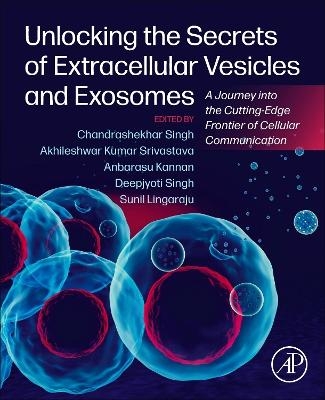
Unlocking the Secrets of Extracellular Vesicles and Exosomes
Academic Press Inc (Verlag)
978-0-443-36390-0 (ISBN)
- Noch nicht erschienen (ca. April 2026)
- Versandkostenfrei
- Auch auf Rechnung
- Artikel merken
Dr. Chandrashekhar Singh is a Research Associate at the Department of Pharmaceutical Engineering and Technology, Indian Institute of Technology, Banaras Hindu University, Varanasi, Uttar Pradesh, India. Dr. Singh earned his Ph.D. in Biotechnology from the Department of Botany, Banaras Hindu University. Dr. Singh has authored 19 research articles that have been published in reputable international journals. Additionally, he has written 4 book chapters in collaboration with renowned science publishers. Dr. Singh's primary research focuses on the development of bio-inspired nanoparticles and their applications as antibacterial in the management of wound infections and plant Biotechnology. His contributions to this field have earned him recognition, including an Indian patent. Furthermore, Dr. Singh is actively engaged in the preparation of more research and review articles, which are currently in the process of publication. Dr. Singh also contributes to the academic community as a reviewer for esteemed journals such as Vegetos (Springer). Dr. Akhileshwar Kumar Srivastava works as a Research Associate (ICMR) at CSIR-Central Food Technological Research Institute, Mysore, India. In his 11 years of research, he has published more than 18 research articles in reputed international journals, along with 4 books and 11 book chapters. His research specialization is primarily in the area of pharmacognosy with genetics, metabolomics, bioinformatics, and molecular biology associated with targeting virulent factors of diseases. In addition, he has studied at Augusta University (formerly, Georgia Regents University) in Augusta, GA, USA, on a J-1 Exchange Scholar Visa and at Ben-Gurion University, Israel. He is also a life member fellow in the Indian Science Congress and the Agriculture, Nutrition and Health Academy, UK. Dr. Anbarasu Kannan is a senior scientist and assistant professor in the Department of Biochemistry, CSIR-CFTRI, Mysuru, Karnataka, India. He had previous training in both Doctorate (2013) and post-doctoral (from 2014-2017) in cancer research. During post-doctoral training, he has been working on exosome biogenesis, mitochondrial genetic alterations, and dynamics in different cancers. His work has been published in peer-reviewed journals. He has been awarded the Early career Research Award (ECRA) in tracing the alteration signature of SH3GL2 in circulating exosomes of breast cancer progression to develop exosome-based biomarker. He has research expertise in the field of exosome biogenesis and mitochondrial dynamics, and in development of exosome biomarkers for cancer diagnostics and therapeutics. Dr. Deepjyoti Singh is a Postdoctoral Researcher at the Department of Entomology and Plant Pathology, North Carolina State University, Raleigh, North Carolina, USA. With over a decade of expertise in molecular biology, her work focuses on plant-virus-vector interactions. She earned her Ph.D. from the School of Life Sciences, Jawaharlal Nehru University, New Delhi, India, where she studied the mechanism of systemic acquired resistance in plants. During her tenure as a postdoctoral fellow at Syracuse University, New York, USA, she worked on understanding the epigenetic mechanism of plant defense in Arabidopsis. She has published 8 research articles in reputable international journals and presented her work at various national and international conferences. In addition to her research, Dr. Singh contributes as a reviewer for esteemed journals, including Molecular Plant-Microbe Interactions (MPMI) and Frontiers in Microbiology. Dr. Sunil L is currently working as a postdoctoral fellow at the Department of Pharmacological and Pharmaceutical Sciences at the University of Houston College of Pharmacy, Houston, TX, USA. He mainly focuses on small molecules of the Munc13.1.C1 domain and the Munc13.1.C1.C2B domain of presynaptic CNS protein, intending to develop drugs for alcohol addiction and Alzheimer’s disease. His research focuses on protein expression, purification, characterization, and molecular simulation of Munc13.1 presynaptic protein and its interaction with small molecules. He has published 22 research articles in Web of Science indexed journals.
Section 1: Extracellular vesicles/exosomes as novel sources of cellular communication
1. Historical context and the evolution of exosome research
2. The cellular machinery behind exosome formation
3. Exosomes as messengers: Intercellular communication
Section 2: Extracellular vesicles/exosomes: Methods and protocols
4. Comprehensive approaches to isolation, characterization, and functional assessment of extracellular vesicles
Section 3: Extracellular vesicles/exosomes in health and diseases: Potential applications
5. Exosomes as biomarkers for disease diagnosis
6. The intricate interplay between cancer cells and exosomes
7. Advancements in stem cell therapy facilitated by exosomes
8. Crossing the blood-brain barrier: Exosomes in neurological research
9. Unravelling the role of exosomes in modulating immune responses
10. Exploring the link between exosomes and metabolic diseases
11. Exosomes in aging and longevity
Section 4: Engineering and scaling up extracellular vesicles and exosomes production: Medicine, nutraceuticals, cosmetics, and novel applications
12. Cutting-edge technology for extracellular vesicles and exosomes production: Future prospects
13. Novel application of extracellular vesicles and exosomes in nutraceutical and cosmetic production
14. Ethical considerations, challenges, and the road ahead: Exosomes in the next decade
| Erscheint lt. Verlag | 1.4.2026 |
|---|---|
| Verlagsort | San Diego |
| Sprache | englisch |
| Maße | 191 x 235 mm |
| Gewicht | 450 g |
| Themenwelt | Naturwissenschaften ► Biologie ► Zellbiologie |
| ISBN-10 | 0-443-36390-0 / 0443363900 |
| ISBN-13 | 978-0-443-36390-0 / 9780443363900 |
| Zustand | Neuware |
| Informationen gemäß Produktsicherheitsverordnung (GPSR) | |
| Haben Sie eine Frage zum Produkt? |
aus dem Bereich