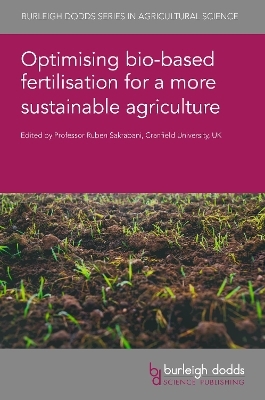
Optimising Bio-Based Fertilisation for a More Sustainable Agriculture
Burleigh Dodds Science Publishing Limited (Verlag)
9781835451861 (ISBN)
- Titel nicht im Sortiment
- Artikel merken
Optimising bio-based fertilisation for a more sustainable agriculture provides a comprehensive overview of the recent research undertaken in this area, focussing primarily on the role of differing types of soil amendments and their contribution to improvements in soil organic matter content, nutrient availability, crop growth and yields. The book also reviews recent advances in biostimulants, such as plant growth-promoting rhizobacteria, and considers optimising their use to promote crop health and nutrient use efficiency.
Dr Ruben Sakrabani is Professor of Soil Chemistry in the Centre for Soil, Agrifood and Biosciences at Cranfield University, UK. He has an international reputation particularly for his research on the nutrient dynamics, resource use efficiency and reliability of organic soil amendments such as compost, manure, slurry sludge, biochar and digestates. Professor Sakrabani is an Associate Editor of Soil Use and Management. He is also a member of the Advisory Board of the UK Natural Environment Research Council (NERC) responsible for research funding in environmental science.
Part 1 Advances in soil amendments
1.Optimising crop residues as soil amendments: Marcelo Galdos, Agreena, UK;
2.Optimising cover crops for soil health: Rob Myers, University of Missouri, USA;
3.The use of vermicompost and biochar as soil amendments: Parveen Rupani, Cranfield University, UK;
4.The potential of organo-mineral fertilisers: Ruben Sakrabani, Cranfield University, UK;
5.Optimising use of anaerobic digestate as a soil amendment: Christina van Midden, Agri Food & Biosciences Institute (AFBI), UK;
6.Optimising poultry litter for soil improvement: Xiuping Jiang, Clemson University, USA;
7.Optimising on-farm management and use of slurry to minimise its environmental impact: Lisa Norton, UK Centre for Ecology and Hydrology, UK;
8.Optimising use of frass as a soil amendment: David Houben, UniLaSalle, France;
Part 2 Advances in biostimulants
9.Optimising use of biostimulants: using plant growth-promoting rhizobacteria (PGPR) to promote crop nutrient use efficiency and other properties: S. Pereira, Universidade Catolica Portuguesa, Portugal;
10.Understanding and promoting existing communities of plant growth-promoting rhizobacteria (PGPR) in agricultural soils: Zakaria M. Solaiman, University of Western Australia, Australia;
11.Optimising functionality of phosphate-solubilising microorganisms (PSM) in promoting crop nutrient use efficiency and health: Nelly Raymond, University of Copenhagen, Denmark;
12.Understanding and optimising the role of cyanobacteria in promoting crop health and nutrient use efficiency: Nouriddine Bouaicha, University of Paris-Saclay, France;
13.Understanding and optimising the use of amino acid-based biostimulants in promoting crop nutrient use efficiency and health: Wenli Sun, Chinese Academy of Agricultural Sciences, China;
14.Understanding and optimising the use of inorganic salts as biostimulants in promoting crop nutrient use efficiency and health: John Havlin, North Carolina State University, USA;
15.Understanding and optimising the use of algae in promoting crop nutrient use efficiency and health: Domenico Ronga, University of Salerno, Italy;
| Erscheint lt. Verlag | 21.7.2026 |
|---|---|
| Reihe/Serie | Burleigh Dodds Series in Agricultural Science |
| Co-Autor | Dr Marcelo Galdos, Dr Rob Myers, Dr Parveen Rupani, Dr Christina van Midden |
| Zusatzinfo | Color tables, photos and figures |
| Verlagsort | Cambridge |
| Sprache | englisch |
| Maße | 152 x 229 mm |
| Themenwelt | Naturwissenschaften ► Geowissenschaften ► Geologie |
| Weitere Fachgebiete ► Land- / Forstwirtschaft / Fischerei | |
| ISBN-13 | 9781835451861 / 9781835451861 |
| Zustand | Neuware |
| Informationen gemäß Produktsicherheitsverordnung (GPSR) | |
| Haben Sie eine Frage zum Produkt? |
aus dem Bereich