Chemistry
WW Norton & Co
978-1-324-10490-2 (ISBN)
- Noch nicht erschienen (ca. Juli 2026)
- Versandkostenfrei
- Auch auf Rechnung
- Artikel merken
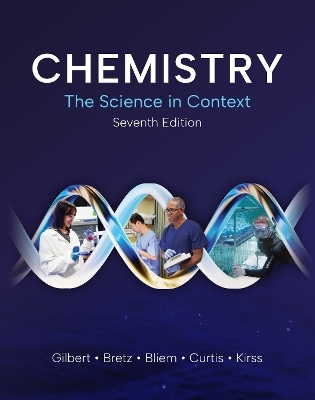
Gilbert et al.'s integrated learning system for general chemistry combines the COAST problem-solving approach, visuals supported by Stacey Lowery Bretz's chemistry education research, and contextual methods that help students envision using chemistry in their future careers. The Seventh Edition introduces new co-authors Carribeth Bliem and Anna Curtis, who bring guided inquiry assignments, new visualization tools, and additional career applications of chemistry. Smartwork leverages the text's visuals, terminology, and four-step COAST strategy for problem-solving practice. Instructors can use Smartwork Adaptive to automatically create personalized learning paths, making it the most flexible and user-friendly homework system available.
New to this edition:
Norton Illumine Ebook with NortonAI: The Norton Illumine Ebook keeps students engaged with assignable reading that includes integrated Check Your Understanding questions throughout each chapter. Paired with NortonAI—our powerful generative AI engine with strategic guardrails to support—but not replace!—the process of learning. Features like Smart Highlight rephrase complex ideas or provide helpful examples, and on-demand questions allow students to work through important concepts in a low-stakes practice environment.
Particulate-Level Visualizations: Added to every chapter opener, these visualizations help students understand the chemistry behind everyday objects and processes.
Stepwise Figures: Developed by our new co-author Carribeth Bliem, these dynamic figures are embedded in the ebook to break down complex graphs into annotated components for easier comprehension.
ChemTour: Guided Inquiry Assignments: Created by co-author Anna Curtis, these new Smartwork assignments offer a formative learning experience with rich feedback, ensuring students master new concepts before progressing.
New or Revised Sample Exercises focusing on authentic problem-solving: The authors have added or updated two new sample exercises to each chapter. These exercises demonstrate how chemistry is applied in various careers and help students connect chemical concepts to real-world applications.
Thomas R. Gilbert has a BS in chemistry from Clarkson and a PhD in analytical chemistry from MIT. After 10 years with the Research Department of the New England Aquarium in Boston, he joined the faculty of Northeastern University, where he is currently associate professor of chemistry and chemical biology. His research interests are in chemical and science education. He teaches general chemistry and science education courses and conducts professional development workshops for K–12 teachers. He has won Northeastern’s Excellence in Teaching Award and Outstanding Teacher of First-Year Engineering Students Award. He is a fellow of the American Chemical Society and in 2012 was elected to the ACS Board of Directors. Stacey Lowery Bretz is the Dean of the Getty College of Arts and Sciences at Ohio Northern University, where she holds the rank of professor in the Department of Chemistry and Biochemistry. For 28 years, she taught general chemistry to thousands of students. At Miami University, she held the rank of University Distinguished Professor and was honored with the Benjamin Harrison Medallion for “outstanding contribution to the education of the nation.” She has mentored 60+ post-docs and research students, with 25 of her former mentees teaching chemistry at colleges, universities, and high schools. Together, they have authored over 100 peer-reviewed articles and given over 500 keynotes, seminars, and conference presentations. Her research investigates students’ learning of chemistry, with expertise in developing assessments of students’ thinking in the laboratory and with multiple representations of molecules and compounds. Dr. Bretz is a Fellow of the American Chemical Society (ACS), is a Fellow of the American Association for the Advancement of Science, and was an American Council on Education Fellow in the Office of the Chancellor at the University of Illinois Urbana-Champaign. She served on the National Research Council Committee on Discipline-Based Education Research, and she chaired the Gordon Conference on Chemistry Education Research and Practice. Her colleagues honored her with the 2020 ACS Award for Achievement in Research on Teaching and Learning of Chemistry. Dr. Bretz served for three years in the Chair succession of the ACS Division of Chemical Education. She earned her BA in chemistry from Cornell University, her MS from the Pennsylvania State University, her Ph.D. in chemistry education research (CER) from Cornell University, and completed a post-doc at the University of California, Berkeley in the Department of Chemistry. Carribeth Bliem earned her BS in chemistry from the University of Utah and her MS in chemistry from the University of Colorado Boulder. She is a teaching associate professor at the University of North Carolina at Chapel Hill, where she brings evidence-based practices of high structure and active learning to the undergraduate classroom, both in general chemistry and physical chemistry. Her instructional goals are to provide opportunities for students to think critically about problems, work collaboratively to find solutions, and connect chemistry to daily life. When not in the classroom, she studies factors that support student learning in large-enrollment courses, including classroom design and the use of undergraduate learning assistants. Anna C. Curtis is a teaching assistant professor in the Department of Chemistry at the University of North Carolina at Chapel Hill. She earned her B.S. in chemistry from the University of North Carolina at Chapel Hill and her PhD in physical chemistry from the University of Colorado Boulder. She spent one year as a postdoctoral teaching fellow at Radford University before returning to the University of North Carolina at Chapel Hill to share her passion for chemistry with the next generation of students. Her graduate work focused on understanding electronic dynamics in semiconductor nanocrystals with applications in solar cell technology, as well as studying students’ ability to think scientifically in the general chemistry classroom. The current focus of her research lies in undergraduate chemistry course assessment and reform with a focus on the efficacy of active learning strategies within different learning spaces. As both a teacher and a researcher, she is committed to incorporating current research and best practices in chemical education into her teaching and assessing their impact on student learning. Her interest in chemical education is driven by her belief that, with a growth mindset and an effective learning environment, all students are capable of learning chemistry. Rein V. Kirss received both a BS in chemistry and a BA in history as well as an MA in chemistry from SUNY Buffalo. He received his PhD in inorganic chemistry from the University of Wisconsin, Madison, where the seeds for this textbook were undoubtedly planted. After two years of postdoctoral study at the University of Rochester, he spent a year at Advanced Technology Materials, Inc., before returning to academics at Northeastern University in 1989. He is an associate professor of chemistry with an active research interest in organometallic chemistry.
| Erscheint lt. Verlag | 1.7.2026 |
|---|---|
| Verlagsort | New York |
| Sprache | englisch |
| Themenwelt | Naturwissenschaften ► Chemie |
| ISBN-10 | 1-324-10490-2 / 1324104902 |
| ISBN-13 | 978-1-324-10490-2 / 9781324104902 |
| Zustand | Neuware |
| Informationen gemäß Produktsicherheitsverordnung (GPSR) | |
| Haben Sie eine Frage zum Produkt? |
aus dem Bereich