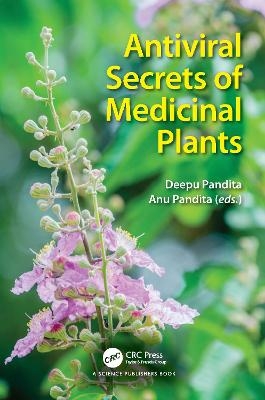
Antiviral Secrets of Medicinal Plants
CRC Press (Verlag)
978-1-032-56052-6 (ISBN)
Plant-based therapies are in tune with nature and have relatively little or no side effects. World Health Organisation (WHO) is a strong advocate of herbal inputs in modern systems of medicine. This book contains detailed descriptions of 23 medicinal plants with antiviral properties. The molecules from these plants are known to be effective against viruses. For instance, alkaloids like perivine, pericalline, periformyline, leurocristine, leurosivine, vincaleukoblastine, perividine, vindolinine, and carosine derived from Catharanthus roseus, are effective against viruses like herpes simplex virus type 1, vaccinia virus, poliovirus, and dengue virus type 2 (DENV-2). Large amounts of pentacyclic triterpenoid saponins, also referred as centelloids, are present in C. asiatica. Asiaticoside, centelloside, madecassoside, brahmoside, brahminoside, thankuniside, sceffoleoside, centellose, asiatic-, brahmic-, centellic-, and madecassic acids are some of the terpenoids of this group. Studies show the effectiveness of asiatic acid and their derivatives against the inhibition of human enterovirus 71 replication and anti-HSV-1 and 2 activity of Centella asiatica is because of the asiaticoside.
The book is intended for botanists, biotechnologists, healthcare professionals and general readers interested in enhancing their knowledge on natural plant-based sources of antiviral compounds.
Deepu Pandita is a Senior Lecturer in Government Department of School Education, Jammu, India. Deepu has accolades like Best Oral Presentation Award at International Conference on Biotechnology for Better Tomorrow, as well as Women Researcher Award and Research Excellence Award from professional associations. She serves as a reviewer and editor for several reputed international journals. Her publications include editorials, 55 book chapters, and 23 review and research articles and 8 edited books as the principal editor. Anu Pandita is a Senior Dietician at Vatsalya Clinic in Krishna Nagar, New Delhi, India, previously serving as a lecturer at Bee Enn College of Nursing in Talab Tillo, Jammu, India, and Dietician at Ahinsa Dham Bhagwan Mahavir Charitable Health Centre, New Delhi. Anu Pandita is a lifetime member of Indian Dietetic Association and Indian Science Congress Association, Kolkata. She has contributed significantly to academia, co-editing eight books, authoring various book chapters, research and review articles in reputed international journals.
1. Artemisia-Mother of Herbs: Unlocking the Antiviral Potential of Nature’s Arsenal 2. Antiviral Effects of Curcuma longa L. and its Phytochemical Constituents 3. Decoding the Antiviral Prowess of Tinospora cordifolia (Willd.) Hook. f. and Thomson 4. Acorus calamus L.: Bioactive Compounds act Pharmacologically as Antiviral Agents 5. Ethnopharmacological, Nutraceutical, and Therapeutic Potential of Citrullus colocynthis (L.) Schrad. 6. Antiviral Effects of Zingiber officinale Roscoe and its Phytochemical Constituents 7. An Investigation into the Antiviral Properties of Calendula officinalis L. 8. Unravelling the Diverse Antiviral Therapeutic Ootential of Camellia sinensis (L.) Kuntze 9. Bioactive Compounds of Ficus religiosa L. and its Antiviral Activity 10. Antiviral Potential of Tamarindus indica L.: Exploring Nature’s Shield 11. Cissampelos pareira L.: The Herb with Antiviral Potential 12. Secondary Metabolites of Catharanthus roseus (L.) G. Don and its Antiviral Properties 13. Centella asiatica (L.) Urban-Antiviral Properties 14. Unlocking the Antiviral Power of Piper longum L.:Nature’s Potential Against Viruses 15. Therapeutic Potential of Elephantopus scaber L. in Human Diseases and Viral Infections 16. Antiviral Bioactive Compounds of Terminalia chebula Ritz. (Myrobalan) and their Antiviral Mechanisms 17. How Potent is Natural Sugar Destroyer “Gymnema sylvestre R. Br. ex Sm.” Apropos of Antiviral Activity? 18. Exploring the Anti-Viral Potential of Medicinal Gem Hypericum perforatum L. 19. Ocimum spp. (Tulsi): The Queen of Herbs with Antiviral Potential 20. Antiviral Potential of Vitex negundo L. 21. Azadirachta indica A. Juss. with Antiviral Potential 22. Deciphering Promising Antiviral Effects of Medicinal Marvel Xanthoceras sorbifolium Bunge 23. Glycyrrhiza glabra L. (Liquorice): Unveiling Biological Marvels and Therapeutic Promise, and Emphasizing Antiviral Potency
| Erscheinungsdatum | 17.10.2025 |
|---|---|
| Zusatzinfo | 48 Tables, black and white; 5 Line drawings, color; 26 Line drawings, black and white; 19 Halftones, color; 24 Halftones, black and white; 24 Illustrations, color; 50 Illustrations, black and white |
| Verlagsort | London |
| Sprache | englisch |
| Maße | 156 x 234 mm |
| Gewicht | 1000 g |
| Themenwelt | Sachbuch/Ratgeber ► Gesundheit / Leben / Psychologie ► Alternative Heilverfahren |
| Medizin / Pharmazie ► Medizinische Fachgebiete ► Pharmakologie / Pharmakotherapie | |
| Medizin / Pharmazie ► Naturheilkunde ► Phytotherapie | |
| Naturwissenschaften ► Biologie ► Botanik | |
| ISBN-10 | 1-032-56052-5 / 1032560525 |
| ISBN-13 | 978-1-032-56052-6 / 9781032560526 |
| Zustand | Neuware |
| Informationen gemäß Produktsicherheitsverordnung (GPSR) | |
| Haben Sie eine Frage zum Produkt? |
aus dem Bereich