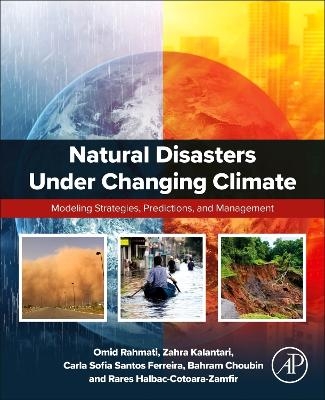
Natural Disasters Under Changing Climate
Academic Press Inc (Verlag)
978-0-443-33879-3 (ISBN)
- Noch nicht erschienen (ca. September 2026)
- Versandkostenfrei
- Auch auf Rechnung
- Artikel merken
Dr. Omid Rahmati is a geo-environmental researcher and Assistant Professor at the Agricultural Research, Education, and Extension Organization (AREEO) in Iran. His research focuses on applying machine learning models to natural hazard mitigation and watershed management. He has authored and co-authored over 70 articles in international peer-reviewed journals, as well as several books and book chapters. Dr. Rahmati’s publications have been cited more than 12,500 times (H-index: 56), and he has been recognized as a Highly Cited Researcher. He is ranked among the World’s Top 1% of Scientists by Web of Science (Clarivate, 2021–2022) and listed in Stanford University’s “World’s Top 2% Scientists from 2021 to 2025. His publications over the past decade reflect a broad and significant influence in his field. Zahra Kalantari has successfully led and carried out interdisciplinary research with focus on understanding of earth and human systems to develop science, technology and innovation solutions to planet’s most pressing environmental challenges associated with the combined effects of changes in climate, land-use and water-use in terrestrial environments. Carla Sofia Ferreira is at Polytechnic Institute of Coimbra, Portugal Bahram Choubin is an Assistant Professor at the West Azarbaijan Agricultural and Natural Resources Research and Education Center in Urmia, Iran. He has been working at this center since 2019. Before that, he was a Postdoctoral Researcher at the University of Tehran from 2018 to 2019. He has published more than 50 articles in JCR-indexed journals and is a scientific reviewer for more than 80 ISI journals. According to Elsevier's World Scientists Rankings, he is among the top 2% of scientists in the world. Choubin's primary research interests encompass hydrometeorology, natural hazard prediction, forecasting in ungauged basins (PUB), advanced machine learning techniques, and cutting-edge radar/remodeling applications in hazard assessment. As a prolific co-author of numerous peer-reviewed research articles and book chapters within these fields, Choubin has been recognized with several prestigious awards for his scientific contributions (e.g., from Iran's National Elites Foundation). Dr. Eng. Rares Halbac-Cotoara-Zamfir is Lecturer and PhD supervisor at Politehnica University of Timisoara, Faculty of Civil Engineering. He has a MSc in Environment Protection and a PhD in Civil Engineering (integrating also elements of environment and sustainable development). In 2016, Dr. Eng. Halbac-Cotoara-Zamfir Rares successfully defended his habilitation thesis “land reclamation and improvement works and sustainable land management in the context of climatic changes. He spent fifteen years in academia as PhD candidate, Assistant Professor and Lecturer with teaching and transnational project research responsibilities in civil engineering (land reclamation and improvement, sustainable land management, water resources management), sustainable development, environment protection natural hazards, climate change adaptation. Dr. Eng. Rares Halbac-Cotoara-Zamfir was and is currently involved in EEA, Horizon, COST and EUKI projects.
1. Natural Disasters Under Climate Change: Challenges and Issues of Modeling, Prediction and Management
2. Spatial Prediction of Flood Hazard Using Data-Mining Models
3. Landslide Susceptibility Modeling under climate change impact: The Role of Machine Learning for Prioritizing Landslide-Chapter
4. Analysis of Earthquake Effects Using DinSAR
5. Mitigation Strategies for Dust Storm with an Interdisciplinary Approach
6. Spatiotemporal Behavior of Landslides Reactivation Using Optic and Radar Satellite Images
7. Spatiotemporal Pattern of Desertification: The Impacts of Land Use and Climate Changes
8. Deep Learning-Based Flood Hazard Assessment
9. Radar-Based Remote Sensing for Land Subsidence Monitoring and Modeling
10. Wildfire Susceptibility Mapping Using Novel Optimized Hybrid Deep Learning Models
11. Vulnerability to Sea Level Rise in Coastal Coupled Social-Ecological Systems
12. Application of MODIS-based Reflectance Spectral Data for Drought Detection and Prediction
13. Snow Avalanche Prediction in Large-Scale Regions Using Deep-Learning and Metaheuristic Algorithms
14. Modeling of Debris Flow Susceptibility Using Artificial Intelligence Approach
15. Detecting Near-Real Time Flood Extent Using Radar-Based Satellite Images
16. Sand Dune Migration Disaster: Monitoring and Protections
17. Dust events and analysis of farmers' resilience measures
18. Heatwave: Mechanisms, Monitoring, and Predictions
| Erscheint lt. Verlag | 1.9.2026 |
|---|---|
| Verlagsort | San Diego |
| Sprache | englisch |
| Maße | 191 x 235 mm |
| Themenwelt | Naturwissenschaften ► Biologie ► Ökologie / Naturschutz |
| ISBN-10 | 0-443-33879-5 / 0443338795 |
| ISBN-13 | 978-0-443-33879-3 / 9780443338793 |
| Zustand | Neuware |
| Informationen gemäß Produktsicherheitsverordnung (GPSR) | |
| Haben Sie eine Frage zum Produkt? |
aus dem Bereich