


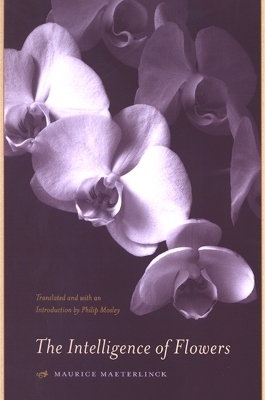
The Intelligence of Flowers
Seiten
2007
State University of New York Press (Verlag)
978-0-7914-7274-3 (ISBN)
State University of New York Press (Verlag)
978-0-7914-7274-3 (ISBN)
Features a translation of one of Maeterlinck's four nature essays.
A new translation of one of Maeterlinck's four great nature essays.
Winner of the 2008 Prix de la Traduction Littéraire presented by French Community of Belgium
The second of Maeterlinck's four celebrated nature essays-along with those on the life of the bee, ant, and termite-"The Intelligence of Flowers" (1907) represents his impassioned attempt to popularize scientific knowledge for an international audience. Writing with characteristic eloquence, Maeterlinck asserts that flowers possess the power of thought without knowledge, a capacity that constitutes a form of intelligence. Appearing one hundred years after the first publication, Philip Mosley's new translation of the original French essay, and the related essay "Scents," maintains the verve of Maeterlinck's prose and renders it accessible to the present-day reader. This is a book for those who are excited by creative encounters between literature and science as well as current debates on the relationship of humankind to the natural world.
A new translation of one of Maeterlinck's four great nature essays.
Winner of the 2008 Prix de la Traduction Littéraire presented by French Community of Belgium
The second of Maeterlinck's four celebrated nature essays-along with those on the life of the bee, ant, and termite-"The Intelligence of Flowers" (1907) represents his impassioned attempt to popularize scientific knowledge for an international audience. Writing with characteristic eloquence, Maeterlinck asserts that flowers possess the power of thought without knowledge, a capacity that constitutes a form of intelligence. Appearing one hundred years after the first publication, Philip Mosley's new translation of the original French essay, and the related essay "Scents," maintains the verve of Maeterlinck's prose and renders it accessible to the present-day reader. This is a book for those who are excited by creative encounters between literature and science as well as current debates on the relationship of humankind to the natural world.
The Belgian author Maurice Maeterlinck (1862–1949) is remembered best as a pioneer of Symbolist drama in the 1890s. Recipient of the Nobel Prize for Literature in 1911, Maeterlinck was also a prolific and accomplished essayist. Philip Mosley is Professor of English, Communications, and Comparative Literature at Penn State University.
Acknowledgments
Introduction
The Intelligence of Flowers
Scents
On the Publication History of Maeterlinck’s Botanical Essays
Select Bibliography
| Erscheint lt. Verlag | 29.11.2007 |
|---|---|
| Einführung | Philip Mosley |
| Übersetzer | Philip Mosley |
| Verlagsort | Albany, NY |
| Sprache | englisch |
| Maße | 127 x 203 mm |
| Gewicht | 113 g |
| Themenwelt | Naturwissenschaften ► Biologie ► Botanik |
| ISBN-10 | 0-7914-7274-4 / 0791472744 |
| ISBN-13 | 978-0-7914-7274-3 / 9780791472743 |
| Zustand | Neuware |
| Informationen gemäß Produktsicherheitsverordnung (GPSR) | |
| Haben Sie eine Frage zum Produkt? |
Mehr entdecken
aus dem Bereich


aus dem Bereich
ein Baum erzählt seine erstaunliche Geschichte
Buch | Hardcover (2024)
Ludwig (Verlag)
CHF 32,15
Gefäßpflanzen: Grundband
Buch | Hardcover (2021)
Springer Spektrum (Verlag)
CHF 62,95


