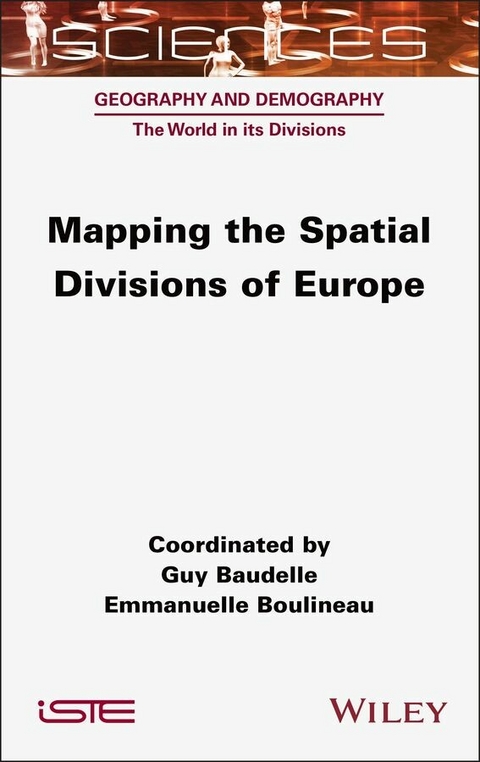
Mapping the Spatial Divisions of Europe (eBook)
425 Seiten
Wiley-Iste (Verlag)
978-1-394-39365-7 (ISBN)
Each of these divisions, a vector of identity and territoriality, reflects an intentionality, as revealed in Mapping the Spatial Divisions of Europe. The book shows the multiplicity of forms and modalities of these divisions and the actors who produce, use and question them in a globalized, and reticular world.
From the continent as a whole to the individual regions via metropolitan areas and their networks, from meshing to zoning, from regionalization to representations, this book explores how these divisions are used to govern, plan, imagine and build European territories beyond the heritage of states and their borders. The chapters shed new light on the theoretical and practical issues involved in carving Europe on different time and space scales.
Guy Baudelle is Professor Emeritus of Spatial Planning at the University of Rennes 2, France. He is also a member of the UMR CNRS ESO research unit and former Jean Monnet Chair (2003-2022). His work focuses on territorial development policies in the European Union and France.
Emmanuelle Boulineau is Professor of Geography at the École normale supérieure de Lyon, France, and a member of the CNRS EVS research unit. She specializes in the political geography of territorial reform in Europe, particularly in Central and Eastern Europe.
The European continent has given rise to the greatest number of spatial divisions. Its limits have provoked numerous debates, both within and outside of the continent. The European Union, for its part, has become a laboratory for the production of divisions. Each of these divisions, a vector of identity and territoriality, reflects an intentionality, as revealed in Mapping the Spatial Divisions of Europe. The book shows the multiplicity of forms and modalities of these divisions and the actors who produce, use and question them in a globalized, and reticular world. From the continent as a whole to the individual regions via metropolitan areas and their networks, from meshing to zoning, from regionalization to representations, this book explores how these divisions are used to govern, plan, imagine and build European territories beyond the heritage of states and their borders. The chapters shed new light on the theoretical and practical issues involved in carving Europe on different time and space scales.
Introduction
Guy BAUDELLE1 and Emmanuelle BOULINEAU2
1ESO, Rennes 2 University, France
2EVS, ENS Lyon, France
The divisions of space are a social, political and even economic production, which order and represent the world. These divisions do not simply split up space into sections; they have different functions, uses and representations, depending on the actors producing and using them. They thus respond to an intention by those who construct them. They take different forms depending on whether or not they are contiguous, hierarchical, interlocked and encompassing or a product of different practices, and whether their purpose is knowledge, political or economic administration, or even identity. In short, everything that relates to territoriality, the link between societies and space.
In this vast field, why should we devote a specific book to Europe and its divisions? Europe is firstly the continent on which the most well-known model for the political division of space was born and spread: the modern State. The question of frontiers and limits takes on a particular acuteness in this region, from the frontiers of national territories or the diversity of the administrative networks of the States that make it up. Europe also offers an entanglement of perimeters that the European Union (EU) or its Member States have constructed. In all cases, this profusion can be explained through social choices. Studying Europe through its divisions also makes it possible to illustrate the multiple aspects of the definitions of spatial divisions and show that there is no good or bad division, nor an ideal or optimal template. Finally, contemporary dynamics – globalization, regionalization, the era of daily flows, the proliferation of actors in space management, the democratic imperative of representation and the challenge of climate change – modify the reference points, modalities and functions of divisions. Europe perfectly illustrates the richness and stakes of divisions in a world of networks and interconnected territories.
This book provides a multiplicity of viewpoints on divisions in Europe and examines the question of scale, actors and temporalities in particular, without being weighed down by the issue of administrative divisions within States – their variants already being well documented in the literature (and even their frontiers) – as addressed in other works in this collection. Taking Europe as a reference point for observation, as a continent, as a union of States (EU) and as a region within globalization, this work shows the diversity of actors (producers, users, critics) who infuse these divisions with life in order to explain the dynamics of their production, reassessment and innovation. It is nevertheless worth returning to what a “division” actually is, and the extent to which Europe, through its divisions, can tell us about this act. More than providing a theoretical demonstration, this introduction is illustrative of the book’s intentions.
Understanding Europe through its divisions
Let us return to the preliminary definition: a division designates both an action and the result of this action. There are three main ways of dividing up space. We can distinguish an area and its boundaries through a double partition from other adjacent and distinct areas, in which case we are dealing with a network. The administrative network of European States is founded on the principles of the completeness of territorial coverage, contiguity and the non-inclusion of sections at the same level, the interlocking of sections at different levels and the hierarchy of functions operated by a superior level over an inferior level. We can also divide a perimeter that defines an inside and an outside. In this case, this is a zoning, meaning that the limits and criteria that distinguish a zone from its surroundings, without the principle of contiguity, are an important factor. For instance, low emission zones (LEZs) in European city centers delimits areas of regulated traffic based on the vehicles. Finally, in the third form, we can define a division of space based on the classification objectives or the organization of types of space defined by criteria, leading us on to discuss typology. Urban/rural typology is a mode of division that is frequently used in Europe. These three forms of division are especially present in Europe but are not used exclusively without the others: urban/rural typology can depend on zoning in urban areas and in rural zones, just as zoning can break up an administrative network as a unit or in parts.
These three forms do in fact result from two modalities of space division. Regionalization, on the one hand, is based on spatial groupings distinguished by their size and their spatial limits, and most of the time, by their non-coverage. Networks and zones are the principal forms. Classification, characteristic of typology, on the other hand, refers to criteria of similarity or difference that distinguish types of spaces. In both cases, the act of partitioning lends itself to mapping in order to be considered a division of space. There are, however, other, more or less significant spatial divisions: networks. Networks are spatialized – particularly when speaking of transportation networks for example – and these technical networks are increasingly influencing the way in which they are divided up in Europe. Other networks, such as city associations or large metropolitan areas, overcome distance and space to build links that sometimes counteract those created by administrative divisions. Without simply opposing network and space in a sterile fashion, the importance of networks in the reassessment of inherited European divisions is also addressed in this work.
Having made these distinctions, we can now ask who makes the divisions. Dividing space is never neutral: there is always intentionality. The question deserves to be separated into three lines of investigation, which guide the chapters in this book: the author of a division, the act of dividing in itself and the function of the division. The division of the world for the purpose of knowledge, in order to reduce its complexity, is one of the first acts of the modern period: the birth of Europe as a continent is thus the product of a division of knowledge1, just like today’s divisions of Europe into urban areas. Dividing space is also a response to the objectives of management, administration and even domination for the purpose of producing divisions of power. Taking the example of the European metropolis as an administrative center, most of them oversee a metropolitan region endowed with political abilities and economic functions. However, in the dynamics of divisions, we must also account for the feelings of appropriation and identification that are at the basis of the division of goods: what is it, for example, to be urban, today, in Europe, within the context of generalized mobility, keeping in mind that without appropriation, these divisions turn out to be empty shells, stripped of meaning?
Following the urban example, we can also see that divisions for the purposes of knowledge, power or possession are not mutually exclusive without coinciding. They come from the conceptions of distinct actors who create different spatial and social categories. The following chapters explore, in essence, a scientific investigation of these categories produced by the art of division. An emphasis is also placed on the power of spatial representations and their prospective dimension: to organize European space – as in the imagination they contain – or to imagine the future of European space. When it comes to Europe, there is a lot to be said for the spatial representations held by politicians, scientists and citizens. This is why we can speak of spatial visions when it comes to organizing the European territory, since they reveal the representations of the organizers more than anything about real, territorial divisions.
The multiple forms and modalities of division convey European diversity across time and space. Since any division is situated and occurs at a specific point in time, insofar as it reveals the intention of those who produce it, it is worth analyzing its dynamics over time and over territories. Thus, in Europe, limited, contiguous and hierarchical administrative divisions, representative of the hegemony of the modern State, are subject to regular reforms that abolish or recompose them. They coexist with more recent and unstable divisions such as the transnational or crossborder divisions constructed by the EU, which transcend the effects of interlocking and hierarchical administrative levels. As for the duration of the spatial divisions, this is increasingly called into question by the emergence of ad hoc divisions (zoning or typologies, for example) or indexed over a period of project programming such as the new perimeters of action seeking financial efficiency and political efficacity. The time when we took divisions of space as frameworks for reflection without calling them into question is therefore over. Europe is a laboratory for these divisions, and this book explores the multiple facets of this.
Current divisions in Europe
With a risk of drowning in a voluminous and daunting encyclopedia or a glossary of succinct and nevertheless frustrating entries, this book cannot deal with the thousand and one ways of dividing up Europe that have arisen from imaginations and territorial inventions. The choice was made to capture Europe and its divisions through the lens of current European dynamics. Europe...
| Erscheint lt. Verlag | 15.7.2025 |
|---|---|
| Reihe/Serie | ISTE Invoiced |
| Sprache | englisch |
| Themenwelt | Naturwissenschaften ► Geowissenschaften ► Geografie / Kartografie |
| Schlagworte | Europe • Globalization • mapping • meshing • Meshing • regionalization • Regionalization • spatial divisions • territoriality • Territoriality • zoning |
| ISBN-10 | 1-394-39365-2 / 1394393652 |
| ISBN-13 | 978-1-394-39365-7 / 9781394393657 |
| Informationen gemäß Produktsicherheitsverordnung (GPSR) | |
| Haben Sie eine Frage zum Produkt? |
 EPUB (Adobe DRM)
Kopierschutz: Adobe-DRM
Adobe-DRM ist ein Kopierschutz, der das eBook vor Mißbrauch schützen soll. Dabei wird das eBook bereits beim Download auf Ihre persönliche Adobe-ID autorisiert. Lesen können Sie das eBook dann nur auf den Geräten, welche ebenfalls auf Ihre Adobe-ID registriert sind.
Details zum Adobe-DRM
Dateiformat: EPUB (Electronic Publication)
EPUB ist ein offener Standard für eBooks und eignet sich besonders zur Darstellung von Belletristik und Sachbüchern. Der Fließtext wird dynamisch an die Display- und Schriftgröße angepasst. Auch für mobile Lesegeräte ist EPUB daher gut geeignet.
Systemvoraussetzungen:
PC/Mac: Mit einem PC oder Mac können Sie dieses eBook lesen. Sie benötigen eine
eReader: Dieses eBook kann mit (fast) allen eBook-Readern gelesen werden. Mit dem amazon-Kindle ist es aber nicht kompatibel.
Smartphone/Tablet: Egal ob Apple oder Android, dieses eBook können Sie lesen. Sie benötigen eine
Geräteliste und zusätzliche Hinweise
Buying eBooks from abroad
For tax law reasons we can sell eBooks just within Germany and Switzerland. Regrettably we cannot fulfill eBook-orders from other countries.
aus dem Bereich