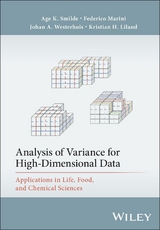
Analysis of Variance for High-Dimensional Data (eBook)
339 Seiten
Wiley (Verlag)
978-1-394-21122-7 (ISBN)
Overview of methods for analyzing high-dimensional experimental data, including theory, methodologies, and applications
Analysis of Variance for High-Dimensional Data summarizes all the methods to analyze high-dimensional data that are obtained through applying an experimental design in the life, food, and chemical sciences, especially those developed in recent years.
Written by international experts who lead development in the field, Analysis of Variance for High-Dimensional Data includes information on:
- Basic and established theories on linear models from a mathematical and statistical perspective
- Available methods and their mutual relationships, including coverage of ASCA, APCA, PC-ANOVA, ASCA+, LiMM-PCA and RM-ASCA+, and PERMANOVA, as well as various alternative methods and extensions
- Applications in metabolomics, microbiome, gene expression, proteomics, food science, sensory science, and chemistry
- Commercially available and open-source software for application of these methods
Analysis of Variance for High-Dimensional Data is an essential reference for practitioners involved in data analysis in the natural sciences, including professionals working in chemometrics, bioinformatics, data science, statistics, and machine learning. The book is valuable for developers of new methods in high dimensional data analysis.
Age K. Smilde is Emeritus-Professor of Biosystems Data Analysis at the Swammerdam Institute for Life Sciences at the University of Amsterdam. He also holds a part-time position at the Department of Plant and Environmental Sciences at the University of Copenhagen.
Federico Marini is Professor of Analytical Chemistry at the Department of Chemistry of the University of Rome 'La Sapienza'.
Johan A. Westerhuis is Assistant Professor at the Swammerdam Institute for Life Sciences, University of Amsterdam, The Netherlands.
Kristian H. Liland is Professor of Statistics at the Faculty of Science and Technology, Norwegian University of Life Sciences, Norway.
Overview of methods for analyzing high-dimensional experimental data, including theory, methodologies, and applications Analysis of Variance for High-Dimensional Data summarizes all the methods to analyze high-dimensional data that are obtained through applying an experimental design in the life, food, and chemical sciences, especially those developed in recent years. Written by international experts who lead development in the field, Analysis of Variance for High-Dimensional Data includes information on: Basic and established theories on linear models from a mathematical and statistical perspectiveAvailable methods and their mutual relationships, including coverage of ASCA, APCA, PC-ANOVA, ASCA+, LiMM-PCA and RM-ASCA+, and PERMANOVA, as well as various alternative methods and extensionsApplications in metabolomics, microbiome, gene expression, proteomics, food science, sensory science, and chemistryCommercially available and open-source software for application of these methods Analysis of Variance for High-Dimensional Data is an essential reference for practitioners involved in data analysis in the natural sciences, including professionals working in chemometrics, bioinformatics, data science, statistics, and machine learning. The book is valuable for developers of new methods in high dimensional data analysis.
| Erscheint lt. Verlag | 15.7.2025 |
|---|---|
| Sprache | englisch |
| Themenwelt | Naturwissenschaften ► Chemie |
| Schlagworte | apca • ASCA • ASCA+ • Chemistry • data experimental design • data methods • food science • gene expression • high dimensional data software • LiMM-PCA • Metabolomics • microbiome • PC-ANOVA • PERMANOVA • Proteomics • RM-ASCA+ • Sensory Science |
| ISBN-10 | 1-394-21122-8 / 1394211228 |
| ISBN-13 | 978-1-394-21122-7 / 9781394211227 |
| Informationen gemäß Produktsicherheitsverordnung (GPSR) | |
| Haben Sie eine Frage zum Produkt? |
 PDF (Adobe DRM)
Kopierschutz: Adobe-DRM
Adobe-DRM ist ein Kopierschutz, der das eBook vor Mißbrauch schützen soll. Dabei wird das eBook bereits beim Download auf Ihre persönliche Adobe-ID autorisiert. Lesen können Sie das eBook dann nur auf den Geräten, welche ebenfalls auf Ihre Adobe-ID registriert sind.
Details zum Adobe-DRM
Dateiformat: PDF (Portable Document Format)
Mit einem festen Seitenlayout eignet sich die PDF besonders für Fachbücher mit Spalten, Tabellen und Abbildungen. Eine PDF kann auf fast allen Geräten angezeigt werden, ist aber für kleine Displays (Smartphone, eReader) nur eingeschränkt geeignet.
Systemvoraussetzungen:
PC/Mac: Mit einem PC oder Mac können Sie dieses eBook lesen. Sie benötigen eine
eReader: Dieses eBook kann mit (fast) allen eBook-Readern gelesen werden. Mit dem amazon-Kindle ist es aber nicht kompatibel.
Smartphone/Tablet: Egal ob Apple oder Android, dieses eBook können Sie lesen. Sie benötigen eine
Geräteliste und zusätzliche Hinweise
Buying eBooks from abroad
For tax law reasons we can sell eBooks just within Germany and Switzerland. Regrettably we cannot fulfill eBook-orders from other countries.
aus dem Bereich