


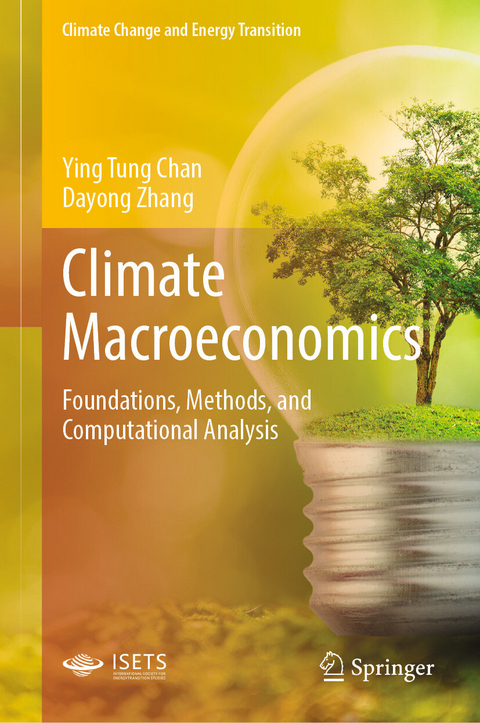
Climate Macroeconomics (eBook)
362 Seiten
Springer Nature Singapore (Verlag)
978-981-96-7967-6 (ISBN)
This book provides a unique bridge between theoretical foundations and practical implementation of environmental economics modeling. Through a progressive approach, it guides readers from basic analytical frameworks to advanced computational techniques for analyzing climate change policies.
Starting with intuitive partial equilibrium models, the book systematically builds understanding of three major modeling frameworks: Environmental Dynamic Stochastic General Equilibrium (E-DSGE), Dynamic Integrated Climate-Economy (DICE), and Computable General Equilibrium (CGE) models. Each framework is thoroughly explained with detailed MATLAB implementations, making complex concepts accessible and practical.
The book's distinctive two-part structure serves multiple audiences: Part I develops fundamental concepts through analytically solvable models ideal for advanced undergraduates, while Part II explores sophisticated modeling approaches suitable for graduate students and researchers. Throughout, readers benefit from:
- Comprehensive coverage of carbon taxation, cap-and-trade systems, and other environmental policy instruments
- Detailed MATLAB code for implementing theoretical concepts
- Clear connections between different modeling approaches for policy analysis
Whether you're an economics student learning environmental modeling, a policy analyst working on climate regulations, or a researcher comparing modeling frameworks, this book provides the tools to engage with modern environmental economic analysis.
This book provides a unique bridge between theoretical foundations and practical implementation of environmental economics modeling. Through a progressive approach, it guides readers from basic analytical frameworks to advanced computational techniques for analyzing climate change policies.Starting with intuitive partial equilibrium models, the book systematically builds understanding of three major modeling frameworks: Environmental Dynamic Stochastic General Equilibrium (E-DSGE), Dynamic Integrated Climate-Economy (DICE), and Computable General Equilibrium (CGE) models. Each framework is thoroughly explained with detailed MATLAB implementations, making complex concepts accessible and practical.The book's distinctive two-part structure serves multiple audiences: Part I develops fundamental concepts through analytically solvable models ideal for advanced undergraduates, while Part II explores sophisticated modeling approaches suitable for graduate students and researchers. Throughout, readers benefit from:Comprehensive coverage of carbon taxation, cap-and-trade systems, and other environmental policy instrumentsDetailed MATLAB code for implementing theoretical conceptsClear connections between different modeling approaches for policy analysisWhether you're an economics student learning environmental modeling, a policy analyst working on climate regulations, or a researcher comparing modeling frameworks, this book provides the tools to engage with modern environmental economic analysis.
| Erscheint lt. Verlag | 14.7.2025 |
|---|---|
| Reihe/Serie | Climate Change and Energy Transition |
| Zusatzinfo | XV, 362 p. 36 illus. |
| Sprache | englisch |
| Themenwelt | Naturwissenschaften ► Geowissenschaften ► Meteorologie / Klimatologie |
| Technik ► Elektrotechnik / Energietechnik | |
| Wirtschaft ► Volkswirtschaftslehre ► Makroökonomie | |
| Schlagworte | Climate Change Economics • Computational Economics • DICE model • Dynamic climate policy optimization • Environmental CGE model • Environmental DSGE model • Environmental policy simulation • Integrated assessment models • Macroeconomic climate policy • MATLAB |
| ISBN-10 | 981-96-7967-2 / 9819679672 |
| ISBN-13 | 978-981-96-7967-6 / 9789819679676 |
| Informationen gemäß Produktsicherheitsverordnung (GPSR) | |
| Haben Sie eine Frage zum Produkt? |
 PDF (Wasserzeichen)
Größe: 7,3 MB
DRM: Digitales Wasserzeichen
Dieses eBook enthält ein digitales Wasserzeichen und ist damit für Sie personalisiert. Bei einer missbräuchlichen Weitergabe des eBooks an Dritte ist eine Rückverfolgung an die Quelle möglich.
Dateiformat: PDF (Portable Document Format)
Mit einem festen Seitenlayout eignet sich die PDF besonders für Fachbücher mit Spalten, Tabellen und Abbildungen. Eine PDF kann auf fast allen Geräten angezeigt werden, ist aber für kleine Displays (Smartphone, eReader) nur eingeschränkt geeignet.
Systemvoraussetzungen:
PC/Mac: Mit einem PC oder Mac können Sie dieses eBook lesen. Sie benötigen dafür einen PDF-Viewer - z.B. den Adobe Reader oder Adobe Digital Editions.
eReader: Dieses eBook kann mit (fast) allen eBook-Readern gelesen werden. Mit dem amazon-Kindle ist es aber nicht kompatibel.
Smartphone/Tablet: Egal ob Apple oder Android, dieses eBook können Sie lesen. Sie benötigen dafür einen PDF-Viewer - z.B. die kostenlose Adobe Digital Editions-App.
Buying eBooks from abroad
For tax law reasons we can sell eBooks just within Germany and Switzerland. Regrettably we cannot fulfill eBook-orders from other countries.
aus dem Bereich


