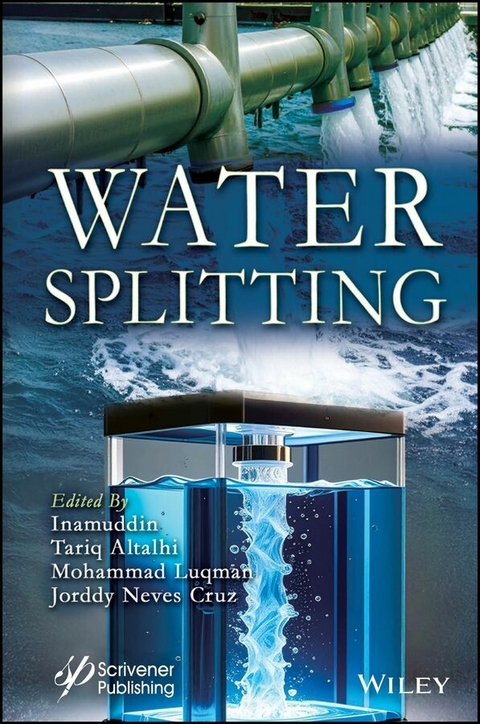
Water Splitting (eBook)
498 Seiten
Wiley-Scrivener (Verlag)
978-1-394-24763-9 (ISBN)
Water Splitting is essential for anyone looking to stay at the cutting edge of hydrogen production and renewable energy, as it provides a thorough exploration of the latest advancements and interdisciplinary approaches to addressing global energy challenges.
Water splitting for the production of hydrogen is a rapidly evolving field at the forefront of interdisciplinary research and industrial development. It encompasses the integration of multiple scientific disciplines, including chemistry, physics, materials science, engineering, and environmental science, to address the global energy challenge and transition towards a sustainable future. The integration of water splitting with other renewable energy sources, such as solar and wind, presents opportunities for the development of integrated systems and the establishment of a hydrogen economy. The ability to store and utilize hydrogen as a versatile energy carrier has the potential to revolutionize transportation, power generation, and industrial applications, enabling a transition away from fossil fuels and reducing carbon emissions.
Water Splitting provides a comprehensive exploration of water splitting, starting with the foundational principles of thermodynamics and kinetics, crucial for understanding hydrogen production. It covers diverse methods and catalysts, emphasizing material selection and reaction optimization, and explores recent innovations in materials and catalysts tailored for water splitting, highlighting synthesis techniques, functional materials, and nanotechnology integration. A significant portion of the book is dedicated to water photoelectrochemistry, analyzing semiconductor materials, photoelectrode design, and solar-to-hydrogen conversion strategies. The book delves into integrated systems, advanced reactors, and the role of artificial intelligence, machine learning, and big data in enhancing water splitting technologies. Water Splitting addresses gaps in current resources, focusing on cutting-edge advancements and ensuring researchers stay informed and prepared to contribute to the field's progress.
Inamuddin, PhD, is an assistant professor at the Department of Applied Chemistry, Zakir Husain College of Engineering and Technology, Faculty of Engineering and Technology, Aligarh Muslim University, Aligarh, India. He has extensive research experience in multidisciplinary fields of analytical chemistry, materials chemistry, electrochemistry, renewable energy, and environmental science. He has worked on different research projects funded by various government agencies and universities and is the recipient of awards, including the Department of Science and Technology, India, Fast-Track Young Scientist Award and Young Researcher of the Year Award 2020 from Aligarh Muslim University. He has published about 210 research articles in various international scientific journals, many book chapters, and dozens of edited books, many with Wiley-Scrivener.
Tariq Altalhi, PhD, is an associate professor in the Department of Chemistry at Taif University, Saudi Arabia. He received his doctorate degree from University of Adelaide, Australia in the year 2014 with Dean's Commendation for Doctoral Thesis Excellence. He has worked as head of the Chemistry Department at Taif university and Vice Dean of Science College. In 2015, one of his works was nominated for Green Tech awards from Germany, Europe's largest environmental and business prize, amongst top 10 entries. He has also co-edited a number of scientific books.
Mohammad Luqman, PhD, has more than 12 years of post-PhD experience in teaching, research, and administration. Currently, he is serving as an assistant professor of Chemical Engineering at Taibah University, Saudi Arabia. Moreover, he served as a post-doctoral fellow at Artificial Muscle Research Center, Konkuk University, South Korea, and he earned his PhD degree in the field of ionomers (Ion-containing Polymers), from Chosun University, South Korea. He has edited three books and published numerous scientific papers and book chapters. He is an editor for several journals, and he has been awarded several grants for academic research.
Jorddy Neves Cruz is a researcher at the Federal University of Pará and the Emilio Goeldi Museum. He has experience in multidisciplinary research in the areas of medicinal chemistry, drug design, extraction of bioactive compounds, extraction of essential oils, food chemistry and biological testing. He has published several research articles in scientific journals and is an associate editor of the Journal of Medicine.
Water Splitting is essential for anyone looking to stay at the cutting edge of hydrogen production and renewable energy, as it provides a thorough exploration of the latest advancements and interdisciplinary approaches to addressing global energy challenges. Water splitting for the production of hydrogen is a rapidly evolving field at the forefront of interdisciplinary research and industrial development. It encompasses the integration of multiple scientific disciplines, including chemistry, physics, materials science, engineering, and environmental science, to address the global energy challenge and transition towards a sustainable future. The integration of water splitting with other renewable energy sources, such as solar and wind, presents opportunities for the development of integrated systems and the establishment of a hydrogen economy. The ability to store and utilize hydrogen as a versatile energy carrier has the potential to revolutionize transportation, power generation, and industrial applications, enabling a transition away from fossil fuels and reducing carbon emissions. Water Splitting provides a comprehensive exploration of water splitting, starting with the foundational principles of thermodynamics and kinetics, crucial for understanding hydrogen production. It covers diverse methods and catalysts, emphasizing material selection and reaction optimization, and explores recent innovations in materials and catalysts tailored for water splitting, highlighting synthesis techniques, functional materials, and nanotechnology integration. A significant portion of the book is dedicated to water photoelectrochemistry, analyzing semiconductor materials, photoelectrode design, and solar-to-hydrogen conversion strategies. The book delves into integrated systems, advanced reactors, and the role of artificial intelligence, machine learning, and big data in enhancing water splitting technologies. Water Splitting addresses gaps in current resources, focusing on cutting-edge advancements and ensuring researchers stay informed and prepared to contribute to the field s progress.
1
Thermodynamics of Electrochemical Water Splitting
Manash P. Nath1,2, Manju Kumari Jaiswal1,2, Suvankar Deka1,2 and Biswajit Choudhury1,2*
1Materials and Energy Laboratory, Physical Sciences Division, Institute of Advanced Study in Science and Technology (IASST), Assam, India
2Academy of Scientific and Innovative Research (AcSIR), Ghaziabad, India
Abstract
The thermodynamics of water splitting elucidates the intricate balance of energy transformations fundamental to this crucial reaction, including photocatalytic and electrocatalytic water splitting. Electrocatalytic water splitting—triggered by the application of an external voltage—holds great potential for creating sustainable energy-producing hydrogen gas (cathode) and oxygen (anode). It requires overcoming the thermodynamic barriers, such as enthalpy change (ΔH) and Gibbs free energy change (ΔG), associated with the bond dissociation energies of water molecules and the formation of intermediates. Gibbs free energy barrier (ΔG) must be negative to proceed with the water splitting reaction spontaneously. At this hour, electrocatalysts play a pivotal role in decreasing the activation energy barrier enhancing the water splitting kinetics, and increasing the overall efficiency. Noble metal-based electrocatalysts such as platinum (Pt), ruthenium (Ru), and iridium (Ir) have been employed for their high catalytic activity with an extremely low free energy barrier. However, their expensiveness and scarcity have instigated researchers to search for low-cost earth-abundant electrocatalysts such as transition metal oxides, sulfides, phosphides, and high entropy alloys, among others. Therefore, the study provides an in-depth and comprehensive understanding of various thermodynamic parameters associated with the electrocatalytic water splitting process.
Keywords: Electrochemical, gibbs free energy, noble metal, layered materials
1.1 Introduction
The worldwide energy crisis and the related ecological problems have spurred scientists to seek the replacement of fossil fuels with renewable energy sources [1, 2]. Natural resources, such as energy generated by the sun or wind and water splitting technologies, offer an enticing means of producing hydrogen sustainably [3]. Water splitting involves the breaking down of water molecules into H2 and O2 under the effect of an external energy source such as a high temperature, light, or the application of an electric field [4]. From an environmental perspective, three approaches are mostly adopted for water splitting. These approaches are (a) photocatalytic, (b) electrocatalytic, and (c) photoelectrocatalytic. Photocatalytic water splitting requires a semiconductor with a high absorption cross section for incident solar photons to excite photocarriers and generate free electrons and holes [5]. For overall splitting, a semiconductor’s conduction and valence band edge potential must be suitable enough to carry out the oxidation/reduction of water. In the ideal case, the band gap must exceed the minimum water splitting potential of 1.23 V [6]. Electrocatalytic water splitting involves H2 generation (hydrogen evolution reaction or HER) and O2 generation (oxygen evolution reaction or OER). The first electrolytic cell was proposed in 1789, and it comprises three parts: cathode, anode, and electrolyte [7]. Two moles of hydrogen and oxygen are produced from the splitting of 1 mol of water. It is an endothermic, non-spontaneous process with a standard Gibbs free energy change (ΔG = +237.3 kJ/mol) [8]. Photoelectrocatalytic water splitting (PEC) is an electrocatalytic water splitting process with additional energy provided by light [9]. For photoelectrode materials to be commercially viable, they must have an STH, i.e., solar-to-hydrogen conversion efficiency of above 10% in addition to being sufficiently abundant on Earth and stable in water [10]. In 1972, Honda and Fujisima demonstrated the first PEC with TiO2 photoanode [11].
The efficacy and feasibility of catalytic water splitting are enthalpy, entropy, and Gibbs free energy. Since the water splitting process is endothermic or uphill, its high ΔG of +237 kJ/mol is overcome by providing electrical energy equivalent to 1.23 V and increasing the temperature to accelerate the reaction [12]. To achieve it, the entire enthalpy requirement of ΔH = −283.85 kJ/mol comes from the environment at temperature T as temperature T is necessary to achieve the required work TΔS, which is important for the electrolysis of water [13]. The first law of thermodynamics, “the law of energy conservation,” describes how external energy (light, electricity, or heat) must be added to disintegrate the chemical bonds that bind water molecules, thereby converting them into H2 and O2 [14]. On the other hand, the second law of thermodynamics describes that the water splitting process is not 100% efficient with a positive entropy. A temperature equivalent to (T) >4,500 K can be used to split water, which is a maladroit process. Gibbs free energy change (ΔG), which describes the spontaneity of a water splitting reaction, becomes negative at T >4,500 K or E (V) >1.23 V, which indicates a favorable water splitting process [15]. Several attempts have been made to eliminate the internal energy losses that arise from overpotential and cell resistances to minimize the energy requirements of an electrolytic cell [16]. They include controlling the electrolyte’s temperature, pressure, and chemical potential [16]. Thus, all three thermodynamic parameters, H, S, and G, are dependent on temperature (T) and pressure (P) and will describe the feasibility of an electrochemical water splitting system. In the case of HER, i.e., hydrogen evolution reaction, the change in the thermodynamic parameters (ΔH, ΔS, and ΔG) depends on the electrolytic conditions, i.e., acidic or alkaline. The abundance of protons (H+), in the case of acidic electrolytes, makes the Volmer step rate determining [17]. In alkaline conditions, H2O adsorption and dissociation occur before the Volmer step (adsorption of H). This is similar to OER, where the chemical environment (i.e., acidic or alkaline) determines the oxidation of water [18].
1.2 Thermodynamic Parameters
1.2.1 Enthalpy (H)
It is the system’s overall heat content. Thus, the change in the enthalpy (ΔH) of a system consists of two parts, which are the requirements of thermal energy (ΔQ) and useful work done (ΔW). The overall equation can be written as follows:
A positive change in enthalpy describes an endothermic reaction, whereas a negative change describes an exothermic reaction.
1.2.2 Entropy (S)
The entropy, a state function, measures the reaction system’s overall degree of disorder or unpredictability. The relationship provides the shift in entropy (S).
A more considerable change in entropy with input energy indicates that the system is away from the thermodynamic equilibrium, i.e., it is highly disordered, i.e., chaotic or spontaneous. It is directly dependent upon temperature. In the case of water splitting, H2O (liquid) is broken down into gas H2 and O2, which increase the entropy of the system.
1.2.3 Gibbs Free Energy
Gibbs free energy describes the thermodynamic potential to determine the maximum work performed by a closed system in isothermal and isobaric conditions. Gibbs free energy change (ΔG) is the maximum amount of work that can be obtained from a closed system that can exchange heat and interact with its surroundings, i.e.,
Therefore, upon switching Equations 1.2 and 1.3 in Equation 1.1, we obtain the following:
The ΔGο of water splitting is obtained under the standard temperature “T” = 398 K, pressure “P” = 1 bar, and concentration = 1 M. If ΔG is negative under these standard conditions, the water splitting process is both spontaneous and thermodynamically favorable. The equilibrium constant “K” of the system is relatable to the Gibbs free energy change (ΔG) by the following:
If ΔG decreases, the equilibrium constant “K” of the chemical reaction increases. If ΔG < 0, the spontaneity of the chemical reaction increases.
1.3 Thermodynamics of Water Splitting
Water dissociation, which comprises liquid water and water vapor, decomposes into its elemental compositions (H2 and O2) according to the following:
Table 1.1 The thermodynamic parameters of liquid and gaseous H2O.
| Parameters | Liquid (H2O) | Vapor (H2O) |
|---|
| ΔHH2O ο kJ mol−1 | +285.840 | +241.80 |
| ΔSH2O ο J mol−1 K−1 | +163.15 | +44.10 |
| ΔGH2O ο kJ mol−1 | +237.22 | +228.66 |
Under the standard conditions of temperature (Tο = 298 K) and pressure (Pο = 1 bar) for water, the thermodynamic parameters of enthalpy (ΔHH2O ο), entropy (ΔSH2O ο), and Gibbs free energy...
| Erscheint lt. Verlag | 8.7.2025 |
|---|---|
| Sprache | englisch |
| Themenwelt | Naturwissenschaften ► Chemie |
| Schlagworte | Advanced Electrolyzers • Catalysts for Water Splitting • Clean Energy • electrolysis • energy conversion • Hydrogen Production • interdisciplinary research • Kinetics of Water Splitting • Materials for Water Splitting • Photoelectrochemical Water Splitting • Renewable Hydrogen • Solar-to-Hydrogen Conversion • Sustainable energy • Thermodynamics of Water Splitting • Water splitting |
| ISBN-10 | 1-394-24763-X / 139424763X |
| ISBN-13 | 978-1-394-24763-9 / 9781394247639 |
| Informationen gemäß Produktsicherheitsverordnung (GPSR) | |
| Haben Sie eine Frage zum Produkt? |
 EPUB (Adobe DRM)
Kopierschutz: Adobe-DRM
Adobe-DRM ist ein Kopierschutz, der das eBook vor Mißbrauch schützen soll. Dabei wird das eBook bereits beim Download auf Ihre persönliche Adobe-ID autorisiert. Lesen können Sie das eBook dann nur auf den Geräten, welche ebenfalls auf Ihre Adobe-ID registriert sind.
Details zum Adobe-DRM
Dateiformat: EPUB (Electronic Publication)
EPUB ist ein offener Standard für eBooks und eignet sich besonders zur Darstellung von Belletristik und Sachbüchern. Der Fließtext wird dynamisch an die Display- und Schriftgröße angepasst. Auch für mobile Lesegeräte ist EPUB daher gut geeignet.
Systemvoraussetzungen:
PC/Mac: Mit einem PC oder Mac können Sie dieses eBook lesen. Sie benötigen eine
eReader: Dieses eBook kann mit (fast) allen eBook-Readern gelesen werden. Mit dem amazon-Kindle ist es aber nicht kompatibel.
Smartphone/Tablet: Egal ob Apple oder Android, dieses eBook können Sie lesen. Sie benötigen eine
Geräteliste und zusätzliche Hinweise
Buying eBooks from abroad
For tax law reasons we can sell eBooks just within Germany and Switzerland. Regrettably we cannot fulfill eBook-orders from other countries.
aus dem Bereich