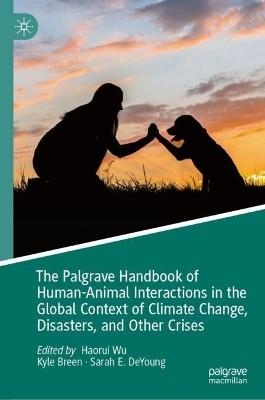
The Palgrave Handbook of Human-Animal Interactions in the Global Context of Climate Change, Disasters, and Other Crises
Springer International Publishing (Verlag)
978-3-032-00312-6 (ISBN)
The increasing frequency, scope, and magnitude of global extreme events affect humans and their animal co-inhabitants on our shared planet. This book features a first-of-its-kind, comprehensive text addressing human-animal interactions (HAIs) in the context of climate change, disasters, and other crises. This book presents international professionals HAI-driven leading ideas, debates, approaches, and promising efforts, providing a range of perspectives across the entire disaster cycle from the Global South and North. Their knowledge, experience, and expertise contribute to a nuanced understanding of disaster-specific HAIs, shedding light on enhancing human-animal welfare, promoting trans-species justice, and building resilience. Students, researchers, educators, practitioners, policymakers, and others can apply this expertise to enhance human-animal welfare and resilience in the global disaster settings.
Chapter "Working Equids in Disasters: Local Concerns and Inspirations" is available open access under a
Creative Commons Attribution 4.0 International License via link.springer.com.
Haorui Wu is the Canada Research Chair in Resilience and an associate professor in the School of Social Work, the Faculty of Health at Dalhousie University, Canada. His community-based interdisciplinary efforts have nuancedly contributed to disaster-driven human and non-human settlement development through the lens of environmental, social, and health justice.
Kyle Breen is an assistant professor of sociology at Texas A&M International University, in Laredo, TX, USA. His research focuses on educational impacts post-disaster, disaster impacts to historically marginalized populations, and disaster volunteerism. Regarding animals in disasters, he has previously researched animal-related information dissemination following the 2023 Nova Scotia wildfires.
Sarah E. DeYoung is a core faculty member in the Disaster Research Center, University of Delaware, USA, and a faculty member in the Department of Sociology & Criminal Justice. Her expertise is within the areas of vulnerable populations in disasters, evacuation decision-making, and public health in disasters.
1. Introduction: Human-Animal-Environment Nexus Associated with Extreme Events.- 2. Conceptualizing Human-Animal Interactions in the Global Context of Climate Change, Disaster, and Other Crises.- Part I Mitigation.- 3. Human-Wildlife Conflict in Mozambique, South Africa, and Zimbabwe: More Than Just a Conservation Concern.- 4. Working Equids in Disasters: Local Concerns and Inspirations.- 5. The Working Dog: A Canine Multi-tool that Assists in Rescue, Disease, and Conservation Initiatives.- 6. Human-Cow Encounters Under Climate Change in Nigeria: The Entanglements of Violence, Politics, and Environment Contestation.- 7. Human-Animal Interactions in Disaster Management: Insights from Pakistan and the Global South.- Part II Preparedness.- 8. A One Health View of Zoonotic Disease Dynamics Through Animal and Vector Movement Due to Climate Change.- 9. Disaster Preparedness and Response for Companion Animals in Japan.- 10. Assessing the Vulnerability of Agricultural Operations.- 11. Exploring the Human-Animal Bond and Climate Risk: A Path Forward?.- Part III Emergency Response.- 12. Experiences of People with (dis)Abilities Living with Companion Animals During the Public Health Emergency of COVID-19: A Comparative Case Study of Xi an, China, and Vancouver, Canada.- 13. The Rise of Animal Emergency Management in Australia.- 14. Guidance for Canada s Wildfire Emergency Response Efforts: Learning from Volunteer Therapy Dog Program Support During Saskatchewan Crises.- 15. Building Risk Communication Capacity for Veterinary Professionals: Insights from Teaching Strategies and Veterinary Practitioners.-
16. Policies and Considerations of Human-Animal Cohabitating and Co-locating in Emergencies: How Colorado Policy Prioritizing the Human-Animal Relationship Is Changing the Conversation of Emergency Planning in Colorado.- Part IV Reconstruction and Recovery.- 17. Social Constructions of Memorialization of Animals in Disasters.- 18. Organizing Ecologies of (Human) Abandonment on Portuguese Wildfires.- 19. A Critical Analysis of Service Dogs Within Canine-Assisted Interventions for PTSD.- 20. (Dis)counting Animals: Media Coverage of Disasters.- 21. The Impacts of Human-Animal Interaction (HAI) on COVID-19 Recovery in Communities: A Scoping Review.- 22. Conclusion.
| Erscheinungsdatum | 13.11.2025 |
|---|---|
| Zusatzinfo | XXX, 647 p. 26 illus. |
| Verlagsort | Cham |
| Sprache | englisch |
| Maße | 155 x 235 mm |
| Themenwelt | Naturwissenschaften ► Biologie ► Ökologie / Naturschutz |
| Naturwissenschaften ► Geowissenschaften | |
| Schlagworte | climate change • climate disasters • Disaster sciences • Environmental Sociology • green social work • Hai • Human-animal interactions • sociology of disasters • veterinary social work |
| ISBN-10 | 3-032-00312-1 / 3032003121 |
| ISBN-13 | 978-3-032-00312-6 / 9783032003126 |
| Zustand | Neuware |
| Informationen gemäß Produktsicherheitsverordnung (GPSR) | |
| Haben Sie eine Frage zum Produkt? |
aus dem Bereich