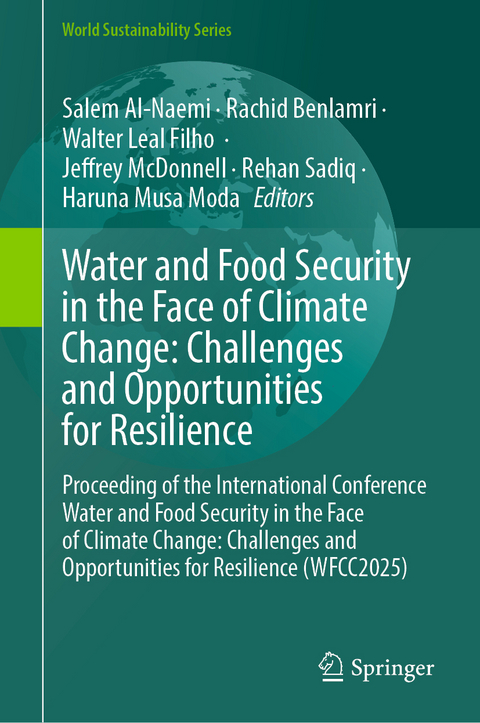
Water and Food Security in the Face of Climate Change: Challenges and Opportunities for Resilience
Springer International Publishing
978-3-032-00097-2 (ISBN)
This book addresses critical issues that align seamlessly with sustainability strategies. Extreme weather events, including increasingly frequent and severe droughts and floods, are now a global reality. Climate change poses a significant threat to both water and food security, driven by the rising temperatures that intensify the demand for water in crop cultivation. This crisis is further exacerbated by declining river runoff, reduced aquifer recharge, diminished inflows, heightened salinity, and rising sea levels, all of which present formidable challenges to water management. Consequently, the livelihoods of rural communities and the food security of urban populations are in imminent danger due to water-related impacts stemming primarily from climate variability. The implementation of sustainable adaptation measures to address climate variability and promote enhanced land and water management practices has vast potential for fortifying resilience in both water and food security challenges. Therefore, the pivotal step in crafting policies to tackle these challenges lies in comprehensively assessing the impact of climate change on water resources and agricultural systems. Closely aligning these policies will not only enhance the resilience of agricultural systems against future impacts but also contribute significantly to the meeting of the United Nations Sustainable Development Goals (SDGs).
To empower water resource management services for the future demands, it is imperative that we re-evaluate existing approaches to managing, mobilizing, and safeguarding this finite resource in the arid and semi-arid regions. This calls for the introduction of innovative technologies that facilitate integrated resource management and prevention. It is a premier platform for academics, researchers, students, policymakers, and stakeholders from government, industry, and society to explore pioneering ideas, techniques, and tools aimed at addressing the global impacts of climate change while concurrently reinforcing resilience in water and food security.
Professor Salem Al-Naemi is President of University of Doha for Science and Technology and has more than 30 years of work experience in both government and private sectors. He is Successful Executive with considerable leadership experience in education, government and business organizations such as Qatar University, Statistics Department/Planning Council, Supreme Education Council and Milaha. Professor Al-Naemi has an extensive international experience working as Managing Director of companies in France, Germany and India. His expertise lies in organizational strategies, managerial leadership, communication and operational efficiency to accomplish goals and achieve success for an organization. He has worked with a diverse workforce and in many multi-national organizations in key positions such as Executive Vice-President of Support Services, CFO and CIO, handling finances, information technology, human capital and administration functions.
Professor Rachid Benlamri is Vice-President and Academic at the University of Doha for Science and Technology (UDST) and holds a rich academic experience of over 30 years. Prior to joining UDST, Prof. Benlamri worked as Vice-President Academic at the Canadian University of Dubai. He also worked as Professor of Software Engineering and Head of the Department of Software Engineering in the Faculty of Engineering at Lakehead University, Canada. His research interests are in the areas of artificial intelligence, data science, semantic web, knowledge engineering, health informatics and mobile and ubiquitous computing. He supervised over 70 students and postdoctoral fellows. He served as Keynote Speaker and as General Chair for many international conferences. Prof. Benlamri serves on the editorial board of several Q1 journals and over 140 papers, mainly in Q1 journals and peer-reviewed international conference proceedings.
Professor Walter Leal Filho is Senior Professor and Head of the Research and Transfer Centre "Sustainable Development and Climate Change Management at the Hamburg University of Applied Sciences in Germany. He also chairs the International Climate Change Information and Research Programme (ICCIRP). Professor Leal Filho has written, co-written, edited, or co-edited more than 800 publications, including books, book chapters and papers in refereed journals. This includes the African Handbook of Climate Change Adaptation, a 4-volume publication illustrating the means via which climate change adaptation is being implemented in Africa today and the Handbook of Climate Change Management: Research, Leadership, Transformation, a 6-volume compendium on the theory and practice of climate change management. With 229 chapters, to which over 500 authors from across all geographical regions have contributed, this is the largest non-publicly funded editorial project on climate change adaptation ever produced.
Professor Jeffrey McDonnell is University of Saskatchewan Distinguished Professor of Hydrology and Associate Director of the Global Institute for Water Security at the University of Saskatchewan. He is Winner of the 2016 International Hydrology Prize from the International Association of Hydrological, UNESCO and the World Meteorological Organization and 2009 Dalton Medal from the European Geosciences Union. McDonnell is Member of the Royal Society of Canada, the American Association for the Advancement of Science and Academia Europaea. He is Fellow of the American Geophysical Union, the Geological Society of America and the Royal Geographical Society. He has been Recipient of numerous awards, among them the Outstanding Achievement Award of the New Zealand Hydrological Society, the Ray K. Linsley Award for Surface Water of the American Institute of Hydrology, the Gordon Warwick Medal of the British Society for Geomorphology and the Scientific and Technological Achievement Award from the US Environmental Protection Agency.
Professor Rehan Sadiq is
Minimizing the Impact of Acid Rain on Crops and Plants by Reducing the Sulfur Oxide Emissions from the Combustion of Organic Sulfur Compounds in Petroleum Fuels.- The Social Impacts of Climate Change and Its Reflections on Working Life in Terms of Occupational Safety.- Challenges and Opportunities in AI-Driven Supply Chain Sustainability.- Climate-Smart Marketing Strategies and Market Outcomes for Commercial Coffee Farms in Uganda.- Interactive Effects of Prosopis Species Biostimulants and Drought Stress on Wheat Germination, Growth, and Resilience.- Efficiency Enhancement of PV Energy System for Aquaponics in Qatar and GCC Countries.- Microplastics and Phthalates Migration from Disposable Paper Cups: A Threat to Beverage Safety in Qatar.- Assessment and Development of Biotechnological Testing Methods for Detecting Bacterial Contaminants in Unlicensed Artesian Wells around Doha.- Awareness and Knowledge of Sustainable Development in Qatar: A Survey of University Students.- Enhancing Awareness and Education on Food Security for Youths in Qatar A Comparative Study.- Farmer Training and Micro-Credentialing for Food Security Upskilling: A Research Review.
| Erscheint lt. Verlag | 16.11.2025 |
|---|---|
| Reihe/Serie | World Sustainability Series |
| Zusatzinfo | XLI, 1033 p. 309 illus., 281 illus. in color. In 2 volumes, not available separately. |
| Verlagsort | Cham |
| Sprache | englisch |
| Maße | 155 x 235 mm |
| Themenwelt | Naturwissenschaften ► Biologie ► Ökologie / Naturschutz |
| Naturwissenschaften ► Geowissenschaften | |
| Schlagworte | Climate change impacts • Climate Extremes and Modelling • Food Security and Sustainability • Policies, Legislations and Society • Water resource management |
| ISBN-10 | 3-032-00097-1 / 3032000971 |
| ISBN-13 | 978-3-032-00097-2 / 9783032000972 |
| Zustand | Neuware |
| Informationen gemäß Produktsicherheitsverordnung (GPSR) | |
| Haben Sie eine Frage zum Produkt? |
aus dem Bereich