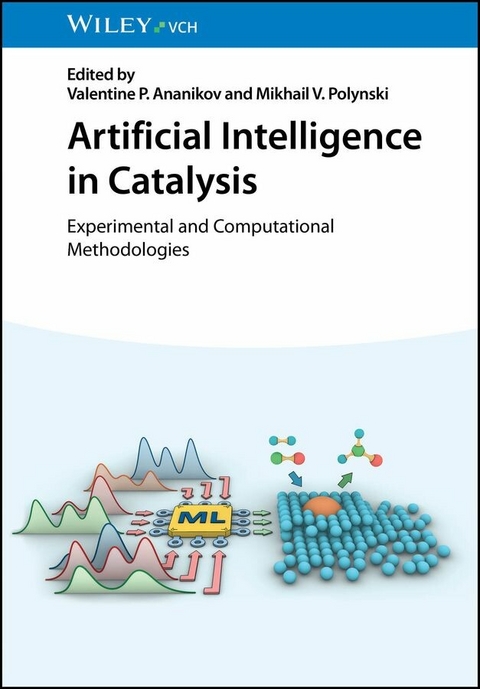
Artificial Intelligence in Catalysis (eBook)
273 Seiten
Wiley-VCH (Verlag)
978-3-527-84704-4 (ISBN)
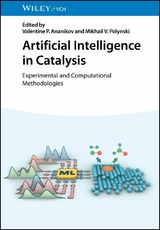
Enables researchers and professionals to leverage machine learning tools to optimize catalyst design and chemical processes
Artificial Intelligence in Catalysis delivers a state-of-the-art overview of artificial intelligence methodologies applied in catalysis. Divided into three parts, it covers the latest advancements and trends for catalyst discovery and characterization, reaction predictions, and process optimization using machine learning, quantum chemistry, and cheminformatics.
Written by an international team of experts in the field, with each chapter combining experimental and computational knowledge, Artificial Intelligence in Catalysis includes information on:
- Artificial intelligence techniques for chemical reaction monitoring and structural analysis
- Application of artificial neural networks in the analysis of electron microscopy data
- Construction of training datasets for chemical reactivity prediction through computational means
- Catalyst optimization and discovery using machine learning models
- Predicting selectivity in asymmetric catalysis with machine learning
Artificial Intelligence in Catalysis is a practical guide for researchers in academia and industry interested in developing new catalysts, improving organic synthesis, and minimizing waste and energy use.
Valentine P. Ananikov is a Professor and Laboratory Head at the Zelinsky Institute of Organic Chemistry at the Russian Academy of Sciences in Moscow, Russia. His research interests are focused on the development of new concepts in transition metal and nanoparticle catalysis, sustainable organic synthesis, and new methodologies for mechanistic studies of complex chemical transformations.
Mikhail V. Polynski is a Senior Research Fellow at the National University of Singapore. His current research focuses on the automation of computational chemistry, machine learning for chemical applications, Born-Oppenheimer molecular dynamics modeling, and the theory of catalysis.
| Erscheint lt. Verlag | 30.6.2025 |
|---|---|
| Sprache | englisch |
| Themenwelt | Naturwissenschaften ► Chemie |
| Schlagworte | Artificial Intelligence • Asymmetric catalysis • Catalyst characterization • catalyst discovery • chemical reaction monitoring • cheminformatics • computational catalysis • Heterogeneous catalysis • machine learning • organic synthesis • Process Optimization • Quantum Chemistry • reaction predictions |
| ISBN-10 | 3-527-84704-9 / 3527847049 |
| ISBN-13 | 978-3-527-84704-4 / 9783527847044 |
| Informationen gemäß Produktsicherheitsverordnung (GPSR) | |
| Haben Sie eine Frage zum Produkt? |
 PDF (Adobe DRM)
Kopierschutz: Adobe-DRM
Adobe-DRM ist ein Kopierschutz, der das eBook vor Mißbrauch schützen soll. Dabei wird das eBook bereits beim Download auf Ihre persönliche Adobe-ID autorisiert. Lesen können Sie das eBook dann nur auf den Geräten, welche ebenfalls auf Ihre Adobe-ID registriert sind.
Details zum Adobe-DRM
Dateiformat: PDF (Portable Document Format)
Mit einem festen Seitenlayout eignet sich die PDF besonders für Fachbücher mit Spalten, Tabellen und Abbildungen. Eine PDF kann auf fast allen Geräten angezeigt werden, ist aber für kleine Displays (Smartphone, eReader) nur eingeschränkt geeignet.
Systemvoraussetzungen:
PC/Mac: Mit einem PC oder Mac können Sie dieses eBook lesen. Sie benötigen eine
eReader: Dieses eBook kann mit (fast) allen eBook-Readern gelesen werden. Mit dem amazon-Kindle ist es aber nicht kompatibel.
Smartphone/Tablet: Egal ob Apple oder Android, dieses eBook können Sie lesen. Sie benötigen eine
Geräteliste und zusätzliche Hinweise
Buying eBooks from abroad
For tax law reasons we can sell eBooks just within Germany and Switzerland. Regrettably we cannot fulfill eBook-orders from other countries.
aus dem Bereich