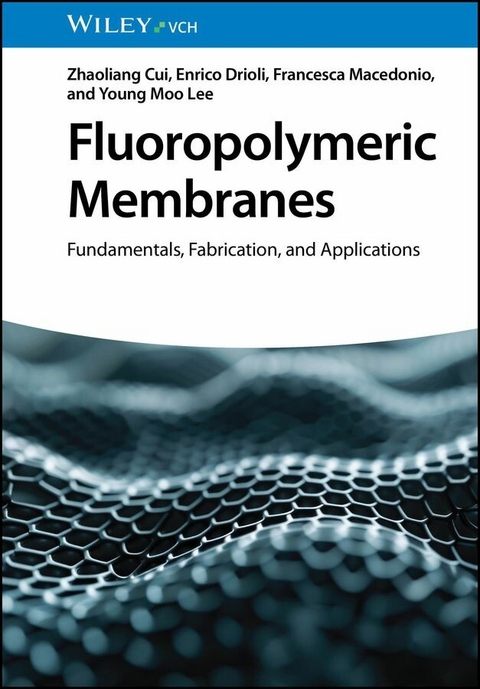
Fluoropolymeric Membranes (eBook)
551 Seiten
Wiley-VCH (Verlag)
978-3-527-82656-8 (ISBN)
Enables readers to gain a comprehensive understanding of fluoropolymeric membrane science and technology from a single resource
Fluoropolymeric Membranes: Fundamentals, Fabrication, and Applications comprehensively and systematically covers the basic science and technology of fluoropolymeric membranes, which have high mechanical strength and excellent chemical stability and thus have been employed for the last several decades as materials for membrane separation processes in a variety of applications.
Written by four highly qualified authors, Fluoropolymeric Membranes includes information on:
- Typical fluoropolymers like poly(vinylidene fluoride), poly(tetrafluoroethylene), and poly(ethylene chlorotrifluoroethylene)
- Structure and properties of fluoropolymeric membranes, and fabrication strategies of advanced fluoropolymeric membranes
- Fluoropolymeric membranes novel applications in chemical- and bio-separations, hybrid systems, energy, fuel cells, batteries, gas and air treatments, and more
- How fluoropolymeric membranes support common water treatment processes, such as ultrafiltration, microfiltration, MBR membrane processes, and more
- New membrane operations such as membrane distillation, membrane crystallization, membrane emulsification, and membrane contactors
Providing complete coverage on the subject, Fluoropolymeric Membranes is an essential resource for polymer chemists, membrane scientists, process engineers, materials scientists, water chemists, environmental chemists, and chemists in industry.
Zhaoliang Cui is Professor at College of Chemical Engineering, Nanjing Tech University, China.
Enrico Drioli is Emeritus Professor at University of Calabria and Founding Director of the Institute on Membrane Technology, CNR (CNR-ITM), Italy.
Francesca Macedonio is a researcher at CNR-ITM, Italy. Her research activities focus on membrane science and engineering for water treatment.
Young Moo Lee is now Distinguished Professor and has been the President of Hanyang University during 2015-2019.
1
Fluoropolymers for Membranes
1.1 Membrane Technology
The birth of membrane science is one of the symbols of the development of modern science. With the development of membrane science, it has spread to various fields of social production and has been applied to many fields worldwide. It will cause qualitative changes in the separation and purification processes in some industrial sectors.
In terms of environmental protection, membrane technology has been used for seawater desalination [1, 2], brackish water desalination [3–5], ultrapure water preparation, and industrial wastewater treatment [6, 7]. For example, in China, Jiangsu Province Membrane Science and Technology Research Institute uses membrane technology for the treatment of nickel and chromium electroplating wastewater, papermaking wastewater concentration, phenol removal from gas and petroleum wastewater, and municipal and factory wastewater treatment.
In chemical industry, membrane technology has been successfully employed for the separation, purification, and concentration of organic and inorganic salts, as well as for the concentration and recovery of high molecular organic materials and the purification of precious metals [8–10]. Some research institutes have used ultrafiltration membranes to concentrate and purify lignin from pulp waste in the world [11]. The membrane technology is also used to extract NaCl and NaSO4 from natural salt mines, to purify NaCl, and to concentrate Na2CO3 [12].
In medical and pharmaceutical industries, membrane technology can be used not only for the separation of bacteria and viruses but also for the concentration and separation of milk, juice, and herbal preparations [13–15]. For example, membrane separation technology is considered a promising cleaner approach, along with chemical extraction, to produce ephedrine from Ephedra sinica Stapf [16]. Chlortetracycline (96%) and nitrate (99%) are removed by membrane biofilm reactors (MBfRs) [17]. At present, membrane technology has been used abroad to make artificial kidneys and artificial lungs [18].
In the field of biotechnology, membrane technology has been used in developed countries to improve enzyme and cell recovery, the development of new cell culture devices and the development of enzyme‐engineered membrane reactors, as well as the concentration or isolation of proteases, saccharification enzymes, etc. [19, 20].
Membrane technology is widely used in the food industry. It has been applied to the extraction of edible protein in soybeans, beans, and rapeseed, the removal of soy sauce, vinegar, and amino acids, and the purification of edible oils. It is also widely used in purification, concentration, and decontamination of fruit juice, fruit wine, beer, and mead [21, 22]. For example, reverse osmosis technology and ultrafiltration technology can be used to concentrate and purify jam, juice, milk, and vegetable juice and maintain their original flavor [13, 23].
Water is considered to be the world's most valuable renewable resource and an important aspect of life. The world's population tripled in the twenty‐first century and will increase by another 40–50% in the next 50 years. Due to population growth, coupled with industrialization and urbanization, the demand for freshwater is increasing rapidly. In addition, some existing freshwater resources have gradually become polluted due to human or industrial activities. In the coming decades, the problem of water scarcity worldwide will become increasingly serious. As a result, many researchers have been looking for suitable ways to obtain freshwater by purifying and reusing it to support future generations. Water purification is an important process of removing chemicals, organic and biological pollutants, and suspended solids from water to obtain satisfactory water [24, 25].
Membrane technology has dominated water purification technologies due to its low cost and high efficiency [26]. Unlike other types of membranes, fluoropolymer membranes are leading the membrane separation industry and market due to their economic and practical benefits. However, there are some limitations in its application, including chemical, mechanical, and heat resistance. Improving flux and selectivity and reducing membrane contamination are the most important problems in membrane applications [27]. In order to remove barriers and reduce problems in membrane technology, a great deal of research has been carried out to develop new materials and methods to manufacture and modify fluoropolymer membranes.
Fluoropolymer membranes are widely used in water treatment applications such as desalination, water softening, purification of industrial and municipal wastewater, production of ultra‐pure water, and in the food, chemical, and pharmaceutical industries. The membrane process has the significant advantages of simple operation, flexibility, high effectiveness, high reliability, low energy consumption, good stability, good environmental compatibility, easy control, handling, and scale‐up, and is suitable for a variety of operating conditions including temperature, pressure, and pH. However, in more serious applications, there are still unresolved problems with the application of fluoropolymer membranes. Membrane fouling, inadequate separation and retention, treatment of concentrates, membrane life, and resistance to certain chemicals are among the most important and well‐known problems associated with fluoropolymer membranes. Table 1.1 lists the representative membrane processes and requirements for membrane materials.
Table 1.1 Representative membrane processes and requirements for membrane materials.
Source: Reproduced from Cui et al. [28]/with permission of Elsevier.
| Membrane process | General mechanism | Main properties | Ref. |
|---|
| MF/UF | Pressure‐driven liquid passes through the membrane pores | Hydrophilic used in aqueous systems, while hydrophobic used in oil systems | [28, 29] |
| MD | Thermally driven, water vapor passes through the membrane pores | Hydrophobic, high porosity | [30] |
| Membrane crystallization (MCr) | Thermally driven, vapor passes through the membrane pores | Hydrophobic used for hydrophilic (aqueous) crystallizing solutions, while hydrophilic used for oleophilic solutions | [31, 32] |
| Membrane emulsification (ME) | Pressure‐driven, contentious phase passed through the membrane pores | Hydrophobic used for producing O/W emulsions, while hydrophilic used for producing W/O emulsions | [33, 34] |
| Osmotic distillation | Vapor pressure‐driven, vapor diffuses through the membranes | Hydrophobic typically | [35] |
| PV | Concentration‐driven, vapor passes through the membranes | Hydrophilic for dehydration of organic solvents or organic mixtures; hydrophobic for removal of organic solvents or volatile organic compounds (VOCs) from water; organophilic for organic/organic separation | [36, 37] |
| Proton‐exchange membrane (PEM) | Proton transports in membranes | High proton conductivity, mechanical, chemical and thermal stability, good barrier properties for gas and methanol | [38, 39] |
| Membrane separator for Li‐ion battery | Transport ionic charge carriers and prevent electric contact between anode and cathode electrodes | High ionic conductivity and good barrier for electron | [40] |
| Gas separation membrane | Pressure‐driven | High diffusivity and/or high solubility to permeate gases | [41] |
| Membrane gas absorption (MGA) | Concentration gradient‐driven, gas passes through the membrane pores | Hydrophobic | [42, 43] |
1.2 Fluoropolymers for Membranes
In the past few decades, there has been an increase in interest in the quest for innovative materials that exhibit the required characteristics for a certain application. A material with low polarizable and electronegative fluorine atoms (van der Waals radius of 1.32 Å) will have a short C—F bond with a high bond energy dissociation of about 4.85 kJ mol−1 [44]. Because of their exceptional qualities, including thermal stability, chemical inertia (against solvents, oils, water, acids, and bases), low refractive index, dielectric constant, dissipation factor, and water absorption, as well as superior weather resistance, durability, and oxidation resistance, fluoropolymers are therefore good niche candidates. They thus have a wide range of high‐tech uses.
Fluoropolymers represent a significant advancement in modern high‐tech industries due to their exceptional properties, which confer high added value across various applications. Their unique combination of chemical resistance, thermal stability,...
| Erscheint lt. Verlag | 1.7.2025 |
|---|---|
| Sprache | englisch |
| Themenwelt | Naturwissenschaften ► Chemie ► Organische Chemie |
| Schlagworte | fabrication fluoropolymeric membranes • Membrane distillation • polyethylene chlorotrifluoroethylene • polytetrafluoroethylene • polyvinylidene fluoride • properties fluoropolymeric membranes • Structure fluoropolymeric membranes |
| ISBN-10 | 3-527-82656-4 / 3527826564 |
| ISBN-13 | 978-3-527-82656-8 / 9783527826568 |
| Informationen gemäß Produktsicherheitsverordnung (GPSR) | |
| Haben Sie eine Frage zum Produkt? |
 EPUB (Adobe DRM)
Kopierschutz: Adobe-DRM
Adobe-DRM ist ein Kopierschutz, der das eBook vor Mißbrauch schützen soll. Dabei wird das eBook bereits beim Download auf Ihre persönliche Adobe-ID autorisiert. Lesen können Sie das eBook dann nur auf den Geräten, welche ebenfalls auf Ihre Adobe-ID registriert sind.
Details zum Adobe-DRM
Dateiformat: EPUB (Electronic Publication)
EPUB ist ein offener Standard für eBooks und eignet sich besonders zur Darstellung von Belletristik und Sachbüchern. Der Fließtext wird dynamisch an die Display- und Schriftgröße angepasst. Auch für mobile Lesegeräte ist EPUB daher gut geeignet.
Systemvoraussetzungen:
PC/Mac: Mit einem PC oder Mac können Sie dieses eBook lesen. Sie benötigen eine
eReader: Dieses eBook kann mit (fast) allen eBook-Readern gelesen werden. Mit dem amazon-Kindle ist es aber nicht kompatibel.
Smartphone/Tablet: Egal ob Apple oder Android, dieses eBook können Sie lesen. Sie benötigen eine
Geräteliste und zusätzliche Hinweise
Buying eBooks from abroad
For tax law reasons we can sell eBooks just within Germany and Switzerland. Regrettably we cannot fulfill eBook-orders from other countries.
aus dem Bereich