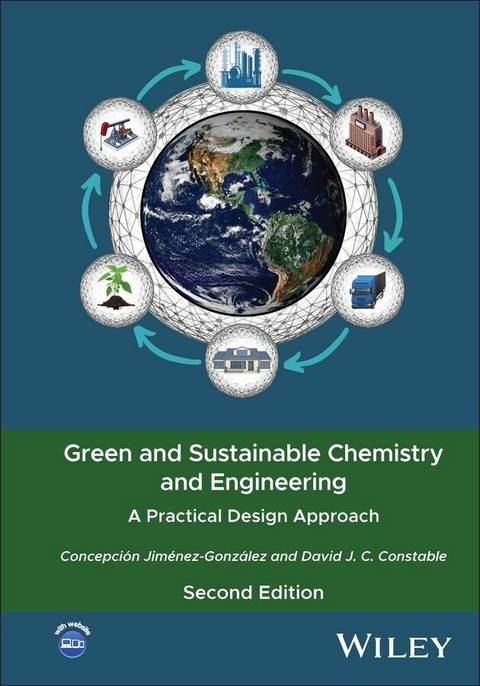
Green and Sustainable Chemistry and Engineering (eBook)
1389 Seiten
Wiley (Verlag)
978-1-394-16414-1 (ISBN)
The first textbook to fully integrate Green and Sustainable Chemistry and Engineering, now in its second edition
Green and Sustainable Chemistry and Engineering addresses key concepts and processes from an industrial and manufacturing perspective. Using an integrated, systems-oriented approach, this invaluable single-volume resource bridges the divide between chemistry, process design, and engineering, as well as environment, health, safety, and life cycle considerations.
This revised new edition discusses trends in chemical processing that can lead to more sustainable practices, explores new methods in the design of greener chemical synthesis, addresses sustainability challenges and implementation issues, and more. Up-to-date examples and new practical exercises based on the broad experience of the authors in applied and fundamental research, corporate consulting, and education are incorporated throughout the text.
Designed to advance green chemistry and green engineering as disciplines in the broader context of sustainability, Green and Sustainable Chemistry and Engineering:
- Illustrates the role of green and sustainable chemistry and engineering in the adoption of sustainable practices
- Describes the components of chemistry supporting the design of sustainable chemical reactions and reaction pathways
- Presents an approach to materials selection promoting the sustainability of chemical synthesis without diminishing efficiency
- Highlights key concepts that support the design of more sustainable chemical processes
- Provides background and context for placing a particular chemical process in the broader chemical enterprise
- Includes access to a companion website with a solutions manual and supplementary resources
Green and Sustainable Chemistry and Engineering: A Practical Design Approach, Second Edition, remains an ideal textbook for graduate and senior-level courses in Chemistry and Chemical Engineering, and an invaluable reference for chemists and engineers in manufacturing and R&D, especially those working in fine chemicals and pharmaceuticals.
Concepción Jiménez-González, PhD is Vice-President, Head of R&D Environment, Health, Safety (EHS) and Sustainability at GSK. With more than 30 years of experience in the field, she has held positions at Monterrey Tec in Mexico and Pfizer. She is also an Adjunct Professor in the Chemical and Biomolecular Engineering Department at North Carolina State University (NCSU).
David J. C. Constable, PhD retired at the end of December 2022 as the Science Director of the ACS Green Chemistry Institute. Before joining the ACS, he was Vice-President of Energy, Environment, Safety, and Health for Lockheed Martin, and served as Director of Operational Sustainability in the Corporate Environment, Health, and Safety Department at GlaxoSmithKline.
The first textbook to fully integrate Green and Sustainable Chemistry and Engineering, now in its second edition Green and Sustainable Chemistry and Engineering addresses key concepts and processes from an industrial and manufacturing perspective. Using an integrated, systems-oriented approach, this invaluable single-volume resource bridges the divide between chemistry, process design, and engineering, as well as environment, health, safety, and life cycle considerations. This revised new edition discusses trends in chemical processing that can lead to more sustainable practices, explores new methods in the design of greener chemical synthesis, addresses sustainability challenges and implementation issues, and more. Up-to-date examples and new practical exercises based on the broad experience of the authors in applied and fundamental research, corporate consulting, and education are incorporated throughout the text. Designed to advance green chemistry and green engineering as disciplines in the broader context of sustainability, Green and Sustainable Chemistry and Engineering: Illustrates the role of green and sustainable chemistry and engineering in the adoption of sustainable practices Describes the components of chemistry supporting the design of sustainable chemical reactions and reaction pathways Presents an approach to materials selection promoting the sustainability of chemical synthesis without diminishing efficiency Highlights key concepts that support the design of more sustainable chemical processes Provides background and context for placing a particular chemical process in the broader chemical enterprise Includes access to a companion website with a solutions manual and supplementary resources Green and Sustainable Chemistry and Engineering: A Practical Design Approach, Second Edition, remains an ideal textbook for graduate and senior-level courses in Chemistry and Chemical Engineering, and an invaluable reference for chemists and engineers in manufacturing and R&D, especially those working in fine chemicals and pharmaceuticals.
LIST OF FIGURES
Chapter 1
| Figure 1.1 | Simplified vision of some of the challenges and realities of designing a chemical synthesis and process. |
| Figure 1.2 | Spheres of action of sustainability. |
Chapter 2
| Figure 2.1 | Chronological representation of environmental laws. |
| Figure 2.2 | Some of the many products in use. |
| Figure 2.3 | Fate and effects of a common household detergent. |
| Figure P2.9 | Atmospheric distillation followed by vapor permeation. |
Chapter 3
| Figure 3.1 | Factors in setting occupational exposure limits. |
| Figure 3.2 | Nodes analyzed in a HAZOP of a pilot plant hydrogenation system. Boldface type indicates deviations that are applicable to the hydrogenation reactor node. |
| Figure 3.3 | Screenshot of a HAZOP study showing the outcome of one deviation (high temperature) in the hydrogenation reactor node of Figure 3.2. |
| Figure P3.3 |
Chapter 4
| Figure 4.1 | Interrelationships between process metrics categories. |
| Figure 4.2 | Generic example of hazard scoring for process materials. |
Chapter 5
| Figure 5.1 | Where systems thinking fits in green chemistry and engineering and life cycle thinking. Adapted from Ginzburg, et. al. |
| Figure 5.2 | Process for defining a chemistry‐specific system from Constable et. al. |
| Figure 5.3 | Systems‐oriented concept map extension (SOCME) for a tire system. |
| Figure 5.4 | Life cycle inventory/assessment for acetone production. Box (a): Synthetic pathway for acetone manufacturing separated into production stages (gate‐to‐gate). Box (b): Schematic of a generic gate‐to‐gate mass and energy (input/output) balance for each unit process within each stage. Box (c): Schematic of the life cycle assessment phase based on the cumulative life cycle inventory for all stages, cradle‐to‐gate. |
Chapter 6
| Figure 6.1 | Example of chemistry types ranked by their relative greenness. |
| Figure 6.2 | Process flow diagram for a single reaction step. |
| Figure 6.3 | Venn diagram for the American Chemical Society’s Green Chemistry Institute Pharmaceutical Roundtable Reagent Guides (https://reagents.acsgcipr.org). |
Chapter 7
| Figure 7.1 | Some solvent uses and examples of applications. |
| Figure 7.2 | The goal is to select a solvent that promotes chemical reactivity and efficient downstream processing with minimal EHS impacts. TPB, toxic, persistent, bioaccumulative; RME, reaction mass efficiency. |
| Figure 7.3 | Chemical tree of ethyl ether. Each block in the tree represents a manufacturing process, and the numbers denote mass of material (in kilograms) to produce 1,000 kg of the solvent. The tree is read from left (final product) to right (cradle material). |
| Figure 7.4 | General iterative solvent selection process. |
| Figure 7.5 | Solvent properties and their role in solvent selection. |
| Figure 7.6 | PCA used for solvent selection. Each dot represents a solvent in tri‐dimensional solvent space. Solvents that are located near each other have similar characteristics given the statistical assessment. |
| Figure 7.7 | Mechanism‐based solvent selection procedure (Britest Ltd., http://www.britest.co.uk). |
| Figure 7.8 | GlaxoSmithKline’s solvent selection guide (http://www.gsk.com). |
| Figure 7.9 | Methodology to select green solvents for organic reactions using computer‐aided molecular design to perform the search. |
| Figure 7.10 | Screen shot of a CAMD search using ProCAMD software. |
| Figure 7.11 | Catalyst effect on activation energy of a reaction. Note that the enthalpy of reaction (energy of products minus energy or reactants) remains unchanged. |
| Figure 7.12 | General classification of catalysts. |
| Figure 7.13 | Industrial processes using acid–base catalysts. |
| Figure 7.14 | Type of catalysts used in industrial processes. |
Chapter 8
| Figure 8.1 | (a) Simple 2‐level factorial design of experiment; (b) response surface for 2‐level factorial design. |
| Figure 8.2 | Figure for example 8.4. Holding a reaction at reflux. |
Chapter 9
| Figure 9.1 | Simplified graphic representation of a bioprocess. |
| Figure 9.2 | Chemical (a) and biocatalytic (b) routes for 7‐ACA. |
| Figure 9.3 | Petrochemical process for polylactic acid. |
| Figure 9.4 | Polylactic acid production. |
| Figure 9.5 | Solvent use of the chemical (a) and biocatalytic (b) routes to Pfizer’s Lyrica (pregabalin). |
| Figure 9.6 | Comparison of chemical and biocatalytic routes to Molnupiravir. |
| Figure P9.8 |
| Figure P9.10 |
Chapter 10
| Figure 10.1 | Block diagram (a) and process flow diagram (b) for Example 10.1. |
| Figure 10.2 | Common symbols used in process flow diagrams. |
| Figure 10.3 | Block diagram for Example 10.2. |
| Figure 10.4 | Two different system boundaries for the same 3‐pentanone process. |
| Figure 10.5 | Process flow diagram for hypochlorous acid, Example 10.5. |
| Figure 10.6 | Changes in temperature at a constant volume. |
| Figure 10.7 | Changes in temperature at a constant volume Example 10.8. |
| Figure 10.8 | Heats of reaction. |
| Figure 10.9 | Block flow diagram for the chemical synthesis of 7‐ACA. |
| Figure P10.10 | Distillation column. |
| Figure P10.17 | Process flow diagram for Problem 10.17. |
Chapter 11
| Figure 11.1 | Activated carbon adsorption process. |
| Figure 11.2 | Scale‐up process and how the various tools interact to provide the right information for the process at the right development stage. |
| Figure 11.3 | Scaling‐up (a) vs. numbering‐up (b). |
Chapter 12
| Figure 12.1 | Reactor configurations. |
| Figure 12.2 | Some characteristics of fluid processing reactors in relationship with hourly spatial velocity, production, and residence time. |
| Figure 12.3 | Examples of separations and size reduction/augmentation unit operations. |
| Figure 12.4 | Mass balance for azeoptropic distillation of Example 12.5. |
| Figure 12.5 | Mass balance for extractive distillation of Example 12.5. |
| Figure 12.6 | Mass balance for pervaporation of Example 12.5. |
| Figure 12.7 | Some areas of process intensification. |
| Figure 12.8 | Illustrative schemes for static (a), y‐shaped jet (b), and vortex (c) mixers. |
| Figure 12.9 | Microchannel reactor. The reaction zones are darker than the heat transfer zones. This is also typically known as a HEX reactor. |
| Figure 12.10 | Spinning disk reactor. |
| Figure... |
| Erscheint lt. Verlag | 2.7.2025 |
|---|---|
| Sprache | englisch |
| Themenwelt | Naturwissenschaften ► Chemie |
| Schlagworte | green chemistry engineering design • green chemistry engineering reference • green chemistry engineering textbook • sustainable chemistry engineering design • sustainable chemistry engineering reference • sustainable chemistry engineering textbook |
| ISBN-10 | 1-394-16414-9 / 1394164149 |
| ISBN-13 | 978-1-394-16414-1 / 9781394164141 |
| Informationen gemäß Produktsicherheitsverordnung (GPSR) | |
| Haben Sie eine Frage zum Produkt? |
 EPUB (Adobe DRM)
Kopierschutz: Adobe-DRM
Adobe-DRM ist ein Kopierschutz, der das eBook vor Mißbrauch schützen soll. Dabei wird das eBook bereits beim Download auf Ihre persönliche Adobe-ID autorisiert. Lesen können Sie das eBook dann nur auf den Geräten, welche ebenfalls auf Ihre Adobe-ID registriert sind.
Details zum Adobe-DRM
Dateiformat: EPUB (Electronic Publication)
EPUB ist ein offener Standard für eBooks und eignet sich besonders zur Darstellung von Belletristik und Sachbüchern. Der Fließtext wird dynamisch an die Display- und Schriftgröße angepasst. Auch für mobile Lesegeräte ist EPUB daher gut geeignet.
Systemvoraussetzungen:
PC/Mac: Mit einem PC oder Mac können Sie dieses eBook lesen. Sie benötigen eine
eReader: Dieses eBook kann mit (fast) allen eBook-Readern gelesen werden. Mit dem amazon-Kindle ist es aber nicht kompatibel.
Smartphone/Tablet: Egal ob Apple oder Android, dieses eBook können Sie lesen. Sie benötigen eine
Geräteliste und zusätzliche Hinweise
Buying eBooks from abroad
For tax law reasons we can sell eBooks just within Germany and Switzerland. Regrettably we cannot fulfill eBook-orders from other countries.
aus dem Bereich