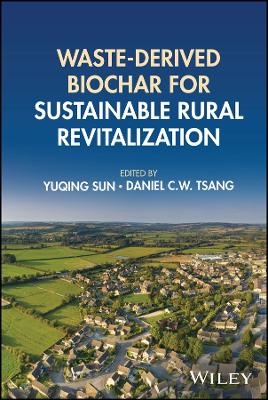
Waste-derived Biochar for Sustainable Rural Revitalization
John Wiley & Sons Inc (Verlag)
978-1-394-25027-1 (ISBN)
Waste-derived Biochar for Sustainable Rural Revitalization summarizes recent research developments, introduces state-of-the-art knowledge, incorporates case studies, offers scientific insights, highlights current challenges, and shows the way forward for biochar technologies as a novel, cost-effective, and environmentally friendly solution for sustainable rural revitalization. This book succinctly summarizes different technologies for application-oriented biochar production from waste biomass resources (e.g., crop residues, pruning of fruit trees, animal waste, food waste, and domestic sludge) in rural areas, with an emphasis on tailored selection of pyrolytic and pre/post-treatment conditions.
Readers will find information on renewable biofuels, clean compost conditioner, organic seeding substrate, slow-release fertilizers, green pesticides, targeting plant disease suppressors, farmland soil conditioner/amendment, adsorbent/catalyst for agriculture wastewater treatment, farmland carbon sequestration, and low-carbon construction materials. This book also evaluates these technologies through Technical and Economic Analysis (TEA) and Environmental, Social, and Governance (ESG) frameworks and discusses potential environmental risks.
Written by a team of highly qualified authors, Waste-derived Biochar for Sustainable Rural Revitalization explores sample topics including:
Slow, fast, microwave, and flash pyrolysis, physical and chemical modification of biochars, and commonly used biochar raw materials
Technologies and key influencing factors in biochar preparation, types and characteristics of carbonation reactors, and migration of alkali metals during biochar combustion
Waste-derived biochar as organic seeding substrate, discussing the growing media of compost, humic acid, and activated carbon
Improvement of soil physical, chemical, and biological properties by waste-derived biochar, covering effects on soil pH, organic matter, and cation exchange quantity
Waste-derived Biochar for Sustainable Rural Revitalization serves as an invaluable reference for engineers, scientists, researchers, and graduate students in waste recycling and management, sustainable rural development, environmental engineering, civil engineering, chemical engineering, and related fields.
Yuqing Sun, PhD, is an Associate Professor in School of Agriculture and Biotechnology at Sun Yat-Sen University. She has published over 60 articles in top 10% journals and received over 7,900 citations. Her research covers the customized design and application of engineered biochar in green and sustainable agricultural applications. Daniel C.W. Tsang, PhD (ICE Fellow, RSC Fellow, HKIE Fellow) is a Professor in Department of Civil and Environmental Engineering and Director of Research Center on Decarbonization Technology at The Hong Kong University of Science and Technology. He has published over 600 articles in top 10% journals and received over 78,000 citations. His research team strives to develop green technologies to ensure sustainable development and long-term decarbonization.
List of Contributors xvii
Preface xxv
1 Tailored Biochar Production from Waste Biomass Resource in Rural Areas 1
Yuqing Sun and Daniel C.W. Tsang
1.1 Introduction 1
1.2 Overview of Rural Solid Wastes 2
1.3 Biochar Production Methods 10
1.4 Biochar Modification Methods 20
1.5 Conclusion 27
2 Waste-derived Biochar as Renewable Bio-fuels 39
Xiefei Zhu, Yuqing Sun, and Daniel C.W. Tsang
2.1 Feedstocks Type of Waste-derived Biochar Fuels 39
2.2 Preparation Technologies of Waste-derived Biochar Fuels 40
2.3 Preparation of Biochar Fuel by Carbonization 44
2.4 Types and Characteristics of Carbonation Reactors 45
2.5 Fuel Properties of Biochar 50
2.6 Combustion of Biochar 53
2.7 Combustion Characteristics of Biochar 55
2.8 Combustion Kinetics of Biochar 60
2.9 Emission Characteristics of Biochar Combustion 62
2.10 Migration of Alkali Metals During Biochar Combustion 64
2.11 Prospects and Challenges of Biochar Energy 68
3 Agricultural Waste-derived Biochar for Energy Recovery from Waste Fermentation 77
Hong-Yu Ren, Qingqing Song, Fanying Kong, and Xueting Song
3.1 Introduction 77
3.2 Biochar Preparation from Agricultural Waste 79
3.3 Energy Recovery from Waste Biomass Fermentation Based on Biochar Treatment 80
3.4 A Case for Biochar in Energy Recovery 83
3.5 Conclusion 83
4 Waste-derived Biochar as Organic Seeding Substrate 87
Yutao Peng, Yuqing Sun, and Daniel C.W. Tsang
4.1 Peat-based Growing Media Substituted by Biochar 87
4.2 Coir-based Growing Media Substituted by Biochar 89
4.3 Growing Media of Compost, Humic Acid, and Activated Carbon 90
5 Waste-derived Biochar as Slow-release Fertilizers 95
Xiaoqian Jiang, Yuqing Sun, and Jing Luo
5.1 Introduction 95
5.2 Research Progress of SRF 96
5.3 The Preparation Technologies of Biochar-based SRFs 99
5.4 Mechanism of Slow Release of Biochar 103
5.5 The Specific Applications of Biochar SRF 104
5.6 Summary and Outlook 106
6 Waste-derived Biochar as Slow-release Pesticides 113
Xiaoqian Jiang, Yuqing Sun, and Jing Luo
6.1 Introduction 113
6.2 Research Progress of Biochar-based Slow-release Pesticides 115
6.3 The Mechanisms of Biochar Loading and Slow Release of Pesticide 117
6.4 Determinants Influencing Biochar Loading Efficiency and Pesticidal Release Capacity 121
6.5 Modification of Biochar for Sustained Release of Pesticide 125
6.6 Summary and Outlook 126
7 Waste-derived Biochar as Targeting Plant Disease Suppressors 133
Mi Wei, Zhongwang Liu, Yuqing Sun, and Jinfang Tan
7.1 Introduction 133
7.2 Methods 134
7.3 Using Biochar for Managing Plant Diseases 134
7.4 Conclusion 142
8 Improvement of Soil Physical, Chemical, and Biological Properties by Waste-derived Biochar 149
Ying Zhao, Zhuqing Liu, Jiang Song, Kui Cheng, and Fan Yang
8.1 Biochar Improves Soil Physical Properties 150
8.2 Biochar Improves Soil Chemical Properties 154
8.3 Biochar Improves Soil Biological Properties 159
9 Impact of Biochar on Pesticides Transportation, Bioavailability, Performance, and Degradation in Soil Environment 169
Xin Liu, Lingfeng Zeng, Yuqing Sun, Yaoyu Zhou, and Daniel C.W. Tsang
9.1 Introduction to Biochar and Pesticides 169
9.2 Biochar Application for Pesticide Control 171
9.3 Biochar’s Impact on Pesticide Transportation 175
9.4 Bioavailability of Pesticides in the Presence of Biochar 176
9.5 Performance Enhancement of Pesticides with Biochar 178
9.6 Degradation of Pesticides Influenced by Biochar 179
9.7 Future Prospects and Challenges in Biochar–Pesticide Research 180
10 Waste-derived Biochar as Adsorbent for Agriculture Wastewater Treatment 187
Jianhua Qu and Ying Zhang
10.1 Introduction 187
10.2 Preparation of Biochar-based Agriculture Wastewater Adsorbent 188
10.3 Efficacy of Biochar-adsorption on Agriculture Wastewater Treatment 192
10.4 Effects of Modification Methods on Biochar-enhanced Adsorption Agriculture Wastewater Treatment 196
10.5 Mechanisms of Adsorption and Future Prospects 203
11 Waste-derived Biochar as Catalyst for Agriculture Wastewater Treatment 211
Xiaofei Tan, Hailan Yang, Qiang Chen, and Qianzhen Fang
11.1 Photocatalysis 212
11.2 H2O2-based Catalysis Processes 216
11.3 PS-based Catalysis Processes 218
11.4 PI-based Catalysis Processes 220
11.5 O3-based Catalysis Processes 226
11.6 PAA-based Catalysis Processes 236
12 Waste-derived Biochar for Efficient CO2 Capture 261
Leichang Cao, Jieni Wang, Shuqin Zhang, Haodong Hou, Yuqing Sun, and Daniel C.W. Tsang
12.1 Introduction 261
12.2 Biomass-based Carbon Materials 262
12.3 Activation Methods for Carbon Materials 268
12.4 The Recent Advances of Functionalized Biochar Materials for CO2 Capture 273
12.5 Conclusion and Outlook 282
13 Biomass Waste-derived Biochar as Graphitic Carbon for Agricultural Applications 291
Baojun Yi, Fang Huang, and Jiaqi Deng
13.1 Literature Statistics Methodology 291
13.2 Biomass Waste Feedstocks Suitable for the Preparation of Graphitic Carbon 293
13.3 Graphitization and Carbonization Processes of Waste Biomass and Characteristics of Graphitic Carbon 299
13.4 Optimization Methods for Biomass Waste-derived Graphitic Carbon 305
13.5 Removal of Organic Pollutants from Water and Soil by Waste-derived Graphitic Carbon 315
13.6 Improvement of Soil Properties by Waste-derived Graphitic Carbon 319
13.7 Improvement of Fertilizer Properties by Waste-derived Graphitic Carbon 321
13.8 Immobilization of Heavy Metals by Waste-derived Graphitic Carbon 322
13.9 Conclusions and Prospects 323
14 Waste-derived Biochar for Low-carbon Construction Materials in Rural Areas 351
Fulin Qu, Weijian Xu, Yizhe Wang, Yipu Guo, Su Yilin, and Daniel C.W. Tsang
14.1 Introduction 351
14.2 Properties of Waste-derived Biochar 353
14.3 Treatment and Engineering of Biochar 357
14.4 Applications in Low-carbon Construction 359
14.5 Environmental and Economic Benefits 365
14.6 Conclusion 367
15 Low-carbon Soil Remediation with Biochar and GGBS 373
Weijian Xu, Jingyi Liang, Yuying Zhang, and Daniel C.W. Tsang
15.1 Introduction 373
15.2 Latest Developments and Applications of Biochar in Soil Remediation 374
15.3 Biochar-enhanced Cement for Stabilization/Solidification 382
15.4 Key Parameters in Biochar-enhanced Soil S/S 387
15.5 Supply Availability of Biochar 392
15.6 GGBS Supply Availability 394
15.7 Environmental Benefits 397
15.8 Conclusion 398
16 Technical and Economic Analysis of Biochar Technologies 407
Le Fang, Yifan Xing, and Yingying Han
16.1 Introduction 407
16.2 Techno-economic Analysis of Biochar Technologies in Production Process 408
16.3 Techno-economic Analysis of Biochar Application Scenarios 412
16.4 Element Circulation and Sustainable Development 416
16.5 Current Limitations and Future Perspectives 418
16.6 Summary 418
17 ESG Perspective and Biodiversity Impact of Waste-derived Biochar 425
Maheshika Senanayake, Pavani Dulanja Dissanayake, Jay Hyuk Rhee, Meththika Vithanage, and Yong Sik Ok
17.1 Introduction 426
17.2 Environmental (E) Perspective 426
17.3 Social (S) Perspective 430
17.4 Governance (G) Perspective 438
17.5 Biodiversity 440
17.6 Challenges and Opportunities 442
17.7 Conclusion 443
18 Environmental Stability of Biochar in Natural Systems 455
Shishu Zhu, Lanfang Han, and Ke Sun
18.1 Environmental Reactivity of Biochar 455
18.2 Aggregation and Transport Behaviors of Biochar Colloids 458
18.3 Biochar Carbon Stability 461
18.4 Perspectives 469
19 Risk Assessment of Biochar in Soil and Aquatic Ecosystem 479
Xiaochen Huang, Peng Xie, Huijun Li, and Shih-Hsin Ho
19.1 Negative Impacts of Biochar on Soil Ecosystem 479
19.2 Negative Impacts of Biochar on Aquatic Ecosystem 482
19.3 Combined Effects of Biochar and Pollutants to Organisms 485
19.4 Potential Measures for Risk Avoidance 487
Index 493
| Erscheinungsdatum | 30.12.2025 |
|---|---|
| Verlagsort | New York |
| Sprache | englisch |
| Themenwelt | Naturwissenschaften ► Chemie ► Analytische Chemie |
| ISBN-10 | 1-394-25027-4 / 1394250274 |
| ISBN-13 | 978-1-394-25027-1 / 9781394250271 |
| Zustand | Neuware |
| Informationen gemäß Produktsicherheitsverordnung (GPSR) | |
| Haben Sie eine Frage zum Produkt? |
aus dem Bereich