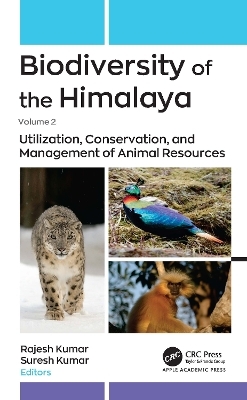
Biodiversity of the Himalaya
Apple Academic Press Inc. (Verlag)
978-1-77491-995-8 (ISBN)
This new two-volume set pays tribute to the incredibly diversified Himalaya. It presents and assesses the various threats and challenges to Himalayan biodiversity, documenting the multifaceted approaches for conservation and sustainable management of biological resources in the Himalayan region.
Volume 2 focuses on the utilization, conservation, and management of animal resources in the Himalayan region. It covers traditional knowledge of insects and animals for food and medicinal purposes and discusses adverse changing climatic conditions; the overuse of chemical and synthetic pesticides; ecotourism, wildlife tourism, and hunting tourism; radiation from cell phone towers; invasive/alien animal and plant species; habitat destruction; etc., and how they impact the region. Sustainable mitigation and conservation strategies are described as well, offering hope for preservation of the rich biodiversity of the Himalaya.
Volume 1: Utilization, Conservation, and Management of Plant Resources focuses on the flora of the area, exploring the diversity, distribution, utilization, threat status, and conservation of medicinal, edible, and other economic plant resources.
Rajesh Kumar, PhD, is an Assistant Professor of Biosciences at Himachal Pradesh University, Shimla, India. With over 10 years of experience in teaching and research, he has been teaching animal physiology and applied zoology and supervising students for their research work. His own research activities also include environmental toxicology, waste management, and the impact of environmental degradation on animal physiology. He is an expert lecturer at beekeeping training/extension activities. Dr. Kumar has successfully completed two major research projects and two startup projects sponsored by government agencies and has published research articles, book chapters, abstracts, and conference papers as well as several books and monographs. He has successfully organized seminars and conferences and delivered invited talks and extension lectures. Suresh Kumar, PhD, is an Associate Professor in the Department of Bio-Sciences, H.P. University, Shimla, India. He has more than 12 years of experience in teaching and research. His thrust areas include floristics, ethnobotany, and biodiversity. Dr. Kumar has published 10 books and more than 20 research papers in journals of national and international repute. Presently, he is guiding several students for their PhD degrees. He has participated in many conferences and seminars and has delivered invited talks as a resource person at various institutions. He is a member of the Indian Science Congress and many other scientific agencies. He is an associate editor as well as a reviewer for various journals in the field of botany.
1. Indian Traditional Knowledge in Relation to Animal Origin Products with Special Reference to Insects 2. The Himalayas: A Hotspot of Biodiversity 3. Effect of Changing Climatic Conditions on Faunal Diversity of Northwestern Himalaya 4. Impact of Chemical and Synthetic Pesticides on Himalayan Insect Diversity 5. Impact of Anthropogenic Activities on Faunal Diversity of the Snow-Covered Himalayan Range 6. Conservation Strategies for Threatened Faunal Diversity of Himachal Pradesh 7. Eco-Tourism: Frenemy of Himalayan Diversity 8. Effect of Invasive/Alien Animal Species in the Himalayan Faunal System 9. Impact of Mobile Tower Radiation on Himalayan Fauna 10. Socio-Economic Evaluation of Insect Products with Special Reference to Himalayan Honeybees 11. Cordyceps militaris: An Entomopathogenic Fungus as a Promising Solution for Conservation of Himalayan Cordyceps 12. Hunting, Habitat Destruction, and Human Fun as Potential Threat to Himalayan Diversity 13. Narpuh Wildlife Sanctuary, Meghalaya: Status, Challenges, Sustainable Benefits and Future Perspectives
| Erscheinungsdatum | 12.09.2025 |
|---|---|
| Zusatzinfo | 18 Tables, black and white; 5 Line drawings, color; 10 Line drawings, black and white; 7 Halftones, color; 3 Halftones, black and white; 12 Illustrations, color; 13 Illustrations, black and white |
| Verlagsort | Oakville |
| Sprache | englisch |
| Maße | 156 x 234 mm |
| Gewicht | 760 g |
| Themenwelt | Naturwissenschaften ► Biologie ► Ökologie / Naturschutz |
| Technik ► Architektur | |
| Technik ► Umwelttechnik / Biotechnologie | |
| Weitere Fachgebiete ► Land- / Forstwirtschaft / Fischerei | |
| ISBN-10 | 1-77491-995-8 / 1774919958 |
| ISBN-13 | 978-1-77491-995-8 / 9781774919958 |
| Zustand | Neuware |
| Informationen gemäß Produktsicherheitsverordnung (GPSR) | |
| Haben Sie eine Frage zum Produkt? |
aus dem Bereich