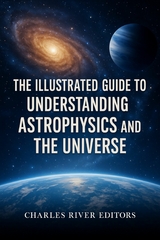
Illustrated Guide to Understanding Astrophysics and the Universe (eBook)
38 Seiten
Charles River Editors (Verlag)
978-1-4753-2920-9 (ISBN)
'My goal is simple. It is a complete understanding of the universe, why it is as it is and why it exists at all.' - Stephen Hawking
From the dawn of time, man has sought to understand the Universe and his place in it. How did the Earth and the Solar System come to be? How was the Universe created?
Like other scientific disciplines, astronomy and astrophysics is one big detective story. Hypotheses are formed, observations taken, and experiments performed in the search for universal laws that describe all that we see. A good hypothesis or theory will make predictions of future observations, the results of which will either refute the theory, or be consistent with it. Astronomy is at a distinct disadvantage over other branches of science in one crucial way: for the most part, our observations only consist of photons (i.e. light) from far away sources, rarely can we touch and manipulate the things we observe, and thus create our own controls for an 'experiment'. We must wait for those far-away objects to cooperate. The light must be analyzed in many different ways (variations in space, time, intensity and frequency to name just a few), comparing different objects with one another, and making informed opinions upon the results. The light over the whole electromagnetic spectrum from a particular 'target' must be explained in a consistent way using the laws of physics, and often it's back to the telescope for a new set of observations when some part of the theory proves inadequate. Or, back to some intensive computations. Nevertheless, astronomers and astrophysicists have done remarkably well over the last couple of centuries, allowing us to present an overview of how the Universe functions.
In this resourceful guide, common questions about the Universe will be explained in comprehensive but easy to understand terms. You'll learn the answers to some of the most important questions, including:
*How do stars form?
*What happens when stars die?
*What do we know about the origin of the universe?
*What is dark matter and why do we suppose it exists?
*How does our solar system fit into the Milky Way Galaxy?
*What galaxies are around us, and how are galaxies classified?
*What is the cosmological principle?
The Illustrated Guide to Understanding Astrophysics and the Universe gives an entertaining and educational overview of our Universe, from the smallest matter to massive black holes, and everything in between. Whether you are an experienced amateur or a complete novice, let The Illustrated Guide to Understanding Astrophysics and the Universe be your guide to the stars.
"e;My goal is simple. It is a complete understanding of the universe, why it is as it is and why it exists at all."e; - Stephen HawkingFrom the dawn of time, man has sought to understand the Universe and his place in it. How did the Earth and the Solar System come to be? How was the Universe created? Like other scientific disciplines, astronomy and astrophysics is one big detective story. Hypotheses are formed, observations taken, and experiments performed in the search for universal laws that describe all that we see. A good hypothesis or theory will make predictions of future observations, the results of which will either refute the theory, or be consistent with it. Astronomy is at a distinct disadvantage over other branches of science in one crucial way: for the most part, our observations only consist of photons (i.e. light) from far away sources, rarely can we touch and manipulate the things we observe, and thus create our own controls for an experiment . We must wait for those far-away objects to cooperate. The light must be analyzed in many different ways (variations in space, time, intensity and frequency to name just a few), comparing different objects with one another, and making informed opinions upon the results. The light over the whole electromagnetic spectrum from a particular target must be explained in a consistent way using the laws of physics, and often it's back to the telescope for a new set of observations when some part of the theory proves inadequate. Or, back to some intensive computations. Nevertheless, astronomers and astrophysicists have done remarkably well over the last couple of centuries, allowing us to present an overview of how the Universe functions.In this resourceful guide, common questions about the Universe will be explained in comprehensive but easy to understand terms. You ll learn the answers to some of the most important questions, including: *How do stars form?*What happens when stars die?*What do we know about the origin of the universe?*What is dark matter and why do we suppose it exists?*How does our solar system fit into the Milky Way Galaxy?*What galaxies are around us, and how are galaxies classified?*What is the cosmological principle? The Illustrated Guide to Understanding Astrophysics and the Universe gives an entertaining and educational overview of our Universe, from the smallest matter to massive black holes, and everything in between. Whether you are an experienced amateur or a complete novice, let The Illustrated Guide to Understanding Astrophysics and the Universe be your guide to the stars.
| Erscheint lt. Verlag | 20.6.2025 |
|---|---|
| Sprache | englisch |
| Themenwelt | Naturwissenschaften ► Physik / Astronomie ► Astronomie / Astrophysik |
| Schlagworte | Black Holes • Einstein • Galileo • Hawking • Newton • Physics • Solar System |
| ISBN-10 | 1-4753-2920-2 / 1475329202 |
| ISBN-13 | 978-1-4753-2920-9 / 9781475329209 |
| Informationen gemäß Produktsicherheitsverordnung (GPSR) | |
| Haben Sie eine Frage zum Produkt? |
 EPUB (Ohne DRM)
Digital Rights Management: ohne DRM
Dieses eBook enthält kein DRM oder Kopierschutz. Eine Weitergabe an Dritte ist jedoch rechtlich nicht zulässig, weil Sie beim Kauf nur die Rechte an der persönlichen Nutzung erwerben.
Dateiformat: EPUB (Electronic Publication)
EPUB ist ein offener Standard für eBooks und eignet sich besonders zur Darstellung von Belletristik und Sachbüchern. Der Fließtext wird dynamisch an die Display- und Schriftgröße angepasst. Auch für mobile Lesegeräte ist EPUB daher gut geeignet.
Systemvoraussetzungen:
PC/Mac: Mit einem PC oder Mac können Sie dieses eBook lesen. Sie benötigen dafür die kostenlose Software Adobe Digital Editions.
eReader: Dieses eBook kann mit (fast) allen eBook-Readern gelesen werden. Mit dem amazon-Kindle ist es aber nicht kompatibel.
Smartphone/Tablet: Egal ob Apple oder Android, dieses eBook können Sie lesen. Sie benötigen dafür eine kostenlose App.
Geräteliste und zusätzliche Hinweise
Buying eBooks from abroad
For tax law reasons we can sell eBooks just within Germany and Switzerland. Regrettably we cannot fulfill eBook-orders from other countries.
aus dem Bereich