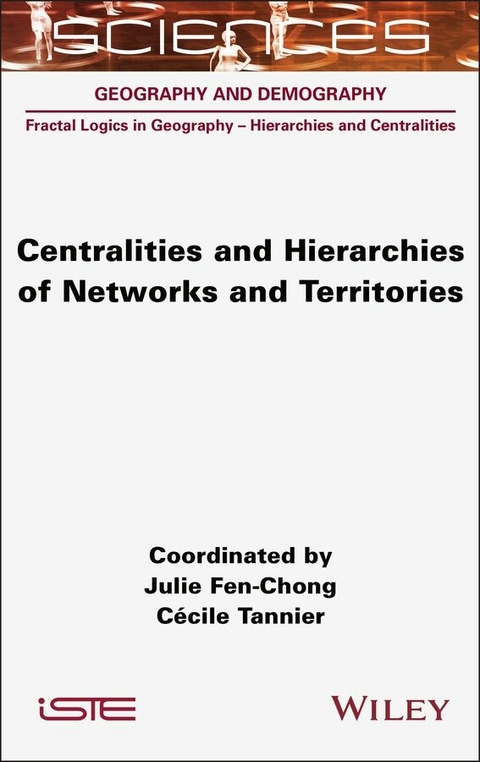
Centralities and Hierarchies of Networks and Territories (eBook)
392 Seiten
Wiley-Iste (Verlag)
9781394388561 (ISBN)
Digital data, graph theory and spatial modeling allow us to apply the concepts of centralities and hierarchies to a wide variety of spatial situations.
The authors of this book offer insight into centralities and hierarchies within networks and territories at different scales and temporalities and for different socio-spatial phenomena. The first part of the book explores the contribution of data from cell phones and social networks to understanding the centralities and hierarchies of urban space within a circumscribed temporality. The second part uses network analysis - ecological networks, media networks and scientific knowledge networks - to propose indicators of spatial organization that reveal the centralities and hierarchies of spatial systems. Finally, in the third part, the territorial processes behind the formation of centralities and hierarchies are presented from a long-term perspective.
Julie Fen-Chong is Geographer and Research Professor at the Université Bourgogne Europe and the ThéMA laboratory, France. Her research interests concern mobility and its effects on the organization of space, which she studies using geomatic and interdisciplinary approaches.
Cécile Tannier is Director of Research in Geography at the ThéMA laboratory (CNRS, Université Marie et Louis Pasteur), France. Her research focuses on changes in the location of activities, the shape of cities and the dynamic modeling of settlement systems.
Digital data, graph theory and spatial modeling allow us to apply the concepts of centralities and hierarchies to a wide variety of spatial situations. The authors of this book offer insight into centralities and hierarchies within networks and territories at different scales and temporalities and for different socio-spatial phenomena. The first part of the book explores the contribution of data from cell phones and social networks to understanding the centralities and hierarchies of urban space within a circumscribed temporality. The second part uses network analysis ecological networks, media networks and scientific knowledge networks to propose indicators of spatial organization that reveal the centralities and hierarchies of spatial systems. Finally, in the third part, the territorial processes behind the formation of centralities and hierarchies are presented from a long-term perspective.
Introduction
Julie FEN-CHONG
ThéMA, CNRS, University of Burgundy, Dijon, France
Geographical space is shaped by movements and exchanges between people and activities located across the Earth’s surface. Its heterogeneity has traditionally been analyzed in geography through the lenses of centrality and hierarchy. Over the past three decades, the representations we have of this space have been profoundly transformed. New communication technologies, notably GPS and smartphones using geolocation, have deeply altered our mobility practices, while new social networks have disrupted the flow of information among individuals. The new data generated by these technologies allow for the observation of movements at temporal and spatial scales considerably more precise than was previously possible. This book seeks to explore two broad questions tied to this new context: what knowledge do the data derived from new communication and information technologies bring to our understanding of spatial networks and their associated territories? How, and to what extent, do these new data and technologies reconstruct the previously existing centralities and hierarchies within geographical space?
The concepts of centrality and hierarchy are fundamental to the field of geography. Whether at the scale of a vast territory, a city or a smaller space, differences in potential between locations generate flows of exchanges and movements. Due to their comparative advantages, certain locations attract more than others and thus polarize the space. For geographers, these locations constitute centralities, both morphological and functional, whose varying importance leads to a hierarchical structuring of space.
Central places, the focus of Christaller’s eponymous theory in 1933, are areas where human activities are concentrated. They provide goods and services to their resident populations and the surrounding regions. The level of diversity and rarity of goods and services offered by these places depends on their population size and serves as an indicator of their position within the urban hierarchy. Christaller’s theory explains the spatial distribution of central places based on differences in centrality. Central places of the same level are equidistant from each other. Their zones of attraction are nested according to their position within the hierarchy and polarize populations from varying distances. Central places higher in the urban hierarchy have larger zones of polarization than those that offer fewer goods and services and occupy lower ranks in the hierarchy. The concepts of centrality and hierarchy are thus interlinked, and quantifying centrality helps measure a place’s rank within the hierarchy.
Christaller’s central place theory has been applied in a number of publications. For instance, in the study by Fleury et al. (2012) on the organization of commerce in Paris, functional centrality is expressed relative to the local environment, based on the rarity and diversity of available businesses. The morphological centrality of Parisian businesses, in turn, is defined through the density and diversity of businesses, the intensity of specialization and local differentials. Other researchers view functional centrality as more tied to coordination or relational functions, considering centrality to involve only a small number of places or neighborhoods (Gaschet and Lacour 2002). In urban economics, centrality is linked to job concentration, activities and maximal accessibility. In the monocentric model developed by Alonso (1964), Mills (1967) and Muth (1969), the urban center is the area with the highest land rent due to the advantages of its location. However, the emergence of multiple employment hubs within a single metropolitan area challenges this monocentric model of a city. The monocentric city either no longer exists or has evolved into multiple centralities of varying sizes and specializations (McMillen 2001). As early as the 20th century, observed land values suggested the presence of peripheral centralities, indicating that the monocentric model might be merely a theoretical construct. According to Berroir et al. (2008, our translation), widespread mobility has driven the rise of peripheral centralities: “The links between urban structures and mobility practices contribute to the formation of increasingly polycentric metropolitan territorialities, both morphologically and functionally”. Berroir et al. (2007), analyzing employment hubs and commuter flows, identified 67 hubs structuring the Île-de-France region. The role of employment and commuting in spatial organization is fundamental, and the decentralization of jobs in Île-de-France strengthens the hypothesis of metropolitan polycentrism.
In this book, the concepts of centrality and hierarchy are revisited in light of data from new communication and information technologies. Defining and measuring centrality represents one of the methodological challenges the authors attempt to address. Geolocated data on populations present in a given territory throughout the day enable the construction of centrality indicators suited to the dynamic representation of the urban space. Urban space thus comprises secondary centers that come to life following urban rhythms, as illustrated by Julie Fen-Chong and Françoise Lucchini in Chapters 1 and 2 of this book. To operationally define urban centrality, Mohamed Hilal and Virginie Piguet (Chapter 6) rely on three criteria: population levels, employment levels and the presence of businesses and services.
The concept of centrality, employed in geography to describe and compare locations, is also found in interdisciplinary research drawing on graph theory; here, central places correspond to specific nodes within a graph, defined by their accessibility and connectivity. Physical networks, such as transportation and ecological networks, as well as intangible networks, such as knowledge networks, feature central nodes. Graph theory metrics allow for the measurement of centralities in networks as diverse as global media representations (Chapter 3) or ecological networks (Chapter 5).
In Chapter 7 of this book, Cécile Tannier demonstrates that centralities and hierarchies represent two facets of the same sociospatial phenomenon, applicable at both intra-urban levels and across city or settlement systems. The concentration of individuals and their activities in central places leads to a hierarchical structuring of these locations in relation to each other. Urban hierarchy “refers to a form of societal organization within a given territory, initially identified by engineers and modeled by geographers” (Pumain 2004, our translation). As Juste Raimbault explains (Chapter 8), hierarchy takes on several forms: order hierarchy, inclusion hierarchy, control hierarchy and level hierarchy. These different types of hierarchy are intrinsic to territorial systems and can be observed through scaling laws. Studying hierarchical patterns using various indicators also reveals correlations between different types of hierarchies, such as between population hierarchies and transportation network hierarchies (Chapter 8) or between urban hierarchies and scientific production hierarchies (Chapter 4).
The book consists of three main parts.
In the first part, titled “Spatial Practices as Indicators of Centralities and Hierarchies”, centralities and hierarchies are explored at the territorial level through the study of individual spatial practices. This part presents empirical studies that utilize diverse data sources such as mobile phone data and data from social networks. These data enable the dynamic analysis of spatial practices, providing insights into the changes occurring within centralities and hierarchies in intra- and interurban spaces over short time scales. In the first chapter, Julie Fen-Chong discusses the specificities of mobile phone and Twitter data, which facilitate a fine-grained spatiotemporal understanding of spatial organization, renewing static approaches and enriching previously inadequate datasets for some studies. The author demonstrates how studies utilizing these data have transformed approaches to intra-urban centralities and the hierarchy of places. Centralities are defined as locations that polarize individuals, while hierarchies are conceptualized as the structuring of these centralities based on differences in potential and attractiveness. The second chapter, authored by Françoise Lucchini, emphasizes the value of these materials in measuring ephemeral phenomena. Determining the appropriate spatiotemporal aggregation level to measure recurrent and ephemeral centralities is the key challenge discussed in this chapter. For Françoise Lucchini, phenomena can be perceived through either a surface-based approach or a network-based approach. The surface-based approach observes ephemeral concentrations across territories, identifying specific events. The network-based approach captures flows of movement between territorial grid cells. These interactions between units dynamically reshape existing centralities throughout the day.
The second part of the book, titled “Networks as Creators of Centralities and Hierarchies”, examines networks, both material (e.g. ecological networks) and immaterial, which, though intangible, are inherently spatially embedded. Immaterial flows, such as media and knowledge flows, rely on and are anchored in territories characterized by inherent heterogeneity. Analyzing the...
| Erscheint lt. Verlag | 19.6.2025 |
|---|---|
| Reihe/Serie | ISTE Invoiced |
| Sprache | englisch |
| Themenwelt | Naturwissenschaften ► Geowissenschaften ► Geografie / Kartografie |
| Schlagworte | Centralities • circumscribed temporality • Digital Data • graph theory • Hierarchies • network analysis • socio-spatial phenomena • spatial modeling • Spatial Systems |
| ISBN-13 | 9781394388561 / 9781394388561 |
| Informationen gemäß Produktsicherheitsverordnung (GPSR) | |
| Haben Sie eine Frage zum Produkt? |
 EPUB (Adobe DRM)
Kopierschutz: Adobe-DRM
Adobe-DRM ist ein Kopierschutz, der das eBook vor Mißbrauch schützen soll. Dabei wird das eBook bereits beim Download auf Ihre persönliche Adobe-ID autorisiert. Lesen können Sie das eBook dann nur auf den Geräten, welche ebenfalls auf Ihre Adobe-ID registriert sind.
Details zum Adobe-DRM
Dateiformat: EPUB (Electronic Publication)
EPUB ist ein offener Standard für eBooks und eignet sich besonders zur Darstellung von Belletristik und Sachbüchern. Der Fließtext wird dynamisch an die Display- und Schriftgröße angepasst. Auch für mobile Lesegeräte ist EPUB daher gut geeignet.
Systemvoraussetzungen:
PC/Mac: Mit einem PC oder Mac können Sie dieses eBook lesen. Sie benötigen eine
eReader: Dieses eBook kann mit (fast) allen eBook-Readern gelesen werden. Mit dem amazon-Kindle ist es aber nicht kompatibel.
Smartphone/Tablet: Egal ob Apple oder Android, dieses eBook können Sie lesen. Sie benötigen eine
Geräteliste und zusätzliche Hinweise
Buying eBooks from abroad
For tax law reasons we can sell eBooks just within Germany and Switzerland. Regrettably we cannot fulfill eBook-orders from other countries.
aus dem Bereich