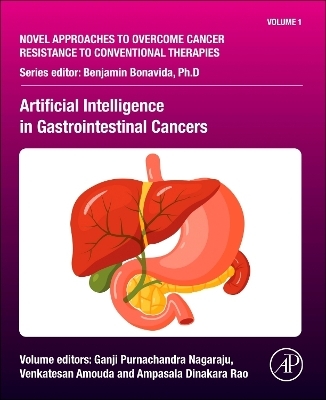
Artificial Intelligence in Gastrointestinal Cancers
Academic Press Inc (Verlag)
978-0-443-44121-9 (ISBN)
- Noch nicht erschienen (ca. April 2026)
- Versandkostenfrei
- Auch auf Rechnung
- Artikel merken
Dr. Nagaraju obtained his MSc and his PhD, both in Biotechnology, from Sri Venkateswara University in Tirupati, Andhra Pradesh, India. He received his DSc from Berhampur University in Berhampur, Odisha, India. Dr. Nagaraju’s research focuses on translational projects related to gastrointestinal malignancies. He has published over 100 research papers in highly reputed international journals and has presented more than 50 abstracts at various national and international conferences. Dr. Nagaraju is author and editor of several published books in Elsevier and Springer Nature. He serves as editorial board member of several internationally recognized academic journals. Dr. Nagaraju has received several international awards including FAACC. He also holds memberships with the Association of Scientists of Indian Origin in America (ASIOA), the Society for Integrative and Comparative Biology (SICB), The Science Advisory Board, The RNA Society, The American Association for Clinical Chemistry (AACC) and the American Association of Cancer Research (AACR). Dr. V. Amouda is an Assistant Professor with a demonstrated history of working in higher education at the Department of Bioinformatics, Pondicherry University, Puducherry, India. She possesses a doctoral degree in Computer Science & Engineering from Pondicherry University. She has more than a decade of research and development experience in new computational data technologies focusing on Data analysis, Machine learning, Data mining, and Big Data analytics across biomedical areas. She has published more than 50 research articles in peer-reviewed international journals and presented many abstracts at national and international conferences. Dr. V. Amouda is a co-author of 4 book chapters published by International publishers and a reviewer of many international journals. She promotes science and progress by organizing 35 national and international conferences at various platforms in the Bioinformatics and Computer Science fields. She has a strong administrative professional experience with a track of contributing science to society by associating with various scientific bodies of Government & NGOs. She has experience in extension activities as she is a member of learned societies of national professional agencies. Dr. Ampasala earned his PhD degree in biochemistry from Sri Venkateswara University. He spent 12 years in research and teaching at Pondicherry University, Puducherry, India, and 10 years in postdoctoral studies in cancer research in United States and Canada. Dr. Ampasala’s current research focuses are on functional genomics, molecular mechanisms of cancer, signal transduction, and computational neurobiology and has published nearly 70 peer-reviewed scholarly research articles and book chapters, which are extensively cited globally. He is a reviewer and editorial member for several biomedical/bioinformatics journals and has received several competitive research grants for his research accomplishments/contributions. He has been honored with fellow award from the Society of Plant Research (2019), and he has bagged other prestigious awards such as DST-Young Scientist (2008), DBT-Young Investigator (2015), Science Communicator-ISCA (2013, 2014), and the Best Teacher Award (2011, Pondicherry University). He received VA Merit Award from Wayne State University, Detroit, MI, United States (2005–2007) for his postdoctoral studies; research associate fellowship funded by Genomic Canada, Canada (2001-2005); and postdoctoral fellowship funded by DBT, Indian Institute of Science (1999–2001).
1. General Introduction of GI Malignancies, Current Treatments and Failures
2. Introduction to AI Applications in GI Cancers
3. AI Classifications and Their Applications
4. Machine Learning and Deep Learning Algorithms and Their Applications in GI Cancers
5. AI-Powered Diagnosis for Gastrointestinal Cancers
6. Advanced Applications of Artificial Intelligence and Biosensors in the Diagnosis and Treatment of Gastrointestinal Cancers
7. Biomarker Discovery in Gastrointestinal Malignancies
8. Exploring New Horizons in the Discovery of Biomarkers for Gastrointestinal Cancers Through Deep Learning
9. AI Detected Targets in GI Cancers
10. AI in Precision Medicine for GI Cancers
11. AI for Immunotherapeutic Strategies for GI Cancers
12. Exploring AI-Enabled Drug Discovery and Repurposing Approaches for Gastrointestinal Tract Cancer
13. From Structure to Therapy: Exploring PRAS40 and AI Approaches in GI Cancers Therapy
14. Transforming Gastrointestinal Cancers Care with Applications and Advancements of Artificial Intelligence and Machine Learning: A Next-Generation Patient Care
15. Future Directions for AI in GI Cancers
| Erscheint lt. Verlag | 1.4.2026 |
|---|---|
| Reihe/Serie | Novel approaches to overcome cancer resistance to conventional therapies |
| Verlagsort | San Diego |
| Sprache | englisch |
| Maße | 191 x 235 mm |
| Gewicht | 450 g |
| Themenwelt | Naturwissenschaften ► Biologie |
| ISBN-10 | 0-443-44121-9 / 0443441219 |
| ISBN-13 | 978-0-443-44121-9 / 9780443441219 |
| Zustand | Neuware |
| Informationen gemäß Produktsicherheitsverordnung (GPSR) | |
| Haben Sie eine Frage zum Produkt? |
aus dem Bereich