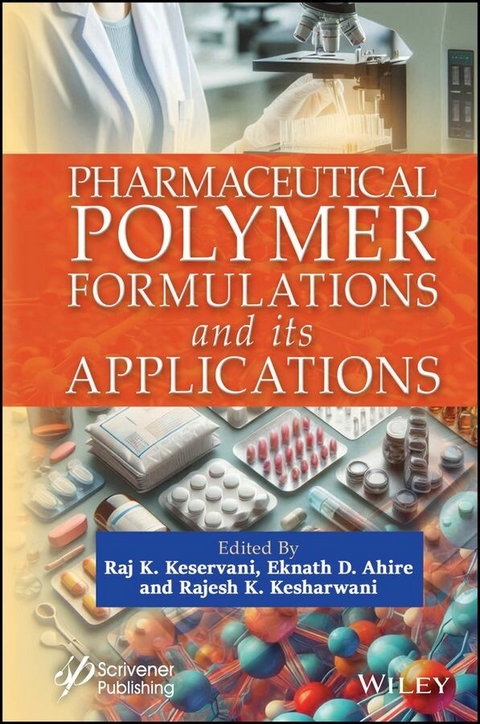
Pharmaceutical Polymer Formulations and its Applications (eBook)
745 Seiten
Wiley-Scrivener (Verlag)
978-1-394-17283-2 (ISBN)
The book is an essential resource for anyone in the pharmaceutical field, as it provides in-depth insights into the versatile roles of polymers in controlled drug delivery, highlighting their critical applications in product innovation, development, and manufacturing.
Pharmaceutical Polymer Formulations and Its Applications provides an overview of the applications of pharmaceutical polymers in the vast field of controlled drug delivery. Polymers have the potential for a range of uses in the design of pharmaceutical dosage forms. They can be used as suspending, emulsifying, binding, or flocculant agents, as well as adhesives and packaging and coating materials. They can be used to make gels, nanoparticles, microparticles, and various capsules. Polymers have played an indispensable role in the manufacture of pharmaceutical products. This volume includes various polymers used in pharmacy based on their applications. The overviews focus on the use of pharmaceutical polymers for controlled drug delivery applications. Examples of pharmaceutical polymers and the principles of controlled drug delivery are outlined, and applications of polymers for controlled drug delivery are also discussed.
Readers will find the book:
- Explores the latest tactics utilized for the application of polymers in the healthcare industry;
- Showcases the numerous innovations of polymers in manufacturing of pharmaceuticals;
- Provides essential elements for the conceptualization and comprehension of polymer products by highlighting their aspects and overcoming manufacturing, regulatory, and quality control obstacles.
Audience
The book will interest chemists and healthcare professionals interested in pharmaceutical innovation using polymers.
The book is an essential resource for anyone in the pharmaceutical field, as it provides in-depth insights into the versatile roles of polymers in controlled drug delivery, highlighting their critical applications in product innovation, development, and manufacturing. Pharmaceutical Polymer Formulations and Its Applications provides an overview of the applications of pharmaceutical polymers in the vast field of controlled drug delivery. Polymers have the potential for a range of uses in the design of pharmaceutical dosage forms. They can be used as suspending, emulsifying, binding, or flocculant agents, as well as adhesives and packaging and coating materials. They can be used to make gels, nanoparticles, microparticles, and various capsules. Polymers have played an indispensable role in the manufacture of pharmaceutical products. This volume includes various polymers used in pharmacy based on their applications. The overviews focus on the use of pharmaceutical polymers for controlled drug delivery applications. Examples of pharmaceutical polymers and the principles of controlled drug delivery are outlined, and applications of polymers for controlled drug delivery are also discussed. Readers will find the book: Explores the latest tactics utilized for the application of polymers in the healthcare industry; Showcases the numerous innovations of polymers in manufacturing of pharmaceuticals; Provides essential elements for the conceptualization and comprehension of polymer products by highlighting their aspects and overcoming manufacturing, regulatory, and quality control obstacles. Audience The book will interest chemists and healthcare professionals interested in pharmaceutical innovation using polymers.
1
Overview and Introduction of Polymers Used in Pharmaceuticals
Nikhil Rajnani1*, Nalini Kurup1, Nikita Rajnani2 and Selvakumar Sambandan2
1Department of Pharmaceutics, Principal K. M. Kundnani College of Pharmacy, Cuffe Parade, Mumbai, India
2Department of Pharmacovigilance, Cognizant Technology Solutions, Navi Mumbai, India
Abstract
Polymers are very important in the process of making pharmaceutical goods. When it comes to chemicals, polymers are known for being big and heavy. Polymers are made up of many smaller parts called monomers. These monomers are linked together by covalent bonds or other chemical reactions. When several monomer units are joined together to make a long chain polymer, this is called polymerization. Polymer nanoparticles (PNPs) are made using physical methods or direct nanosynthesis. They are then polymerized in microor nanoemulsions with nanoreactor sections. Polymers from both natural and man-made sources are used a lot in the medicinal and biomedical fields, and their use is growing quickly. Polymers are used a lot in the pharmacy business today to control how drugs are released. We will talk about this subject in more detail in the parts that follow. Other applications of polymers are packaging materials, medical equipment, and packaging aids for pharmaceuticals, such as coating agents, suspending agents, emulsifying agents, adjuvants, adhesives, etc. This chapter’s goal is to offer a comprehensive overview of the classification of polymers, characterization, and many applications for pharmaceutical polymers in solid oral dosage forms. The several kinds of polymeric excipients are discussed, and their unique functions in oral medication administration are highlighted. This chapter may help scientists rationally use polymeric excipients, taking full advantage of their many properties and potential effects on drug delivery.
Keywords: Polymers, nanospheres, nanocapsules, polymerization, monomer
1.1 Introduction
The quest to produce pharmaceuticals that are effective and reasonably priced presents pharmaceutical businesses with ongoing difficulties in adapting and creating new and efficient production procedures. Pharmaceutical firms are continuously seeking methods to increase their efficiency and cost-effectiveness due to the fast-growing global competition [1]. In the past few years, there has been a lot of interest in making new plastics and changing their qualities to make them more useful in biology and medicine [2]. The Greek words “poly” (meaning many) and “meros” (meaning pieces) are where the word “polymer” comes from. Polymers are large molecules made up of many smaller molecules known as monomers. A “polymer” is a material that is made up of many different parts. A polymer is made up of many monomers that are grouped in a certain way and are repeated [3]. Molecular weights (MWs), shapes, levels of crystallinity, polymerization, and architectures are just a few of the physical and chemical characteristics that can vary between polymers. Because these traits can be changed, especially in controlled release delivery systems, it might be possible to solve problems with drug formulation [4]. Polymers are very important in the process of making pharmacological dosage formulas. It is recognized that the physic-chemical characteristics of the polymers employed in the formulation have a crucial role in the clinical effectiveness of pharmaceutical formulations, such as oral dosage forms, implants, transdermal patches, and dispersion systems [5].
1.1.1 History of Polymer
Since ancient times, humans have used oils, resins, gums, tars, and other polymer-based materials to benefit from polymers’ versatility. However, natural polymers have been employed in medicine for many centuries [6].
1.2 Classification of Polymers
Polymer can be classified based on origin and based on bio-stability (Figure 1.1) [8].
Figure 1.1 General classification of polymer.
1.2.1 Sources
Natural Polymer: Also known as biopolymers, natural polymers are polymers that naturally arise in the environment, e.g., glycogen, acacia, gelatin, agar and chitosan, proteins, albumin, keratin, carbohydrates, glycogen, starch, and cellulose [8].
Synthetic Polymers: A synthetic polymer is a polymer that has been created in a lab. These are also referred to as synthetic polymers, e.g., polyanhydrides, polyamides, and polyesters [8].
Semi-Synthetic Polymer: These are naturally occurring polymers that have undergone chemical modification, such as cellulose, cellulose nitrate, methylcellulose, hydrogenated rubber, and natural rubber [8].
1.2.2 Bio-Stability
Biodegradable: A polymer that can be broken down by naturally occurring microorganisms like bacteria and fungus is said to be biodegradable. Because they transform into physiologically inert and compatible molecules when degraded in the body, biodegradable polymers are extremely desired in their current state. Examples are polyester, proteins, and carbohydrates [9].
Non-Biodegradable: To improve the therapeutic effectiveness of a medicine, these polymers are utilized in pharmaceutical formulation. These days, these polymers are utilized in tissue engineering and medication delivery systems [9]. These substances are inert, and they completely disappear from the application location. Examples: ethyl cellulose, hydroxy propyl cellulose (HPMC), and acrylic polymers [10].
1.2.3 Polymerization
Addition Polymer: They are made from monomers linked to vinyl, olefin, and diolefin. These polymers are created by adding monomeric molecules to one another quickly and repeatedly via a chain mechanism. These polymers include polystyrene, polyethylene, and polypropylene [9].
Condensation Polymer: They are created by an intermolecular interaction involving reactive monomeric molecules with bifunctional and multifunctional functional groups, like –COOH, -NCO, -OH, and -NH2 [9].
1.2.4 Interaction with Water
Hydrogels: When placed in water, they swell but do not break down. Example: polyvinylpyrrolidone [8].
Soluble polymer: These uncross-linked polymers with a modest MW dissolve in water. Example: propylene glycol (PEG), and hydroxy propyl cellulose (HPMC) [8].
1.3 Ideal Characteristics of Polymer
- It must be environmentally friendly and inert [11].
- It should be biologically inert and non-toxic [11].
- It ought to be simple to manage [11].
- It must also be affordable and simple to make [11].
- It ought to be mechanically strong [11].
- It must be compatible with the majority of medications [11].
- It must not have a negative impact on the drug’s rate of release [11].
- It must not have a propensity to accumulate in the tissue and be made of a good biodegradable substance [11].
1.4 Characterization of Polymer
- Typically, the MW, content, and thermal characteristics of polymers used in biomedical and pharmaceutical applications are determined. The attributes of the finished gadget or medication may be influenced by all of these aspects [11, 12].
- The main purposes of the characterization approach are to ascertain the molecular mass, molecular structure, morphology, and mechanical characteristics of a substance (Table 1.1) [11, 12].
Table 1.1 Polymer science progress.
| Sr. no. | Year | Description |
|---|
| 1. | 1833 | In reality, several altered natural polymers have been marketed. For instance, nitrated cellulose was labeled as celluloid and Guncotton [7]. |
| 2. | 1839 | Styrene polymerization was reported [7]. |
| 3. | 1845 | Guncotton was the first semi-artificial polymer ever created (cellulose nitrate). Due to this polymer’s low solubility, processability, and explosivity, the production process has altered throughout time [7]. |
| 4. | 1872 | On the basis of phenol and formaldehyde, the synthetic polymer known as bakelite was created. In the car and electronics sectors, polycondensation-based polymeric goods, including Bakelite and those made of epoxy, phenoxy, ketones resins, and acrylic, were employed as in-expensive replacement for various parts [7]. |
1.5 Applications of Polymers in Drug Delivery System
Numerous polymers may be created with desired features for particular applications, especially in the pharmaceutical and biomedical industries (Figure 1.2), thanks to the accessibility of polymeric materials as well as the capacity to modify their varied chemical, physical, or biological properties. This section will include a quick discussion of the most prevalent uses [2].
Figure 1.2 General application of polymer in pharmaceutical industry.
1.5.1 Tablets
The most popular dosage form for pharmacological products intended for oral administration is the tablet. The formulation’s structure and ingredients can be changed to regulate the...
| Erscheint lt. Verlag | 12.6.2025 |
|---|---|
| Sprache | englisch |
| Themenwelt | Naturwissenschaften ► Chemie ► Organische Chemie |
| ISBN-10 | 1-394-17283-4 / 1394172834 |
| ISBN-13 | 978-1-394-17283-2 / 9781394172832 |
| Informationen gemäß Produktsicherheitsverordnung (GPSR) | |
| Haben Sie eine Frage zum Produkt? |
 EPUB (Adobe DRM)
Kopierschutz: Adobe-DRM
Adobe-DRM ist ein Kopierschutz, der das eBook vor Mißbrauch schützen soll. Dabei wird das eBook bereits beim Download auf Ihre persönliche Adobe-ID autorisiert. Lesen können Sie das eBook dann nur auf den Geräten, welche ebenfalls auf Ihre Adobe-ID registriert sind.
Details zum Adobe-DRM
Dateiformat: EPUB (Electronic Publication)
EPUB ist ein offener Standard für eBooks und eignet sich besonders zur Darstellung von Belletristik und Sachbüchern. Der Fließtext wird dynamisch an die Display- und Schriftgröße angepasst. Auch für mobile Lesegeräte ist EPUB daher gut geeignet.
Systemvoraussetzungen:
PC/Mac: Mit einem PC oder Mac können Sie dieses eBook lesen. Sie benötigen eine
eReader: Dieses eBook kann mit (fast) allen eBook-Readern gelesen werden. Mit dem amazon-Kindle ist es aber nicht kompatibel.
Smartphone/Tablet: Egal ob Apple oder Android, dieses eBook können Sie lesen. Sie benötigen eine
Geräteliste und zusätzliche Hinweise
Buying eBooks from abroad
For tax law reasons we can sell eBooks just within Germany and Switzerland. Regrettably we cannot fulfill eBook-orders from other countries.
aus dem Bereich