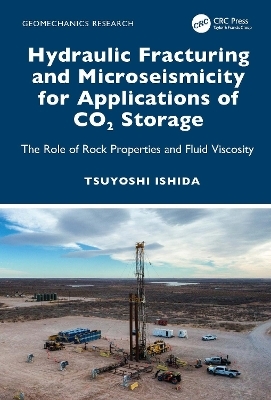
Hydraulic Fracturing and Microseismicity for Applications of CO2 Storage
CRC Press (Verlag)
978-0-367-60843-9 (ISBN)
Hydraulic fracturing (HF) has become essential for extracting oil and gas from unconventional reservoirs and heat energy from hot dry rock masses. However, a paradox remains in the fracturing mode of HF: stress conditions predicted by elasticity theory suggest tensile fracturing, while shear fracturing is dominant in HF-related microseismicity (MS). This book resolves this paradox by reviewing the results of various laboratory and small-scale field experiments conducted by the author over nearly 40 years.
It explores the use of carbon dioxide (CO2) in HF as a method for geologic sequestration and demonstrates that CO2 can induce three-dimensional, sinuous cracks with numerous secondary branches, creating ideal pathways for heat, oil, and gas recovery. The author provides a detailed explanation of the fracturing mechanisms based on rock and fluid properties, particularly the use of supercritical (SC) CO2 as a fracturing fluid. Readers will benefit from a deeper understanding of HF processes and their applications for resource extraction and environmental management.
Hydraulic Fracturing and Microseismicity for Applications of CO2 Storage will serve as a reference for researchers, engineers, and students who are involved or interested in the areas of geomechanics, geophysical exploration, seismology, and geology for petroleum and geothermal engineering, as well as for academics and professionals working in the fields of general rock mechanics, geophysics, and civil engineering.
Tsuyoshi Ishida has been involved in Acoustic Emission (AE) and Micro-seismicity (MS) monitoring for various laboratory and small-scale field experiments on hydraulic fracturing (HF) for nearly 40 years. He obtained his B.E. (1977) and M.S. (1979) degrees in the Department of Mineral Science and Technology from Kyoto University. From 1980 to 1991, he worked at the Central Research Institute of Electric Power Industry, where he conducted rock mechanics research related to the construction of various power generation facilities, such as large underground powerhouse caverns, dams, nuclear power stations, and feasibility studies on high-level radioactive nuclear waste disposal. During this research, he began monitoring AE and MS associated with rock fracturing. He received his Ph.D. (1989) from Kyoto University for his dissertation titled "Study on In-situ Stress State in Rock". From 1991 to 2006, he was a faculty member at Yamaguchi University, where he initiated laboratory HF experiments with AE monitoring. During this period, he also stayed at the University of Minnesota from April 1993 to March 1994 and at the University of Oklahoma from October 1997 to January 1998 as a Visiting Associate Professor. In 2002, he was promoted to Professor at Yamaguchi University, and in 2006, he moved to Kyoto University as a Professor. At Kyoto University, he conducted laboratory and field experiments on HF using water and carbon dioxide for geothermal heat extraction, shale gas/oil exploitation, and underground carbon dioxide sequestration. He retired from Kyoto University in March 2019 upon reaching the mandatory retirement age. He is now a Professor Emeritus at Kyoto University and serves as an adviser for Oyo Corporation, a geological consulting company.
1. Introduction 2. Fracturing Mechanism Depending on Rock Properties 3. Fracturing Mechanism Depending on Viscosity of Fracturing Fluid 4. Numerical Simulation Using Distinct Element Method for Hydraulic Fracturing Considering Fluid Viscosity and Particle Size Distribution 5. Carbon Dioxide Fracturing Experiment in Laboratory 6. Small-Scale Field Water Refracturing Experiments 7. Small-Scale Field Carbon Dioxide Fracturing Experiments 8. Conclusions
| Erscheinungsdatum | 17.10.2025 |
|---|---|
| Reihe/Serie | Geomechanics Research |
| Zusatzinfo | 9 Tables, black and white; 14 Line drawings, color; 138 Line drawings, black and white; 4 Halftones, color; 23 Halftones, black and white; 18 Illustrations, color; 161 Illustrations, black and white |
| Verlagsort | London |
| Sprache | englisch |
| Maße | 174 x 246 mm |
| Gewicht | 580 g |
| Themenwelt | Naturwissenschaften ► Biologie ► Ökologie / Naturschutz |
| Technik ► Bauwesen | |
| Technik ► Bergbau | |
| ISBN-10 | 0-367-60843-X / 036760843X |
| ISBN-13 | 978-0-367-60843-9 / 9780367608439 |
| Zustand | Neuware |
| Informationen gemäß Produktsicherheitsverordnung (GPSR) | |
| Haben Sie eine Frage zum Produkt? |
aus dem Bereich