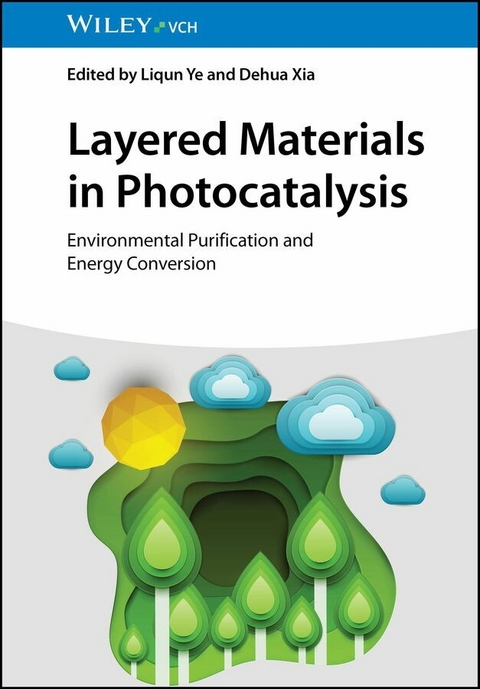
Layered Materials in Photocatalysis (eBook)
633 Seiten
Wiley-VCH (Verlag)
978-3-527-84397-8 (ISBN)

Increase photocatalytic efficiency with cutting-edge materials
Photocatalysis, which modifies the rate of reactions stimulated by light absorption, can be a critical component of many catalytic processes. Layered structures can be used in photocatalysis to broaden surface area and generate more numerous reaction sites, which can in turn increase both photocatalytic activity and quantum efficiency. In recent years these layered materials have generated numerous applications in energy production and environmental chemistry.
Layered Materials in Photocatalysis introduces these materials, their historical development, and their key properties. Analyzing all major classifications of layered photocatalysts, it details their key environmental and energy applications and offers predictions for future research and development. The result is a crucial volume summarizing a growing technology.
Layered Materials in Photocatalysis readers will also find:
- Combines both science and skills for professionals in the field
- Detailed discussion of layered bismuth-based photocatalysts, metal-free layered photocatalysts, and many more
- Authored by one of the leading experts in structured materials in photocatalysis
Layered Materials in Photocatalysis is ideal for catalytic chemists, photochemists, and any other scientists working with catalytic or energy-generating processes.
Liqun Ye, PhD, is a Professor of Chemistry at China Three Gorges University, Yichang, People's Republic of China. He has researched and published extensively on nanomaterials in photocatalysis, and has been rated a Highly Cited Scientist by Clarivate Analytics.
Dehua Xia, PhD, is a Professor of School of Environmental Science and Technology, Sun Yat-sen University, Guangzhou, People's Republic of China. He is mainly engaged in the research on environmental microinterface chemical processes and pollution control.
1
Basic Principles of Photocatalysis
Baker Rhimi and Zhifeng Jiang
Jiangsu University, Institute for Energy Research, School of Chemistry and Chemical Engineering, Zhenjiang 212013, China
1.1 Introduction
Solar energy, being the primary energy source derived from extraterrestrial space, represents a boundless and renewable resource with the potential to surpass global energy demands. Solar energy is widely regarded as the ultimate renewable resource available on Earth due to the long‐predicted lifetime of the sun. However, the energy source under consideration poses notable challenges in terms of harvesting, storage, and utilization due to its diurnal and intermittent features [1, 2]. Currently, there exist various technologies that can be employed to tackle these challenges. One avenue of exploration involves collecting and converting solar energy into thermal energy, which can be utilized to provide heat to residential areas or be further transformed into electricity, along with other types of energy. One of the most extensively researched areas in solar photon harvesting pertains to technologies based on the photovoltaic effect, which relies on advancements in semiconductor theory and practice. These advancements have greatly propelled the field, enabling the efficient transformation of sunlight into electrical energy.
Photochemical reactions are another well‐studied approach for the harvesting and storage of solar energy. The underlying reason is that chemical bonds serve as advantageous mediums for the storage of energy. Over billions of years, biological sources, primarily through photosynthesis, have contributed to the composition of the Earth's atmosphere, with oxygen (O2) constituting approximately 21% of its makeup. This cumulative energy derived from chemical reactions throughout evolutionary history is of immense magnitude, surpassing the quantifiable extent of known reserves of fossil fuels. The understanding of natural photosynthesis process has served as a source of inspiration for numerous scientists, motivating them to create technologies that surpass their efficiency and cost‐effectiveness in order to address our continuously expanding energy demands. Nevertheless, it is crucial to realize that the full investigation of photosynthesis extends beyond the field of solar energy storage, yielding wider implications. The utilization of photon energy, rather than heat to facilitate and potentially drive chemical reactions is a topic of considerable academic interest. The field of study encompassing this particular area of research has been widely recognized and commonly referred to as photocatalysis [3].
Photocatalysis has emerged as a promising approach to tackle environmental and energy challenges by harnessing solar radiation, and it has received significant global interest over the past five decades [4–6]. Research interest in photocatalysis has grown due to the increasing emphasis on sustainability. One promising application of photocatalysis is the direct storage of solar energy in chemicals, also known as solar fuels and artificial photosynthesis. This chapter starts by elucidating the fundamental principles underlying the interaction between light and matter, as well as the electronic structure of semiconductors. These concepts serve as the basis for understanding photocatalysis. Furthermore, this chapter explores the key steps of charge generation, separation, and transfer that take place within photocatalytic systems. The mechanisms by which photon‐induced electron–hole pairs are formed, dissociated, and directed toward specific chemical reactions are explored. Special attention is given to the factors influencing photocatalytic performance, including the selection of appropriate materials, surface modifications, and cocatalyst strategies. The role of dopants, facet engineering, and heterojunctions in enhancing photocatalytic performance is discussed, shedding light on the strategies employed to improve the overall efficiency of photocatalytic systems. Finally, the chapter highlights some key applications of photocatalysis, such as solar hydrogen production through photocatalytic water splitting and environmental remediation by providing real‐world examples and case studies.
1.2 Definition and Fundamental Principles of Photocatalysis
Photocatalysis, which takes inspiration from natural photosynthesis, involves the use of light to drive fundamental processes [7, 8]. Photosynthesis is the term used to describe the mechanism through which green plants, microalgae, and certain bacteria capture sunlight energy to drive energetically demanding reactions, such as the conversion of carbon dioxide (CO2) and water (H2O) into carbohydrates. While the specific mechanisms of photosynthesis can differ among various organisms, they are grounded in fundamental principles that are shared. The general framework of oxygenic photosynthesis, depicted in Figure 1.1a, serves as a basis for understanding these processes. This process, known as the “Z‐scheme,” involves two photosystems (PSI and PSII) as the key components. In PSII, chlorophylls absorb photons with a maximum wavelength of 680 nm (P680) and transfer the energy to extract electrons from H2O, resulting in the production of oxygen through water‐oxidation catalysts. The separated electrons are then transferred to PSI, where chlorophylls absorb photons with a maximum wavelength of 700 nm (P700). The energy from these photons further excites the electrons transferred from PSII, enabling them to reduce nicotinamide adenine dinucleotide phosphate (NADP+ → NADPH). Along with the proton gradient generated during the process, NADPH drives downstream transformations, such as the conversion of CO2 to hydrocarbons via the Calvin cycle [7, 9]. The key aspect of natural photosynthesis is its ability to drive chemical reactions using optical energy. Photocatalysis, which dates back to early research by Edmond Becquerel in 1839 [11], gained significant attention in the late 1960s, thanks to pioneers like Boddy [12] and Honda and Fujishima [13]. In their experiments, Honda and Fujishima coated a titanium dioxide (TiO2) electrode with a thin film of platinum (Pt) and immersed it in a solution containing water. Upon subjecting the electrode to ultraviolet (UV) light, they observed the generation of oxygen gas at the anode and hydrogen gas at the cathode. This observation suggests that water is undergoing a photoelectrochemical process, resulting in the separation of its constituent elements (H2O → H2 + 1/2O2). The aforementioned discovery exemplified the potential of semiconductor materials, particularly TiO2, in serving as photocatalysts for the process of water splitting and the subsequent generation of renewable hydrogen. The phenomenon was designated as the “Honda–Fujishima effect” and served as the basis for extensive investigation in the field of photocatalysis.
Figure 1.1 (a) Schematic representation of natural photosynthesis.
Source: Reproduced with permission from Tachibana et al. [9]/Springer Nature.
(b) Gibbs free energy landscape (G‐potential landscape) of downhill and uphill photocatalytic reactions via the interfacial electron transfer (IET).
Source: Reproduced with permission from Liu et al. [10]/American Chemical Society.
Semiconductor photocatalysis focuses on the use of semiconductor materials as catalysts for light‐driven chemical reactions. Semiconductor materials, namely, TiO2, ZnO, and WO3, exhibit unique properties that make them well‐suited for usage in photocatalytic applications. The material absorbs photons of light and subsequently generates electron–hole pairs. When the energy of incident light equals or exceeds the bandgap energy of a material, electrons in the valence band (VB) are excited to the conduction band (CB), leaving behind positively charged holes in the VB (Figure 1.1b). The electrons and holes generated by photosensitivity have the ability to engage in diverse chemical reactions on the semiconductor's surface [5, 6, 14]. Semiconductor photocatalysts have the ability to facilitate various reactions, including water splitting, pollutant degradation, carbon dioxide reduction, and organic synthesis, by harnessing the energy from sunlight.
In the context of utilizing light energy for driving reactions, it is important to distinguish between two scenarios. First, there are situations where a material employs light energy to facilitate thermodynamically downhill reactions (ΔG < 0, as depicted in Figure 1.1b). In this scenario, the material does not alter the thermodynamics of the reaction but rather enhances the reaction kinetics by providing an alternative pathway through the absorption of optical energy. In such cases, the material can be classified as a photocatalyst only if the photon is considered as a reactant. An example of this situation is the complete oxidation of phenol to CO2 and H2O (ΔG = −3027.36 kJ mol−1) [15]. Conversely, when a material utilizes light to drive thermodynamically uphill reactions (positive Gibbs free energy change, ΔG > 0, as shown in Figure 1.1b), it can be considered as a form of photosynthesis. In this case, the material can be referred to as a...
| Erscheint lt. Verlag | 11.6.2025 |
|---|---|
| Sprache | englisch |
| Themenwelt | Naturwissenschaften ► Chemie ► Physikalische Chemie |
| Schlagworte | 2D heterojunction between layered photocatalysts • energy conversion • Environmental remediation • layered bismuth-based photocatalysts • layer structured co-catalysts • metal-free layered photocatalysts • photoadsorption • Quantum efficiency |
| ISBN-10 | 3-527-84397-3 / 3527843973 |
| ISBN-13 | 978-3-527-84397-8 / 9783527843978 |
| Informationen gemäß Produktsicherheitsverordnung (GPSR) | |
| Haben Sie eine Frage zum Produkt? |
 EPUB (Adobe DRM)
Kopierschutz: Adobe-DRM
Adobe-DRM ist ein Kopierschutz, der das eBook vor Mißbrauch schützen soll. Dabei wird das eBook bereits beim Download auf Ihre persönliche Adobe-ID autorisiert. Lesen können Sie das eBook dann nur auf den Geräten, welche ebenfalls auf Ihre Adobe-ID registriert sind.
Details zum Adobe-DRM
Dateiformat: EPUB (Electronic Publication)
EPUB ist ein offener Standard für eBooks und eignet sich besonders zur Darstellung von Belletristik und Sachbüchern. Der Fließtext wird dynamisch an die Display- und Schriftgröße angepasst. Auch für mobile Lesegeräte ist EPUB daher gut geeignet.
Systemvoraussetzungen:
PC/Mac: Mit einem PC oder Mac können Sie dieses eBook lesen. Sie benötigen eine
eReader: Dieses eBook kann mit (fast) allen eBook-Readern gelesen werden. Mit dem amazon-Kindle ist es aber nicht kompatibel.
Smartphone/Tablet: Egal ob Apple oder Android, dieses eBook können Sie lesen. Sie benötigen eine
Geräteliste und zusätzliche Hinweise
Buying eBooks from abroad
For tax law reasons we can sell eBooks just within Germany and Switzerland. Regrettably we cannot fulfill eBook-orders from other countries.
aus dem Bereich