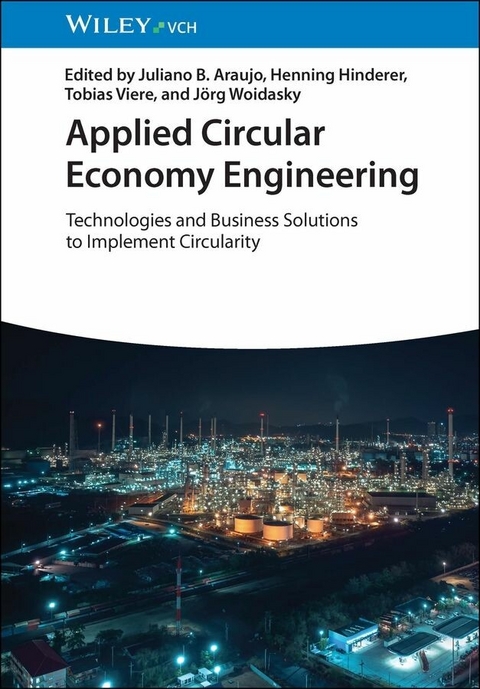
Applied Circular Economy Engineering (eBook)
543 Seiten
Wiley-VCH (Verlag)
978-3-527-84730-3 (ISBN)
An essential resource for circular economy engineering as a business sustainability solution and risk mitigation measure
In Applied Circular Economy Engineering: Technologies and Business Solutions to Implement Circularity, a team of distinguished researchers delivers an up-to-date discussion of the implementation of circular economy concepts in industrial practice. It examines a comprehensive range of solutions and ideas from engineering and business research from the perspective of the European Circular Economy Package.
The book explores the most relevant material and product flows, including metals, polymers, and food, as well as common product lifecycle steps, like product design, material extraction, and recycling. Applied Circular Economy Engineering explains the most effective applied practices, business considerations, and forward-looking solutions to frequently experienced business problems.
Readers will also find:
- A thorough introduction to how circular economy considerations influence process design, product design, energy, and waste management
- Real-world case studies of circular design and processes
- Practical discussions of a wide variety of industries adopting circular economy principles, including medical devices and food
- Complete treatments of circular economy implementation and challenges, including business circularity maturity assessments and transition plans
Perfect for chemical and process engineers, Applied Circular Economy Engineering: Technologies and Business Solutions to Implement Circularity will also benefit business economists, product planners, and anyone else involved in the engineering and development of circular products or processes.
Juliano B. Araujo, PhD, is a production engineer with a doctorate in sustainable manufacturing from the University of Sao Paulo. He's a visiting scientist at Pforzheim University's Institute for Industrial Ecology.
Henning Hinderer, PhD, is Vice Dean and Head of the Business Administration and Engineering department at Pforzheim University. His research focuses on the strategic and technical aspects of value chains.
Tobias Viere, PhD, is Professor at Pforzheim University's business school and directs the Life Cycle & Sustainability master's program.
Jörg Woidasky, PhD, is Professor of Sustainable Product Development at the Faculty of Engineering at Pforzheim University. His research is focused on sustainable processes and product design.
Chapter 1
Challenges and Perspectives of Applying Circular Economy in Business and Engineering
Juliano Araujo, Henning Hinderer, Tobias Viere, Jörg Woidasky
Institute for Industrial Ecology (INEC), Pforzheim University, Pforzheim, Germany
1.1 Introduction
There is a trend among companies to shift toward the circular model of production, seeking to replace the old linear model of “take-make-use-dispose.” The previous model relied on and still relies heavily on cheap energy, abundant minerals, materials, and credit (Webster 2017). Additionally, the environmental and social side effects mount to unsustainable levels, driving new government regulations and initiatives that focus on controlling and reversing the current scenario, e.g., the European Union (EU) Circular Economy Action Plan (European Commission 2020) or the US Save our Seas 2.0 Act (US Government 2020). This has led to a sense of urgency in companies, as they look to the circular economy (CE) as a way to mitigate the risk of mounting costs, shortages, and even the collapse of the system in the future.
In a wide array of definitions for CE, the following definition by the Ellen MacArthur Foundation (2013, p. 7) is the most prominent one: “an industrial system that is restorative or regenerative by intention and design. It replaces the ‘end-of-life’ concept with restoration, shifts toward the use of renewable energy, eliminates the use of toxic chemicals, which impair reuse, and aims for the elimination of waste through the superior design of materials, products, systems, and, within this, business models.” While this definition highlights the crucial role of innovative business models, it overlooks the broader systemic transformation required for a successful transition to a CE. To incorporate this as well, Kirchherr et al. (2017, p. 224) define CE as “an economic system that replaces the ‘end-of-life’ concept with reducing, alternatively reusing, recycling, and recovering materials in production/distribution and consumption processes. It operates at the micro level (products, companies, consumers), meso level (eco-industrial parks), and macro level (city, region, nation, and beyond), with the aim to accomplish sustainable development, thus simultaneously creating environmental quality, economic prosperity, and social equity, to the benefit of current and future generations. It is enabled by novel business models and more responsible consumers.”
Ultimately, CE offers companies the opportunity to simultaneously comply with increasingly stringent environmental regulations while achieving favorable economic outcomes. As highlighted by Geissdoerfer et al. (2018) and Padilla-Rivera et al. (2020), CE can significantly improve organizational environmental practices and contribute to broader sustainability goals.
Some countries have embraced CE principles sooner and implemented policies and legislation to support them. Germany was a pioneer in integrating CE into laws as early as 1996 (Barreiro-Gen and Lozano 2020). Japan and China followed in the next decade launching national laws related to CE (Geissdoerfer et al. 2017). The Netherlands subsequently launched its own CE program to increase its readiness for circularity across various industries. Supranational bodies have also incorporated CE concerns, most notably the EU. The European Commission (2020, p. 2) asserts that the CE “will play a pivotal role in achieving climate neutrality by 2050 and decoupling economic growth from resource consumption, while ensuring the EU’s long-term competitiveness and promoting social inclusivity.” Nevertheless, the world is still at an early stage of implementing CE, with only 7.2% of the global economy being circular in 2023, as described in the Circularity Gap Report (Circle Economy 2023).
Companies are seeking guidance on how to implement CE practices throughout their operations, and they require practical advice to make circularity operational. This support is needed at all hierarchical levels: strategic, tactical, and operational (Barreiro-Gen and Lozano 2020). Thus, the transition to a CE relies on a systemic and coordinated approach that spans strategic to operational aspects.
This chapter aims to present a comprehensive framework for effective CE implementation. It will provide an overview of corporate circularity adoption levels, as assessed through circularity maturity assessments. Additionally, it will explore the pivotal role of circular innovations as the key step in circular economy engineering (CEE) that drives CE implementation.
The first section covers both the top-down and bottom-up perspectives on CE implementation. This chapter then introduces the concept of a CE Readiness Assessment tool, which can help organizations gain greater awareness and leadership support for CE implementation. Finally, this chapter delves into the connection between CE and eco-innovation.
1.2 Strategic Approach for CE Implementation
The CE implementation must consider its systemic nature and work according to four hierarchy levels, namely the nano, micro, meso, and macro perspectives (Kirchherr et al. 2017; Saidani et al. 2017). From a macro perspective, the focus is on the global or national level, emphasizing entire industries. At the meso level, attention shifts to the regional scale, with a focus on business arrangements such as eco-industrial parks. Moving to the micro level, the focus is on the company value chain. Finally, the nano level concentrates on the circularity of products, components, and materials, which need to be designed or applied in a way that allows circular usage and avoids disposal at the end of a product’s lifecycle.
According to Lieder and Rashid (2016), CE implementation on a large scale must happen in an integrated manner, considering both a top-down approach from public institutions and a bottom-up approach through businesses. In this way, the two sides act in a way that converges their interests, i.e., the environmental benefits of public institutions and the economic growth and prosperity of businesses. The interaction between both generates a dynamic of forces that can guarantee or prevent the CE implementation. Figure 1.1 illustrates the two-way approach necessary for CE implementation.
Figure 1.1 Top-down and bottom-up approaches for circular economy implementation.
Source: Adapted from Lieder and Rashid (2016).
At the company level, to successfully shift toward a CE, it is important to implement material flow strategies such as reducing resource consumption, extending resource use periods, and recovering resources at the end of their lifecycle. It is also necessary to design circular products, which means that, already during the engineering process of a new product, the further usage of parts or materials in a circular manner must be a guiding design principle. Baldassarre et al. (2019) provide a focus on other key CE ingredients, namely, technical innovation, new business models, and collaboration. In this regard, circular business models (CBMs) play a pivotal role in implementing CE at the organizational and management levels, as they simultaneously align corporate economic objectives with broader circular and sustainability goals. As noted by Lüdeke-Freund et al. (2019), CBMs create value for companies, customers, the environment, and society, offering benefits such as cost savings and the reduction of adverse ecological and social impacts. Among the numerous types of CBMs, product–service systems (PSS) represent a notable example, where a combination of products and services is utilized to meet customer needs without necessarily requiring the consumer to have ownership of the physical product. As per Montag and Pettau (2022), PSS can catalyze a change in production and consumption patterns, leading to a transition away from material-intensive products toward more dematerialized services.
Thus, the adoption of CE requires advancements in product development practices with multiple life cycles in mind. Over the past decade, considerations related to circular product development and engineering have emerged as a prominent focus in CE research (Reslan et al. 2022). A key guiding principle in ecodesign is the waste hierarchy, as outlined in the European Waste Framework Directive (European Commission 2022). This hierarchy establishes a priority order for waste management, favoring waste prevention as the most preferred option, followed by reuse, recycling, other forms of recovery (e.g., energy recovery), and, finally, disposal, which is the least preferred option (den Hollander et al. 2017). There are various strategies for ecodesign, depending on the objectives and phase of the product development process. These strategies encompass approaches such as design for recycling, design for reuse, and design for disassembly, among others, collectively referred to as Design for X (DfX).
A key implication of CE for corporate production processes is the necessity for improved control and monitoring of manufacturing activities, specifically through the integration of metrics related to natural resources and environmental flows. Industry 4.0 technologies can play a pivotal role in this endeavor by enhancing material efficiency and minimizing production waste. These technologies facilitate a comprehensive approach that considers various stages of the product lifecycle and fosters better information and resource exchange across the supply chain (Eisenreich et al. 2022). An integrative illustration of the essential components for implementing the CE can be seen in...
| Erscheint lt. Verlag | 5.6.2025 |
|---|---|
| Sprache | englisch |
| Themenwelt | Naturwissenschaften ► Chemie |
| Schlagworte | circular economy book • circular economy concepts • Circular economy implementation • circular economy industry • Circular economy processes • circular economy products • circular economy research • european circular economy • European circular economy package |
| ISBN-10 | 3-527-84730-8 / 3527847308 |
| ISBN-13 | 978-3-527-84730-3 / 9783527847303 |
| Informationen gemäß Produktsicherheitsverordnung (GPSR) | |
| Haben Sie eine Frage zum Produkt? |
 EPUB (Adobe DRM)
Kopierschutz: Adobe-DRM
Adobe-DRM ist ein Kopierschutz, der das eBook vor Mißbrauch schützen soll. Dabei wird das eBook bereits beim Download auf Ihre persönliche Adobe-ID autorisiert. Lesen können Sie das eBook dann nur auf den Geräten, welche ebenfalls auf Ihre Adobe-ID registriert sind.
Details zum Adobe-DRM
Dateiformat: EPUB (Electronic Publication)
EPUB ist ein offener Standard für eBooks und eignet sich besonders zur Darstellung von Belletristik und Sachbüchern. Der Fließtext wird dynamisch an die Display- und Schriftgröße angepasst. Auch für mobile Lesegeräte ist EPUB daher gut geeignet.
Systemvoraussetzungen:
PC/Mac: Mit einem PC oder Mac können Sie dieses eBook lesen. Sie benötigen eine
eReader: Dieses eBook kann mit (fast) allen eBook-Readern gelesen werden. Mit dem amazon-Kindle ist es aber nicht kompatibel.
Smartphone/Tablet: Egal ob Apple oder Android, dieses eBook können Sie lesen. Sie benötigen eine
Geräteliste und zusätzliche Hinweise
Buying eBooks from abroad
For tax law reasons we can sell eBooks just within Germany and Switzerland. Regrettably we cannot fulfill eBook-orders from other countries.
aus dem Bereich