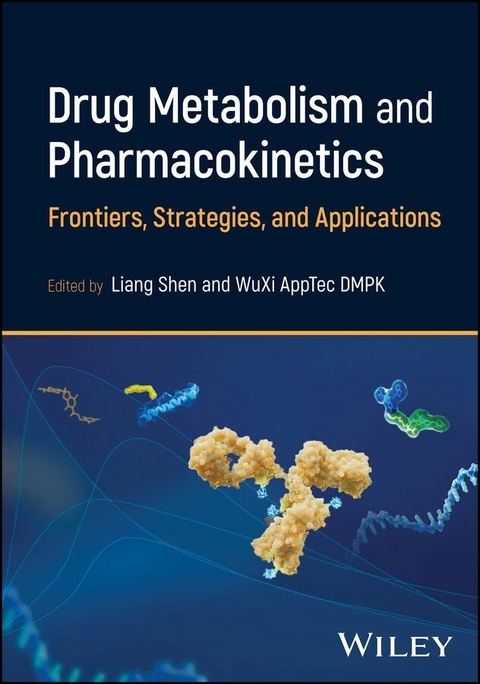
Drug Metabolism and Pharmacokinetics (eBook)
1105 Seiten
Wiley (Verlag)
978-1-394-30013-6 (ISBN)
Practical, state-of-the-art pharmacokinetic research methods, ideas, advancements, applications, and strategies
Drawing on a wealth of extensive practical experience and theoretical research, Drug Metabolism and Pharmacokinetics encapsulates the most recent advancements and illustrative applications in the field. Sixty-eight relatively independent yet interconnected articles are included, each offering a unique perspective and providing in-depth interpretation. Readers can either read systematically or select specific topics of interest from the table of contents.
Basic concepts, frontier advancements, DMPK research strategies, and technical methods are covered for novel drug modalities and therapeutics in different disease areas. The book encompasses a wide range of application and validation cases for DMPK research, including studies in in vitro ADME, in vivo pharmacokinetics, metabolite profiling and identification, radiolabeled ADME, and bioanalysis. Case studies showing the application of topics covered are included throughout, along with valuable insights into problem-solving and critical thinking.
Written by a team of scientists specializing in DMPK research from the DMPK Department of WuXi AppTec, Drug Metabolism and Pharmacokinetics discusses sample topics including:
- ADME properties, metabolite identification, and bioanalytical strategies for oligonucleotide drugs
- Strategies and challenges in the determination of drug-to-antibody ratio (DAR) values of antibody-drug conjugates (ADCs)
- Breaking barriers in CNS drug development with intrathecal and intracerebroventricular administration
- Application and detection techniques of biomarkers in drug development
- Flux dialysis method for assessing plasma protein binding of high protein-binding drugs
Drug Metabolism and Pharmacokinetics is an essential forward-thinking reference on the subject for pharmacy students, pharmaceutical industry researchers, and DMPK scientists, especially those exploring novel drug modalities.
Liang Shen, PhD, is the head of DMPK at WuXi AppTec.
Practical, state-of-the-art pharmacokinetic research methods, ideas, advancements, applications, and strategies Drawing on a wealth of extensive practical experience and theoretical research, Drug Metabolism and Pharmacokinetics encapsulates the most recent advancements and illustrative applications in the field. Sixty-eight relatively independent yet interconnected articles are included, each offering a unique perspective and providing in-depth interpretation. Readers can either read systematically or select specific topics of interest from the table of contents. Basic concepts, frontier advancements, DMPK research strategies, and technical methods are covered for novel drug modalities and therapeutics in different disease areas. The book encompasses a wide range of application and validation cases for DMPK research, including studies in in vitro ADME, in vivo pharmacokinetics, metabolite profiling and identification, radiolabeled ADME, and bioanalysis. Case studies showing the application of topics covered are included throughout, along with valuable insights into problem-solving and critical thinking. Written by a team of scientists specializing in DMPK research from the DMPK Department of WuXi AppTec, Drug Metabolism and Pharmacokinetics discusses sample topics including: ADME properties, metabolite identification, and bioanalytical strategies for oligonucleotide drugsStrategies and challenges in the determination of drug-to-antibody ratio (DAR) values of antibody-drug conjugates (ADCs)Breaking barriers in CNS drug development with intrathecal and intracerebroventricular administrationApplication and detection techniques of biomarkers in drug developmentFlux dialysis method for assessing plasma protein binding of high protein-binding drugs Drug Metabolism and Pharmacokinetics is an essential forward-thinking reference on the subject for pharmacy students, pharmaceutical industry researchers, and DMPK scientists, especially those exploring novel drug modalities.
1
Proteolysis‐Targeting Chimeras (PROTACs)
1.1 An Overview of PROTAC Technology and Drug Metabolism and Pharmacokinetic (DMPK) Research Strategies
Chengyuan Li, Yu Wang, Jing Jin
1.1.1 Introduction
In recent decades, significant advances have been achieved in the development of new therapeutic approaches. Proteolysis‐targeting chimera (PROTAC) offers a new approach to some disease treatments, which has increasingly attracted the attention of drug developers in the last five years. Additionally, PROTAC, as a new therapeutic technology, has facilitated substantial investment worldwide. In this chapter, we summarized the PROTAC’s structure and mechanism of action, its global landscape, the drug metabolism and PK (DMPK) challenges in PROTAC research, and corresponding potential solutions.
1.1.2 Structure and Mechanism of Action of PROTACs
PROTAC utilizes the body’s natural protein degradation mechanism, known as the ubiquitin–proteasome system [1]. PROTAC is a bifunctional molecule that consists of three key structural parts: a ligand that binds the target protein, a ligand that binds the ubiquitin–protein ligase (E3), and a linker that connects the two ligands (Figure 1.1).
Because of its unique structure, PROTAC brings the E3 ligase and the target protein to proximity, which induces the E3 ligase to label the target protein with ubiquitin. This causes the target protein to degrade [2]. The PROTAC molecules that detach after the degradation of the target protein can be recycled (Figure 1.2). In contrast to the occupancy‐driven pharmacology of most small‐molecule drugs, PROTAC can access proteins that were previously inaccessible without occupying an active pocket or relying on target occupancy to disrupt the function of the target protein. This is known as event‐driven pharmacology.
Therefore, PROTAC offers many advantages in drug discovery:
- It has the potential to target many undruggable protein targets that lack active sites.
- While retaining the advantage of directly targeting intracellular proteins, it has the potential to overcome some of the disadvantages of small molecules such as drug resistance.
- To improve patient compliance, it can be administered orally.
Figure 1.1 Schematic of typical PROTAC structure.
Figure 1.2 Mechanism of action of PROTAC.
1.1.3 PROTAC Landscape Analysis
By using the event‐driven pharmacology, PROTAC offers an attractive therapeutic concept to control target protein levels. Although this is a relatively new modality, it has made rapid progress in the drug discovery pipeline.
1.1.3.1 PROTAC Research and Development Progress: International Pharmaceutical Companies
PROTAC has boomed in the last three years with Arvinas’ two candidate molecules, ARV‐110 and ARV‐471, being the first to demonstrate positive clinical data. In addition, ARV‐766, the company’s third PROTAC molecule, is set to enter the clinical phase. Other international companies, such as Kymera Therapeutics, C4 Therapeutics, and Nurix Therapeutics, that focus on developing protein degraders have a molecule in clinical phase I as well. In addition, other pharmaceutical companies such as Bristol‐Myers Squibb, Dialectic Therapeutics, and Accutar Biotechnology also own a PROTAC molecule in clinical phase I (Table 1.1).
Table 1.1 PROTAC research and development progress of some international pharmaceutical companies.
| Company | PROTAC | Indications | Target | Study phase |
|---|
| Arvinas, Inc. | ARV‐471 | Breast cancer (ER+/HER2‐breast cancer) | Estrogen receptor (ER) | Clinical phase III |
| ARV‐393 | B‐Cell Malignancies | B‐cell lymphoma 6 protein (BCL6) | Clinical phase I |
| ARV‐102 | Parkinson’s Disease Progressive Supranuclear Palsy | Leucine‐rich repeat kinase 2 (LRRK2) | Clinical phase I |
| Nurix Therapeutics, Inc. | NX‐2127 | B cell malignancies | BTK + IMiD activity | Clinical phase I |
| NX‐1607 | Immuno‐oncology | CBL‐B | Clinical phase I |
| NX‐5948 | B cell malignancies and autoimmune diseases | BTK | Clinical phase I |
| Kymera Therapeutics, Inc. | KT‐474 | Allergic dermatitis, hidradenitis suppurativa, rheumatoid arthritis | Interleukin‐1 receptor‐associated kinase 4 (IRAK4) | Clinical phase II |
| KT‐621 | Immunology | STAT6 | Clinical phase I |
| KT‐333 | Solid tumors | STAT3 | Clinical phase I |
| KT‐253 | Solid tumors | MDM2 | Clinical phase I |
| C4 Therapeutics, Inc. | CFT7455 | Relapsed/refractory non‐Hodgkin’s lymphoma or multiple myeloma | IKZF1/3 | Clinical phase I/II |
| CFT8919 | Non‐small cell lung cancer (NSCLC) with drug‐resistant EGFR mutation | EGFR L858R | Clinical phase I |
| CFT1946 | V600 mutant cancers | BRAF V600 | Clinical phase I/II |
| Bristol‐Myers Squibb | AR‐LDD | Prostate cancer | AR | Clinical phase I |
| Dialectic Therapeutics, Inc. | DT‐2216 | Tumor | BCL‐XL | Clinical phase I |
| Accutar Biotechnology Inc. | AC0699 | Breast cancer | ER | Clinical phase I |
| AC0682 | Breast cancer | ER | Clinical phase I |
| Ac176 | Prostate cancer | AR | Clinical phase I |
| AC0676 | Autoimmunity | BTK WT & C481S | Clinical phase I |
Note: The information was obtained from the official websites of the companies mentioned in the table and the deadline for information collection is 15 December 2024.
(Only research pipelines with compounds are listed.) Vividion Therapeutics, ERASCA, and other PROTAC companies do not disclose pipeline information.
Table 1.2 PROTAC R&D progress of Chinese pharmaceutical companies.
| Company | PROTAC | Indications | Target | Study phase |
|---|
| Lynk Pharmaceuticals Co., Ltd. | LNK01002 | Hematological tumor | — | Clinical phase I |
| Kintor Pharmaceutical Limited | GT20029 | Androgenetic alopecia, acne | AR | Clinical phase II |
| Haisco Pharmaceutical Group Co., Ltd. | HSK29116 | B‐cell malignancies | BTK | Clinical phase I |
| BeiGene Ltd. | BGB‐16673 | B‐cell malignancies | BTK | Clinical phase I |
| Cullgen Inc. | CG001419 | Solid tumor | TRK | Clinical phase I/II |
| Hinova Pharmaceuticals, Inc.... |
| Erscheint lt. Verlag | 3.6.2025 |
|---|---|
| Sprache | englisch |
| Themenwelt | Naturwissenschaften ► Chemie |
| Schlagworte | antibody drug conjugate • bioanalysis • Biomarkers • DMPK • drug development • drug interactions • Drug metabolism • Drug research • in vitro ADME • in vivo pharmacokinetics • Macromolecules • metabolite identification • Oligonucleotide • peptide drug • pharmaceuticals • Pharmacokinetics • PK study • radiolabeled compounds |
| ISBN-10 | 1-394-30013-1 / 1394300131 |
| ISBN-13 | 978-1-394-30013-6 / 9781394300136 |
| Informationen gemäß Produktsicherheitsverordnung (GPSR) | |
| Haben Sie eine Frage zum Produkt? |
 EPUB (Adobe DRM)
Kopierschutz: Adobe-DRM
Adobe-DRM ist ein Kopierschutz, der das eBook vor Mißbrauch schützen soll. Dabei wird das eBook bereits beim Download auf Ihre persönliche Adobe-ID autorisiert. Lesen können Sie das eBook dann nur auf den Geräten, welche ebenfalls auf Ihre Adobe-ID registriert sind.
Details zum Adobe-DRM
Dateiformat: EPUB (Electronic Publication)
EPUB ist ein offener Standard für eBooks und eignet sich besonders zur Darstellung von Belletristik und Sachbüchern. Der Fließtext wird dynamisch an die Display- und Schriftgröße angepasst. Auch für mobile Lesegeräte ist EPUB daher gut geeignet.
Systemvoraussetzungen:
PC/Mac: Mit einem PC oder Mac können Sie dieses eBook lesen. Sie benötigen eine
eReader: Dieses eBook kann mit (fast) allen eBook-Readern gelesen werden. Mit dem amazon-Kindle ist es aber nicht kompatibel.
Smartphone/Tablet: Egal ob Apple oder Android, dieses eBook können Sie lesen. Sie benötigen eine
Geräteliste und zusätzliche Hinweise
Buying eBooks from abroad
For tax law reasons we can sell eBooks just within Germany and Switzerland. Regrettably we cannot fulfill eBook-orders from other countries.
aus dem Bereich