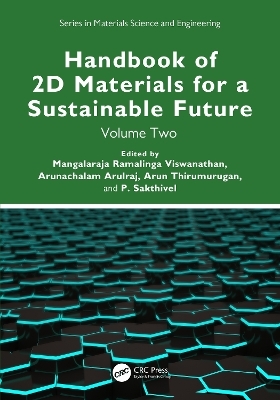
Handbook of 2D Materials for a Sustainable Future
CRC Press (Verlag)
978-1-041-12821-2 (ISBN)
Handbook of 2D Materials for a Sustainable Future reviews a cutting‑edge area of materials science with enormous potential for a wide range of applications. It provides readers with a comprehensive understanding of the recent advancements of two‑dimensional (2D) materials alongside their functional modifications and practical applications, with a forward‑looking view on sustainable and scalable technologies.
Volume Two provides a comprehensive exploration of the evolution, properties, and applications of 2D materials. Beginning with the historical and scientific background, it looks at the diverse functionalities of graphene, such as its role in biosensors and energy storage. It expands to other 2D materials like transition metal diselenides for solar cells, MXenes, and fullerene. It addresses broader energy applications and biomedical uses of 2D materials for neurodegenerative disorders.
Key Features:
Covers foundational concepts and emerging advancements in 2D materials
Integrates interdisciplinary applications across energy, environmental science, electronics, and biomedicine, showcasing the broad utility of 2D materials
Highlights cutting‑edge research on MXenes, graphene quantum dots, and 2D heterostructures, areas not comprehensively covered in existing literature
This book is intended for researchers, graduate students, and professionals in materials science, nanotechnology, chemical engineering, and applied physics. It serves as both a reference for experienced scientists and a foundational guide for those new to the field, fostering new ideas and future breakthroughs in nanoscience and nanotechnology.
Prof. Mangalaraja Ramalinga Viswanathan is Full Professor in the Faculty of Engineering and Architecture at Universidad Arturo Prat, Iquique, Chile, and he specializes in nanotechnology‑driven advanced functional and structural materials for energy and environmental applications. He has 4 granted patents, authored 360+ research articles, led 47 funded projects, and mentored 12 Ph.D. scholars and 41 postdoctoral researchers. A globally recognized expert, he has held leadership roles in academia and professional societies, contributing significantly to materials science and engineering. Dr. Arunachalam Arulraj is Assistant Professor in the Departamento de Electricidad, Universidad Tecnológica Metropolitana, Santiago, Chile, and he specializes in renewable energy, focusing on solar energy conversion, storage technologies, and nanoelectronics. With a Ph.D. in Renewable Energy, he has published extensively, edited three books, and mentored students while advancing sustainable energy solutions through interdisciplinary research. Dr. Arun Thirumurugan is Assistant Professor at the Universidad de Atacama, Sede Vallenar, Vallenar, Chile. His research interests include the synthesis and surface modification of nanomaterials for energy and environmental applications. Dr. P. Sakthivel is Associate Professor of Physics in the Faculty of Science, Technology and Architecture at Manipal University Jaipur, Rajasthan, India. He has two decades of experience in teaching and research. His main areas of expertise are nanomaterials synthesis, characterization techniques, and electronic and optical materials for optoelectronic applications.
1. Evolution of Two-Dimensional (2D) Materials 2. Graphene and graphene-based 2D materials: synthesis, properties, and applications 3. Recent developments in graphene and its derivatives for electrochemical (Bio)sensors as well as energy storage applications 4. Graphene-based Nanocomposite Materials for Green Hydrogen Production 5. MXenes-based hybrid composite: An effective photocatalytic degradation of environmental contamination 6. Layered 2D Transition Metal diselenides for Solar Cells 7. Two-dimensional graphitic carbon nitride-based nanocomposite: synthesis, properties and food quality analysis 8. Recent breakthroughs in fullerene C60 nanostructures for organic photovoltaic advancements 9. Two-dimensional (2D) materials for Solar Cells and Supercapacitor Applications 10. Advances in Graphene and TMDs-based 2D Materials for Neurodegenerative Disorders 11. Inorganic nanosheets-based photocatalysis: Recent insights into water purification application 12. 2D Materials for a Sustainable Future 13. Recent Development in Tribological Properties of 2D Nanomaterials as Lubricant Additives 14. MXene-based Nanomaterials for Photocatalytic Applications 15. Two Dimensional MXene-based Nanocomposites for Sustainable Applications 16. Ti3C2 MXene as an efficient electrocatalyst for hydrogen and oxygen evolution reactions 17. Experimental and Computational Insights into the MXene-based Nanocomposite Systems for Enhanced Fuel Cell Applications 18. Carbon-Based Nanocomposites for Supercapacitor Applications
| Erscheinungsdatum | 04.11.2025 |
|---|---|
| Reihe/Serie | Series in Materials Science and Engineering |
| Zusatzinfo | 48 Tables, black and white; 154 Line drawings, black and white; 8 Halftones, black and white; 162 Illustrations, black and white |
| Verlagsort | London |
| Sprache | englisch |
| Maße | 178 x 254 mm |
| Gewicht | 1010 g |
| Themenwelt | Naturwissenschaften ► Biologie ► Ökologie / Naturschutz |
| Technik ► Maschinenbau | |
| ISBN-10 | 1-041-12821-5 / 1041128215 |
| ISBN-13 | 978-1-041-12821-2 / 9781041128212 |
| Zustand | Neuware |
| Informationen gemäß Produktsicherheitsverordnung (GPSR) | |
| Haben Sie eine Frage zum Produkt? |
aus dem Bereich