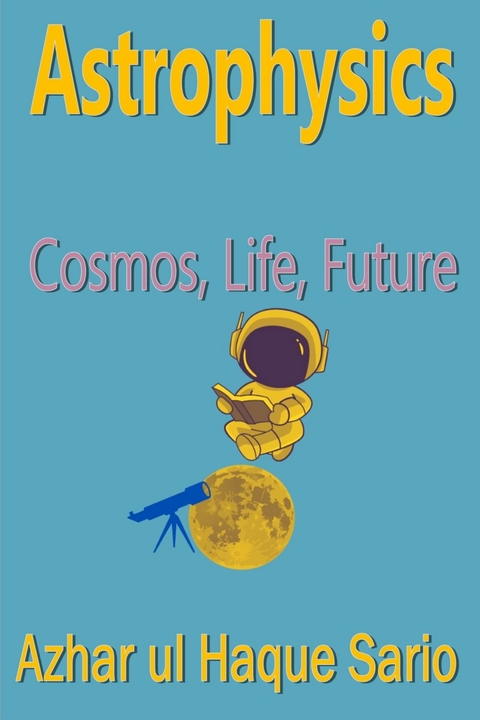
Astrophysics (eBook)
151 Seiten
Royal Co. (Verlag)
978-3-384-62174-0 (ISBN)
Embark on an extraordinary journey through the cosmos with 'Astrophysics: Cosmos, Life, Future'! This book is your comprehensive guide to the wonders of the universe, exploring everything from distant exoplanets and the search for extraterrestrial life to the mysteries of dark matter and dark energy.
Dive into the fascinating world of gravitational waves, the formation of galaxies, and the life cycle of stars. Unravel the secrets of black holes, the Big Bang, and the future of our universe. We'll also delve into astrobiology, the role of AI in astrophysics, and the impact of space weather on Earth. Plus, explore the latest in space exploration, from the search for Earth-like planets to the study of comets and asteroids.
This book stands out by offering a unique blend of cutting-edge research and captivating storytelling. It goes beyond the basics, providing in-depth insights into the latest discoveries and advancements in astrophysics. 'Astrophysics: Cosmos, Life, Future' not only explains complex concepts in a clear and accessible way but also inspires a sense of wonder and curiosity about our place in the vast universe. It's a must-read for anyone who has ever looked up at the stars and wondered about the mysteries they hold.
Chapter 1: The Search for Exoplanets and Extraterrestrial Life: Beyond the Goldilocks Zone
1.1 Redefining Habitability: Unveiling Life's Potential in Extreme Environments
The universe is a vast and mysterious expanse, teeming with celestial wonders that challenge our understanding of life's boundaries. For centuries, our search for extraterrestrial life has been guided by the concept of the "habitable zone," a Goldilocks region around a star where conditions are just right for liquid water to exist on a planet's surface. This Earth-centric perspective, however, has recently undergone a paradigm shift, as we begin to unveil the astonishing potential for life in environments far more extreme than our own.
Breaking Free from Earth's Mold
Imagine a world where the sun never sets, where oceans churn beneath icy shells, and where the very air we breathe is a toxic cocktail. These are the realms of extreme environments, where life, if it exists, has adapted in ways we can only begin to fathom.
Traditionally, our definition of habitability has been inextricably linked to the presence of liquid water, the lifeblood of our planet. However, this anthropocentric view may be blinding us to the myriad possibilities that lie beyond our familiar blue oasis.
Reimagining Life's Cradle
To truly grasp the potential for life in extreme environments, we must embrace a broader perspective, one that considers a wider range of factors:
Energy's Diverse Palette: Life thrives on energy, and while sunlight is Earth's primary source, other celestial bodies may harbor alternative powerhouses. Geothermal vents spewing forth heat from a planet's core, or chemical reactions fueled by exotic compounds, could provide the spark for life's flame.
The Chemistry of Existence: Life as we know it is built upon a foundation of carbon, hydrogen, oxygen, and other essential elements. But what if life elsewhere has found a different recipe? Could silicon-based organisms thrive in scorching heat, or ammonia-breathing creatures populate frigid worlds?
Stability Amidst Chaos: While life on Earth has shown remarkable resilience in the face of environmental change, long-term stability is crucial for its emergence and evolution. In extreme environments, life may cling to oases of constancy, where pockets of habitability persist amidst a backdrop of turmoil.
Venturing into the Unknown
Recent discoveries have revealed a treasure trove of celestial bodies that defy our expectations of habitability. These worlds, characterized by extreme conditions, have expanded our understanding of life's potential and challenged our preconceived notions.
Tidally Locked Worlds: A Dance of Extremes
Imagine a planet forever locked in an embrace with its star, one hemisphere bathed in perpetual sunlight, the other shrouded in eternal darkness. This is the realm of tidally locked planets, where extreme temperature differences create a stark dichotomy between day and night.
Yet, even in this seemingly inhospitable environment, life may find a way. Atmospheric circulation could distribute heat, while clouds or ice might reflect sunlight, creating pockets of moderation. The terminator region, the boundary between light and darkness, could offer a refuge for life, a haven of equilibrium amidst extremes.
Subsurface Oceans: Hidden Havens of Life
Beneath the icy shells of distant moons, vast oceans churn, hidden from the harsh realities of space. These subsurface realms, shielded from radiation and temperature extremes, may harbor life in ways we can only imagine.
Water, the elixir of life, is abundant in these hidden oceans, and potential energy sources like geothermal vents or tidal forces could provide the sustenance needed for life to flourish.
Alien Atmospheres: Breathing Life into the Unknown
Earth's atmosphere, a delicate balance of nitrogen and oxygen, is essential for our existence. But other worlds possess atmospheres of vastly different compositions, raising the possibility of life adapted to these alien environments.
Titan, Saturn's enigmatic moon, is shrouded in a dense atmosphere of nitrogen and methane. While its surface is frigid, the presence of organic molecules and the potential for liquid methane lakes make it a tantalizing target in our search for extraterrestrial life.
Conclusion: A Universe of Possibilities
The redefinition of habitability has opened our eyes to a universe teeming with possibilities. As we continue our exploration of the cosmos, we must remain open to the extraordinary, to the existence of life in forms and environments that challenge our understanding.
The search for extraterrestrial life is not merely a quest to find our cosmic neighbors; it is a journey to redefine our understanding of life itself. It is a testament to the boundless creativity of the universe, a reminder that we are but one small part of a grand cosmic tapestry.
The Cosmic Dance of Life: A Tapestry of Chance and Necessity
Imagine the universe as a vast, swirling canvas, where the colors of chance and the lines of necessity intertwine to create the masterpiece of life. The birth of life from the inanimate, abiogenesis, is not a mere flip of a coin, but an intricate ballet where serendipity waltzes with the laws of nature.
The Probability of Life's Spark: A Cosmic Lottery or an Inevitable Dawn?
Think of early Earth as a giant chemistry lab, bubbling with potential. Experiments like the Miller-Urey show us that the basic ingredients of life could have been cooked up in this primordial soup. But going from these ingredients to a living, breathing organism is like assembling a symphony orchestra from scattered instruments – it requires something more than just the parts.
Scientists grapple with this puzzle, using theoretical models and the diversity of existing life as clues. Some envision abiogenesis as a rare winning ticket in the cosmic lottery, while others see it as an almost inevitable sunrise, given the vastness of time and the countless environments where life could have taken root.
The Rare Earth Hypothesis: Is Earth a Cosmic Unicorn?
The Rare Earth Hypothesis paints Earth as a pampered pet, enjoying a unique set of circumstances: a stable home in the galaxy, a long-lived Sun, a protective big brother Jupiter, and the invigorating spa treatment of plate tectonics. But is Earth truly a one-of-a-kind unicorn in the cosmic zoo?
The discovery of exoplanets, those distant worlds orbiting other stars, challenges this notion. And let's not forget the extremophiles, those tough little critters thriving in Earth's most extreme environments, hinting that life might be more adaptable and widespread than we once thought.
Shadow Biospheres: Could Life Have More Than One Root?
What if life on Earth had a secret twin, a "shadow biosphere" with a completely different origin story? Imagine organisms with alternative biochemistries, like silicon-based life forms or creatures with mirror-image DNA. While this remains a tantalizing possibility, the search for these hidden life forms continues, pushing the boundaries of our understanding.
The Grand Finale: A Symphony of Chance and Necessity
The emergence of life is not a simple story of either/or, but a grand symphony where chance and necessity play different movements, sometimes harmonizing, sometimes contrasting. Chance might have shuffled the deck of molecules on early Earth, but the laws of physics and chemistry orchestrated their assembly into the first living organisms.
As we continue to explore the universe and unravel the mysteries of life's origins, we come to appreciate this intricate dance between chance and necessity, a dance that has given rise to the incredible diversity and complexity of life on Earth and perhaps beyond.
The Cosmic Symphony of Techno signatures: A Quest for Echoes of Intelligence
Imagine the universe as a vast, silent concert hall. For centuries, we've strained our ears, listening for the faintest whispers of life – the biological melodies of biosignatures. But what if, amidst the silence, a new kind of music is playing? A symphony of technology, a cosmic concert of techno signatures, hinting at civilizations far more advanced than our own.
Beyond the Microscope: Unveiling the Footprints of Technology
We've long sought life beyond Earth by searching for biosignatures – the telltale signs of biology. But techno signatures offer a bolder path. They are the echoes of intelligence, the markers of civilizations that have not only survived but thrived, leaving their technological fingerprints on the cosmos.
Think of Dyson spheres, colossal structures enveloping stars, like glittering ornaments on a cosmic Christmas tree. Or imagine stumbling upon the radiant glow of artificial light on a distant exoplanet, a beacon of civilization in the cosmic night. These are the grand, awe-inspiring techno signatures that capture our imagination.
But there are subtler clues as well. Unusual energy emissions, like cosmic radio bursts, could be the exhaust fumes of advanced alien engines. Or...
| Erscheint lt. Verlag | 26.11.2024 |
|---|---|
| Sprache | englisch |
| Themenwelt | Naturwissenschaften ► Physik / Astronomie ► Astronomie / Astrophysik |
| Naturwissenschaften ► Physik / Astronomie ► Thermodynamik | |
| Schlagworte | Astrobiology • astrophysics • Black Holes • Cosmology • exoplanets • gravitational waves • space exploration |
| ISBN-10 | 3-384-62174-3 / 3384621743 |
| ISBN-13 | 978-3-384-62174-0 / 9783384621740 |
| Informationen gemäß Produktsicherheitsverordnung (GPSR) | |
| Haben Sie eine Frage zum Produkt? |
 EPUB (Ohne DRM)
Digital Rights Management: ohne DRM
Dieses eBook enthält kein DRM oder Kopierschutz. Eine Weitergabe an Dritte ist jedoch rechtlich nicht zulässig, weil Sie beim Kauf nur die Rechte an der persönlichen Nutzung erwerben.
Dateiformat: EPUB (Electronic Publication)
EPUB ist ein offener Standard für eBooks und eignet sich besonders zur Darstellung von Belletristik und Sachbüchern. Der Fließtext wird dynamisch an die Display- und Schriftgröße angepasst. Auch für mobile Lesegeräte ist EPUB daher gut geeignet.
Systemvoraussetzungen:
PC/Mac: Mit einem PC oder Mac können Sie dieses eBook lesen. Sie benötigen dafür die kostenlose Software Adobe Digital Editions.
eReader: Dieses eBook kann mit (fast) allen eBook-Readern gelesen werden. Mit dem amazon-Kindle ist es aber nicht kompatibel.
Smartphone/Tablet: Egal ob Apple oder Android, dieses eBook können Sie lesen. Sie benötigen dafür eine kostenlose App.
Geräteliste und zusätzliche Hinweise
Buying eBooks from abroad
For tax law reasons we can sell eBooks just within Germany and Switzerland. Regrettably we cannot fulfill eBook-orders from other countries.
aus dem Bereich