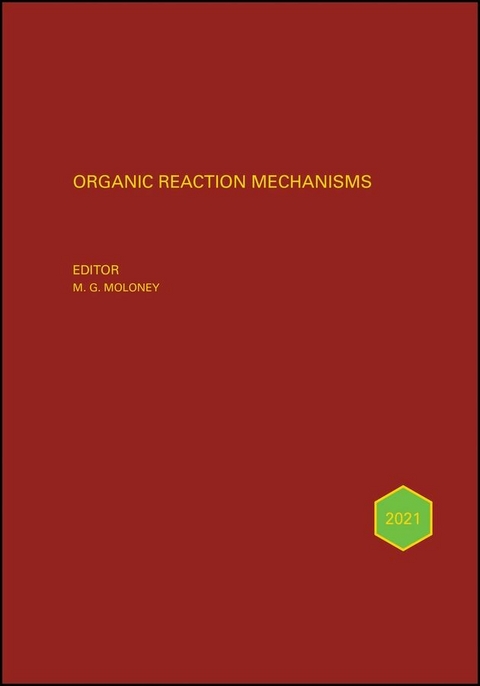
Organic Reaction Mechanisms 2021 (eBook)
1073 Seiten
Wiley (Verlag)
978-1-119-82197-7 (ISBN)

Organic Reaction Mechanisms 2021, the 57th annual volume in this highly successful and unique series, surveys research on organic reaction mechanisms described in the available literature dated 2021.
The following classes of organic reaction mechanisms are comprehensively reviewed:
- Reaction of Aldehydes and Ketones and their Derivatives
- Reactions of Carboxylic, Phosphoric, and Sulfonic Acids and their Derivatives
- Oxidation and Reduction
- Carbenes and Nitrenes
- Nucleophilic Aromatic Substitution
- Electrophilic Aromatic Substitution
- Carbocations
- Nucleophilic Aliphatic Substitution
- Carbanions and Electrophilic Aliphatic Substitution
- Elimination Reactions
- Polar Addition Reactions
- Cycloaddition Reactions
- Molecular Rearrangements
- Transition Metal Coupling
- Radicals
An experienced team of authors compile these reviews every year, so that the reader can rely on a continuing quality of selection and presentation.
Professor Mark G. Moloney, Chemistry Research Laboratory, University of Oxford, UK.
Organic Reaction Mechanisms 2021, the 57th annual volume in this highly successful and unique series, surveys research on organic reaction mechanisms described in the available literature dated 2021. The following classes of organic reaction mechanisms are comprehensively reviewed: Reaction of Aldehydes and Ketones and their Derivatives Reactions of Carboxylic, Phosphoric, and Sulfonic Acids and their Derivatives Oxidation and Reduction Carbenes and Nitrenes Nucleophilic Aromatic Substitution Electrophilic Aromatic Substitution Carbocations Nucleophilic Aliphatic Substitution Carbanions and Electrophilic Aliphatic Substitution Elimination Reactions Polar Addition Reactions Cycloaddition Reactions Molecular Rearrangements Transition Metal Coupling Radicals An experienced team of authors compile these reviews every year, so that the reader can rely on a continuing quality of selection and presentation.
1
Reactions of Aldehydes and Ketones and Their Derivatives
1Department of Chemistry, University of Oxford, Oxford, UK
2Oxford Suzhou Centre for Advanced Research, Jiangsu, P.R. China
CHAPTER MENU
- Aldehydes and Ketones
- Formation and Reactions of Acetals and Related Species
- Reactions of Glucosides
- Reactions of Ketenes and Related Cumulenes
- Imines: Synthesis, and General and Iminium Chemistry
- Mannich and Mannich-type Reactions
- Oximes, Oxime Ethers, and Oxime Esters
- Hydrazones and Related Species
- C—C Bond Formation and Fission: Aldol and Related Reactions
- The Asymmetric Aldol
- The Morita–Baylis–Hilman Reaction and its Aza-Variants
- The Michael Addition
- The Wittig and Other Olefinations
- Reactions of Enolates and Related Reactions
- Miscellaneous Reactions
- Redox Processes
- References
Aldehydes and Ketones
A study on the formation and real-space distribution of acetophenone dimers on an H-containing Pt(111) surface using scanning tunneling microscopy and infrared reflected absorption spectroscopy shows that different types of acetophenone dimers (1–4) were found, depending on the coverage of H species at the surface (Figure 1).1 A combined experimental and theoretical study of the twisted intramolecular charge transfer process in hemithioindigo photoswitches with picosecond time resolution has been reported.2 The gas-phase decomposition of aluminum acetylacetonate between 325 and 1273 K proceeds by initial formation of the Al(C5H7O2)2+ ion, and then formation of up to 49 species, including aluminum bis(diketo)acetylacetonate-H, Al(C5H7O2)C5H6O2, acetylacetone (C5H8O2), Al(OH)2(C5H7O2), a substituted pentalene ring species (C10H12O2), acetylallene (C5H6O), acetone (C3H6O), and ketene (H2C=C=O). Arrhenius parameters have been determined for the gas-phase decomposition kinetics of Al(C5H7O2)3.3
The preparation of deuterated aldehydes via a hydrogen-isotope exchange reaction on an aldehyde starting material (ArCH=O ⇒ ArCD=O) using a rationally engineered mutant thiamine diphosphate (ThDP)-dependent enzyme has been reported.4 In this process, the ThDP cofactor activates aldehyde C—H bonds via a Breslow-type intermediate, enabling deuteration in the presence of D2O, even though a benzoin condensation is kinetically favored under the same conditions. The desired selectivity was achieved by the incorporation of suitable binding pockets favoring the formation of the desired deuterated aldehydes. The reaction mechanism of 2-succinyl-5-enolpyruvyl-6-hydroxy-3-cyclohexene-1-carboxylic-acid (SEPHCHC) synthase (known as MenD), a thiamin diphosphate-dependent decarboxylase that catalyzes the formation of SEPHCHC from 2-ketoglutarate and isochorismate, has been studied using X-ray data and computational analysis. This enzyme is involved in the menaquinone biosynthesis pathway in Mycobacterium tuberculosis and is proposed as a potential drug target for antituberculosis therapeutics. The structure and role of the tetrahedral post-decarboxylation intermediate are discussed.5
The transition-metal-catalyzed sp2 C–H functionalization of arenes directed by aldehydes has been reviewed.6 An axially chiral aldehyde (5) is formed by a Pd(II)-catalyzed atroposelective dual C–H activation using leucine as the chirality source in good yields (up to 95%) and with excellent enantioinduction (up to 99%) (Scheme 1).7 Mechanistic studies indicate that conversion of the starting aldehyde and L-tert-leucine gives an imine intermediate suitable for chelated C–H activation to give an axially stereo-enriched biaryl palladacycle intermediate, which then reacts with an alkyne to form the annulated product; subsequent hydrolysis of the imine unit releases the aldehyde and L-tert-leucine. Pd0 is reoxidized to PdII by silver(I) to continue the catalytic cycle. The chiral aldehyde may be manipulated further to introduce new aromatic functionality. A Ru(II)-catalyzed cross-dehydrogenative Heck-type olefination of arenes with allyl sulfones, assisted by weakly coordinating ketone or amide functions, proceeds by a reversible metalation step, with β-hydride elimination from the benzylic position and without β-sulfonyl elimination.8 Although a sub-stoichiometric amount of Cu(II) acetate and oxygen is required, experiments exclude an SET or radical pathway.
The synthesis of homoallenyl alcohols (6) from the corresponding aldehyde and chloroprene-derived Grignard reagents using bis[2-dimethylaminoethyl]ether (BDMAEE) as an additive at low temperature has been reported (Scheme 2); this allows the almost exclusive formation of the allene product, which is suggested to be favored by chelation of the magnesium in a six-membered transition state.9
Aryl aldehydes and ketones may be converted either to alcohols or to pinacol products using CdSe/CdS core/shell quantum dots as photocatalysts by adjusting the amount of 4-methylthiophenol, which is present; the catalyst may be recycled, the reaction shows good functional group tolerance, and an intermediate ketyl radical is proposed.10 Fe(PMe3)4-catalyzed coupling using a perdeuterio-labeled aromatic ketone with various alkenes showed linear alkylation products formed by 1,2-insertion of alkene into an Ar—Fe—H bond. Reversible 2,1-insertion is possible but depends on the choice of the alkene, being favored for styrene but not for vinylsilanes and N-vinylcarbazoles.11
A review covering the organocatalyzed enantioselective α-functionalization of aldehydes, with a focus on catalytic cycles and mechanisms, has appeared; Horner–Wadsworth–Emmons, aldol and organometallic addition reactions are considered explicitly.12 A review of methodologies to access α-aminoketones of relevance to synthetic and medicinal chemistry, including mechanistic details, has been published.13 A Pd-catalyzed redox coupling of ketones with terpenols gives α-substituted ketones at various levels of unsaturation, which can be controlled using different additives to give reductive, migratory, or oxidative coupling; using [η3-allylPdCl]2, an N-heterocyclic carbene ligand (SIPr·HCl) and aniline solvent, in the presence of benzyl alcohol, the reductive coupling is thermodynamically favored and gives the product of alkylation (7), while in the presence of LiBr and 4-aminopyridine, α,β-unsaturated ketones (8), are formed and by switching the solvent to chlorobenzene in the presence of piperidine and NaOMe, oxidative coupling gives α,β,γ,δ-unsaturated ketones (9), with exclusive E-stereoselectivity (Scheme 3). An alkoxide-Pd(II) intermediate XPd(L)OCH2CH=CMe2 is a key intermediate common to the formation of all products, and the process can be considered to be complementary to Tsuji–Trost allylation of ketones.14
The pinacol coupling reaction of aldehydes or ketones with samarium and TMSBr gives the expected diol products (10), proceeding best for aliphatic ketones and less well for aromatic ketones (Scheme 4). Mechanistic studies suggest an anionic Brook rearrangement of a Sm(II) or Sm(III) silyl species rather than a direct radical coupling pathway.15
A dynamic kinetic resolution—asymmetric transfer hydrogenation of α-keto/enol-lactams (11) leading to a range of disubstituted cis-α-hydroxylactams (12) with high enantiopurity (>99%) has been reported; a transition state stabilized by η6-arene CH—O interaction was proposed (Scheme 5).16
The formation of enamines from primary arylamines, leading to α-enaminones by reaction with ketones, proceeds by amine radical cation generation involving O2 singlet energy transfer. Their use for [3+3] cycloaddition reaction to give dihydropyridines in good yields (58–85%) was established. α-Enaminones displayed a set of reactivities that were different from those of enamines.17 The O-alkylation of extended tricarbonyl-conjugated tetramates could be achieved under Mitsunobu conditions but gave regioisomeric products. Thus, both C-9 and C-6 O-alkylation were observed but not C-8 O-alkylation for tetramate carboxamides, while C-7 alkylation with allyl and prenyl derivatives arose by the rearrangement of initially formed O-alkyl products. These modifications at C-6/C-9 of tetramates were found to lead to a complete loss of metal-chelating ability, which correlated with the loss of antibacterial activity, demonstrating that the metal-chelating capability of tetramates can be significant.18 The benzylic alkylation of chiral benzyl esters with malonates as a carbon nucleophile can be catalyzed by [Cp*RuCl2]2 and picolinic acid and proceeds with retention of the stereochemistry of the starting material via a...
| Erscheint lt. Verlag | 30.5.2025 |
|---|---|
| Reihe/Serie | Organic Reaction Mechanisms |
| Sprache | englisch |
| Themenwelt | Naturwissenschaften ► Chemie ► Organische Chemie |
| Schlagworte | addition reactions • aldehydes • carbanions • carbenes • Carbocations • Cycloaddition • electrophilic aliphatic substitution • electrophilic aromatic substitution • elimination reactions • Ketones • Nitrenes • nucleophilic aliphatic substitution • nucleophilic aromatic substitution • Oxidation • Radicals • Reaction mechanisms • rearrangements • Redox • reduction • transition metals |
| ISBN-10 | 1-119-82197-5 / 1119821975 |
| ISBN-13 | 978-1-119-82197-7 / 9781119821977 |
| Informationen gemäß Produktsicherheitsverordnung (GPSR) | |
| Haben Sie eine Frage zum Produkt? |
 EPUB (Adobe DRM)
Kopierschutz: Adobe-DRM
Adobe-DRM ist ein Kopierschutz, der das eBook vor Mißbrauch schützen soll. Dabei wird das eBook bereits beim Download auf Ihre persönliche Adobe-ID autorisiert. Lesen können Sie das eBook dann nur auf den Geräten, welche ebenfalls auf Ihre Adobe-ID registriert sind.
Details zum Adobe-DRM
Dateiformat: EPUB (Electronic Publication)
EPUB ist ein offener Standard für eBooks und eignet sich besonders zur Darstellung von Belletristik und Sachbüchern. Der Fließtext wird dynamisch an die Display- und Schriftgröße angepasst. Auch für mobile Lesegeräte ist EPUB daher gut geeignet.
Systemvoraussetzungen:
PC/Mac: Mit einem PC oder Mac können Sie dieses eBook lesen. Sie benötigen eine
eReader: Dieses eBook kann mit (fast) allen eBook-Readern gelesen werden. Mit dem amazon-Kindle ist es aber nicht kompatibel.
Smartphone/Tablet: Egal ob Apple oder Android, dieses eBook können Sie lesen. Sie benötigen eine
Geräteliste und zusätzliche Hinweise
Buying eBooks from abroad
For tax law reasons we can sell eBooks just within Germany and Switzerland. Regrettably we cannot fulfill eBook-orders from other countries.
aus dem Bereich