


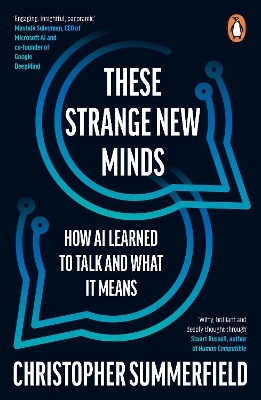
These Strange New Minds
How AI Learned to Talk and What It Means
Seiten
2026
Penguin Books Ltd (Verlag)
978-1-4059-6616-0 (ISBN)
Penguin Books Ltd (Verlag)
978-1-4059-6616-0 (ISBN)
- Noch nicht erschienen (ca. Februar 2026)
- Portofrei ab CHF 40
- Auch auf Rechnung
- Artikel merken
‘Engaging, insightful, panoramic’ Mustafa Suleyman, CEO of Microsoft AI & Cofounder of DeepMind
'An eye-opening exploration of a revolution unfolding before our eyes' New York Journal of Books
Stunning advances in digital technology have introduced a new wave of human-like AI systems. Chatbots like ChatGPT, Claude, and Gemini are already reshaping economies, challenge democracies, and reshaping society in unpredictable ways. And soon, these AI systems could make autonomous decisions on their users' behalf, transforming everything we do. Understanding how they work is crucial.
Can AI systems think, know, and understand?
Could they manipulate or deceive you, and if so, what might they make you do?
Whose interests do they represent?
When will they be able to move beyond words and take action in the real world?
Neuroscientist and AI researcher Christopher Summerfield explores these questions, charting AI's evolution from early ideas in the seventeenth century to today's deep neural networks. His book is the most accessible, up-to-date, and authoritative exploration of this radical technology. With an understanding of AI's inner workings, we can address the existential question of our age: can we look forward to a technological utopia, or are we writing ourselves out of history?
‘As a leading authority...Summerfield is perfectly situated to explore the meaning and implications of these machines that are so uncannily like – and unlike – ourselves’ Brian Christian, co-author of Algorithms to Live by
'You might choose to be alarmed, excited, or indifferent to LLMs, but you should read Chris’s book before you decide’ Mike Woolridge, author of The Road to Conscious Machines
'An eye-opening exploration of a revolution unfolding before our eyes' New York Journal of Books
Stunning advances in digital technology have introduced a new wave of human-like AI systems. Chatbots like ChatGPT, Claude, and Gemini are already reshaping economies, challenge democracies, and reshaping society in unpredictable ways. And soon, these AI systems could make autonomous decisions on their users' behalf, transforming everything we do. Understanding how they work is crucial.
Can AI systems think, know, and understand?
Could they manipulate or deceive you, and if so, what might they make you do?
Whose interests do they represent?
When will they be able to move beyond words and take action in the real world?
Neuroscientist and AI researcher Christopher Summerfield explores these questions, charting AI's evolution from early ideas in the seventeenth century to today's deep neural networks. His book is the most accessible, up-to-date, and authoritative exploration of this radical technology. With an understanding of AI's inner workings, we can address the existential question of our age: can we look forward to a technological utopia, or are we writing ourselves out of history?
‘As a leading authority...Summerfield is perfectly situated to explore the meaning and implications of these machines that are so uncannily like – and unlike – ourselves’ Brian Christian, co-author of Algorithms to Live by
'You might choose to be alarmed, excited, or indifferent to LLMs, but you should read Chris’s book before you decide’ Mike Woolridge, author of The Road to Conscious Machines
Christopher Summerfield has one foot in the field of Cognitive Neuroscience – studying the brains of humans as Professor of Cognitive Neuroscience at the University of Oxford – and the other in AI research, helping build intelligent systems as a Staff Research Scientist at the pioneering Google DeepMind. He has won several awards, including the prestigious Cognitive Neuroscience Society Young Investigator Award in 2015, and is regularly invited to give keynote talks across the world. Christopher has published over 100 peer-reviewed articles, reviews, and book chapters and his academic book, Natural General Intelligence: How understanding the brain can help us build AI, was widely acclaimed. This is his first book for a general readership.
| Erscheint lt. Verlag | 26.2.2026 |
|---|---|
| Verlagsort | London |
| Sprache | englisch |
| Maße | 129 x 198 mm |
| Gewicht | 500 g |
| Themenwelt | Sachbuch/Ratgeber ► Natur / Technik |
| Informatik ► Theorie / Studium ► Künstliche Intelligenz / Robotik | |
| Naturwissenschaften | |
| ISBN-10 | 1-4059-6616-5 / 1405966165 |
| ISBN-13 | 978-1-4059-6616-0 / 9781405966160 |
| Zustand | Neuware |
| Informationen gemäß Produktsicherheitsverordnung (GPSR) | |
| Haben Sie eine Frage zum Produkt? |
Mehr entdecken
aus dem Bereich


aus dem Bereich
Eine praxisorientierte Einführung
Buch | Softcover (2025)
Springer Vieweg (Verlag)
CHF 53,15
Künstliche Intelligenz, Macht und das größte Dilemma des 21. …
Buch | Softcover (2025)
C.H.Beck (Verlag)
CHF 25,20
Buch | Softcover (2025)
Reclam, Philipp (Verlag)
CHF 11,20


