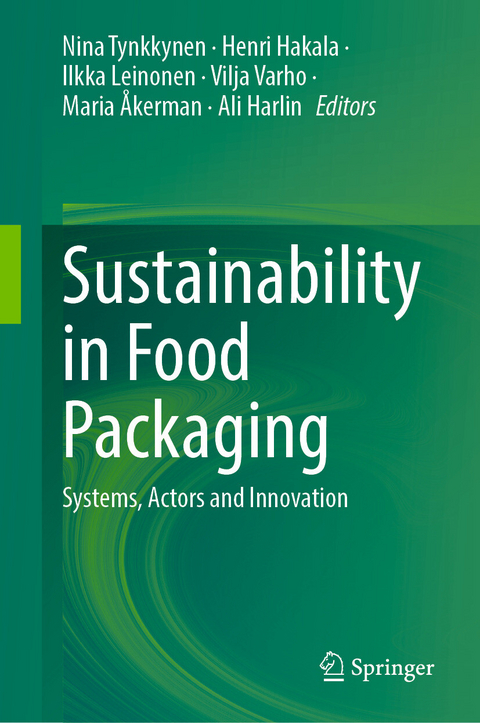
Sustainability in Food Packaging (eBook)
XIV, 266 Seiten
Springer-Verlag
978-3-031-87492-5 (ISBN)
The sustainability of food packaging is a key priority in the food industry, as plastic waste and littering have become global concerns. Packaging waste accounts for over half of total global waste, predominantly from single-use plastic food packaging. Production of packaging consumes significant natural resources and contributes to climate change and pollution. However, packaging is also crucial for reducing food waste, protecting food safety, and providing vital information about contents, making it an essential sustainability solution, not just a problem.
Sustainability Transition in Food Packaging: Systems, Actors, and Innovation explores sustainable food packaging from an interdisciplinary perspective, integrating economics, environmental science, technology, social sciences and cultural studies. This broad approach expands beyond the traditional focus on packaging as a product, considering its content and the services it provides. While sustainable packaging is often defined by four principles—effectiveness, efficiency, circularity, and safety—current applications primarily focus on the packaging itself, overlooking broader impacts such as marine and soil littering.
Life cycle assessments (LCA) of packaging frequently ignore social, cultural, and economic sustainability aspects and often fail to account for the diverse interpretations of LCA standards. While the Product Environmental Footprint (PEF) offers a uniform solution, challenges remain due to undefined packaging category rules.
Food packaging is rapidly evolving, driven by innovation, political action, and consumer demand. Given the global and varied nature of the food supply chain, one-size-fits-all solutions are insufficient. This book offers a holistic, interdisciplinary approach to sustainability, fostering dialogue and research across different research fields. It examines different conceptualizations of sustainable food packaging including methods for analyzing sustainability. The volume introduces novel methodologies, such as LCA with a focus on littering, and provides insights on overcoming the challenges of transitioning to a more sustainable food packaging system.
| Erscheint lt. Verlag | 26.5.2025 |
|---|---|
| Zusatzinfo | XIV, 266 p. 25 illus., 17 illus. in color. |
| Sprache | englisch |
| Themenwelt | Naturwissenschaften ► Biologie |
| Naturwissenschaften ► Chemie | |
| Technik | |
| Schlagworte | Food Packaging • Food Systems • Packaging Systems • Sustainability analysis • sustainability trade-offs • Sustainable Food Packaging |
| ISBN-10 | 3-031-87492-7 / 3031874927 |
| ISBN-13 | 978-3-031-87492-5 / 9783031874925 |
| Informationen gemäß Produktsicherheitsverordnung (GPSR) | |
| Haben Sie eine Frage zum Produkt? |
 PDF (Wasserzeichen)
DRM: Digitales Wasserzeichen
Dieses eBook enthält ein digitales Wasserzeichen und ist damit für Sie personalisiert. Bei einer missbräuchlichen Weitergabe des eBooks an Dritte ist eine Rückverfolgung an die Quelle möglich.
Dateiformat: PDF (Portable Document Format)
Mit einem festen Seitenlayout eignet sich die PDF besonders für Fachbücher mit Spalten, Tabellen und Abbildungen. Eine PDF kann auf fast allen Geräten angezeigt werden, ist aber für kleine Displays (Smartphone, eReader) nur eingeschränkt geeignet.
Systemvoraussetzungen:
PC/Mac: Mit einem PC oder Mac können Sie dieses eBook lesen. Sie benötigen dafür einen PDF-Viewer - z.B. den Adobe Reader oder Adobe Digital Editions.
eReader: Dieses eBook kann mit (fast) allen eBook-Readern gelesen werden. Mit dem amazon-Kindle ist es aber nicht kompatibel.
Smartphone/Tablet: Egal ob Apple oder Android, dieses eBook können Sie lesen. Sie benötigen dafür einen PDF-Viewer - z.B. die kostenlose Adobe Digital Editions-App.
Buying eBooks from abroad
For tax law reasons we can sell eBooks just within Germany and Switzerland. Regrettably we cannot fulfill eBook-orders from other countries.
aus dem Bereich