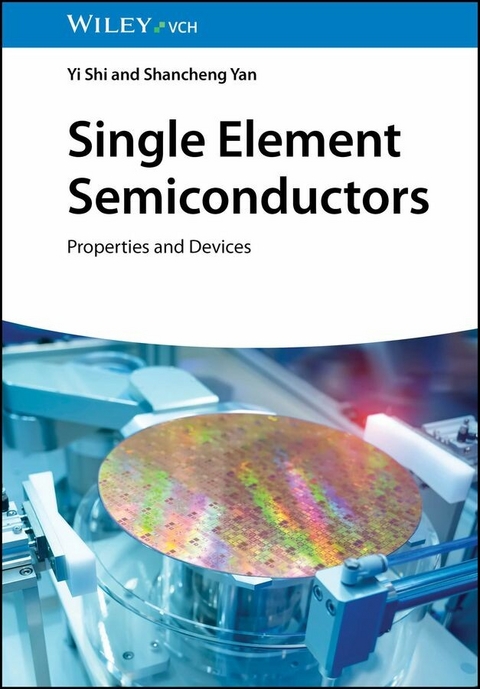
Single Element Semiconductors (eBook)
518 Seiten
Wiley-VCH (Verlag)
978-3-527-85176-8 (ISBN)
Comprehensive reference on the use of single-element semiconductor materials, such as carbon, silicon, and others, in modern electronic devices
Single Element Semiconductors discusses the preparation, properties, and applications of single-element semiconductor materials in modern electronic devices. Special attention is paid to the nanostructures which show great potential in the fields of energy, electronics, and sensing due to their unique physicochemical properties.
Written by a highly qualified team of researchers, Single Element Semiconductors includes information on:
- Properties and fabrication of carbon nanomaterials, germanium, borophene, stanene, arsenene, and antimonene
- Synthesis, self-assembly, and in-plane epitaxy of horizontal silicon nanowires
- Blue, black, and violet phosphorus and the controlled synthesis of tellurium nanomaterials
- Most suitable applications for each element semiconductor, including in photodetectors, solar cells, batteries, biomedical sensors, and photocatalysis
Single Element Semiconductors is an ideal reference for researchers and engineers seeking to advance the research and application development of single-element semiconductor materials.
Yi Shi has been a Changjiang Professor at Nanjing University since 2006. He has published extensively on advanced electronic and optoelectronic materials and devices as well as on nanotechnology. Currently, his research interests are focused on nanostructured materials and the applications in optoelectronics.
Shancheng Yan joined Nanjing University of Posts and Telecommunications as a Professor in May 2010. His research interests focus on novel nanomaterials, controlled synthesis, characterization, assembly, and their biological/optoelectronic applications.
Chapter I
Carbon
Yi Shi
1.1 Introduction
Carbon (C) is a nonmetallic element of period 2, group 14 (group IVA) of the periodic table, and the fourth most abundant element in the universe [1]. There are four valence electrons (2s22p2) outside the carbon atom, meaning that all three types (sp, sp2, sp3) of hybridization between s- and p-orbitals could occur in carbon atoms during the formation of chemical bonds. Due to the bonding characteristics, millions of organic compounds in which carbon atoms usually bond with other nonmetallic atoms (e.g. hydrogen, oxygen, nitrogen, etc.) or the C atom itself (forming carbon chain, branch, or ring structures) have been discovered in nature or synthesized artificially.
For elementary substances of carbon (not regarded as organic molecules but inorganic ones), different hybridization modes between carbon atoms lead to the diversity of structure and properties of its allotropes. Consider two typical types of carbon bulk materials: diamond is a three-dimensional (3D) network composed of sp3-hybridized carbon, known as the hardest natural material, while graphite is a 3D structure stacked by a sp2-hybridized carbon monolayer with a low degree of hardness but good lubricity. Carbon nanomaterials include diverse low-dimensional allotropes of carbon, such as graphene [2], graphene nanoribbons (GNRs) [3], carbon nanotubes (CNTs) [4], graphyne (GY) [5], fullerenes [6], and carbon dots (CDs) [7]. In contrast to natural bulk materials, theoretical research, practical preparation, and potential applications of carbon nanomaterials have only been in development for about one century. Nevertheless, numerous studies have demonstrated these carbon nanomaterials’ unlimited promise with retained properties of bulk materials and unique properties of low-dimensional materials. In particular, the primary fabrication of two-dimensional (2D) graphene monolayers triggered an unprecedented graphene “gold rush” while opening the door to the two-dimensional materials (2DM) system, which is a historic step for the carbon nanomaterial system [8].
In this chapter, we will take graphene, CNTs, and GY as representative carbon nanomaterials and illustrate their fabrication methods, essential properties, and applications through recent frontier research findings.
1.2 Fabrication of Carbon Nanomaterials
1.2.1 Graphene
Graphene is a 2D building material for all other dimensions of sp2-hybridized carbon materials, which can be transferred to zero-dimensional buckyballs (fullerenes), one-dimensional (1D) nanotubes, and 3D graphite (Figure 1.1) [8]. Although it was not until the early twenty-first century that graphene was isolated from bulk graphite, the concept of “graphene” or “monolayer graphite” had been proposed in the mid-twentieth century but initially used as a theoretical model that did not exist in a free state. This concept was derived from the conventional perspective proposed by Landau [9] and Peierls [10], who argued that 2D crystals could not exist independently because of their thermodynamic instability. For a long time afterward, atomic monolayer was considered to be obtained only by epitaxy on a 3D substrate. However, due to the interaction between the substrate and 2DM, epitaxial graphene may not entirely reflect the characteristics of “monolayer graphite.” Hence, researchers are still looking for methods to prepare independent graphene [11–13].
Figure 1.1 The relationship between graphene and other carbon nanostructures.
Source: Reprinted with permission from Ref. [8]. Copyright 2007, Springer Nature Limited.
In fact, since the groundbreaking isolation of graphene monolayer [2], various top-down methods, such as micromechanical cleavage, liquid-phase exfoliation, and graphene oxide (GO) reduction, have successfully proved the independent existence of 2D crystals. Furthermore, aiming for the scalable application for the post-Moore era, bottom-up methods, such as confinement-controlled sublimation (CCS) and chemical vapor deposition (CVD), are actively used in large-scale, high-quality synthesis of graphene.
1.2.1.1 Top-down Methods
1.2.1.1.1 Dry Exfoliation of Graphene
In 2004, Novoselov et al. demonstrated the preparation of few-layer graphene (FLG) consisting of monolayer by micromechanical cleavage (repeated peeling by scotch tape) of highly oriented pyrolytic graphite [2]. This surprisingly simple method produced FLG films up to in size with stability and reliability (Figure 1.2a), and the properties of FLG are almost identical to those of theoretical studies. With convenience but low yield, the original cleavage method is suitable for research or proof of concept but not practical for large-scale applications. A layer-engineered exfoliation (LEE) technique was introduced by Moon et al. for large-area, layer-controlled graphene exfoliation (Figure 1.2b) [14]. In the LEE process, bulk natural graphite was firstly cleaved on adhesive tape, and then a selective metal film was directly deposited on the graphite by e-beam evaporation. The lattice mismatch between metal and graphite produced tensile stress at the interface, which created a crack at the boundaries of graphite induced by external bending and eventually led to large-area exfoliation of graphene [15]. The thickness of exfoliated graphene was determined by the difference between the metal–graphene binding energy and interlayer binding energy of graphite , resulting in a thicker layer with a higher difference (Figure 1.2b,c) [15, 16]. Due to the slight difference between and , Au-assisted LEE graphene showed a defect-free monolayer with a large lateral size of 1 mm and could be repeatedly exfoliated from the same bulk graphite (Figure 1.2d,e). The large-area exfoliation strategy controlled by interface binding energy between metal and 2DM is also applicable in other 2DM systems, such as transition metal dichalcogenides [17].
Figure 1.2 (a) OM image of FLG produced using original micromechanical cleavage method.
Source: Reprinted with permission from Ref. [2]. Copyright 2004, The American Association for the Advancement of Science.
(b) Schematic of LEE process and the relation between and . (c) AFM profile of Co-, Ni-, and Pd-LEE graphene with the relation . (d) Low-magnification OM image of LEE graphene with millimeter-size monolayer. (e) OM images of repeated LEE graphene.
Source: Reprinted with permission from Ref. [14]. Copyright 2020, The American Association for the Advancement of Science.
1.2.1.1.2 Liquid-phase Exfoliation of Graphene
Compared with air ambience, liquid immersion can significantly reduce the van der Waals (vdW) interaction between neighboring layers of graphite. With external forces induced by sonication [18], ball milling [19], or shear mixing [20], graphene nanosheets could be easily exfoliated in the liquid phase, generally provided by water or organic solvents. High tension at the solid/liquid interface hurts solid dispersion in a liquid medium. Therefore, the selection of a liquid medium can directly determine the quality of liquid-exfoliated graphene, and solvents with a lower surface tension ( [18]) could minimize the tension at the graphene/solvent interface [21]. Furthermore, adding surfactants or intercalation particles can also weaken the vdW interaction of graphite.
Supercritical fluid (SCF) is a special substance with a temperature and pressure above the critical point , where liquid and gas phases cannot be distinct (Figure 1.3a). SCFs have specific intermediate properties between liquid and gas, such as gas-like diffusivity, liquid-like solubility, and adjustable density and viscosity controlled by temperature and pressure [22, 23]. Supercritical carbon dioxide (SCCO2), with an easily accessible critical point (, [24]), is a suitable medium for graphene exfoliation owing to extremely low surface tension, shearing effect produced by complex hydrodynamics, and intercalation of CO2 molecules. Zhu et al. characterized the SCCO2-exfoliated graphene and explained the stress mechanism in SCCO2 applying on graphite (Figure 1.3b) [25]. Tangential stress could enhance the intercalation effect of SCCO2 on graphite’s vdW gap, while the direct impact of normal stress on the graphene surface could break bonds and reduce the size of graphene. The increasing pressure makes SCCO2 denser, enhancing the stress mechanism and leading to more efficient exfoliation. Longer processing time also contributes to complete exfoliation, but excessive processing will cause the agglomeration of graphene. Under the same posttreatment condition, graphene obtained at 45 MPa, 48 h showed the highest concentration with an average thickness of ~1.272 nm, which could be regarded as two or three layers (Figure 1.3c).
Figure 1.3 (a) Schematic of a pressure–temperature phase diagram showing the supercritical region.
Source: Reprinted with permission from Ref. [22]. Copyright 2023, Wiley-VCH GmbH.
(b) Demonstration of SCCO2-assisted graphene exfoliation mechanism. (c) AFM image of graphene nanosheets with centrifugation posttreatment and corresponding height profiles along...
| Erscheint lt. Verlag | 23.5.2025 |
|---|---|
| Sprache | englisch |
| Themenwelt | Naturwissenschaften ► Chemie |
| Schlagworte | antimonene • arsenene • batteries • Biomedical sensors • borophone • Carbon Nanomaterials • Germanium • phosphorus • photocatalysis • photodetectors • selenium • Semiconductor Electronics • Silicon Nanowires • Solar cells • stanene • tellurium |
| ISBN-10 | 3-527-85176-3 / 3527851763 |
| ISBN-13 | 978-3-527-85176-8 / 9783527851768 |
| Informationen gemäß Produktsicherheitsverordnung (GPSR) | |
| Haben Sie eine Frage zum Produkt? |
 EPUB (Adobe DRM)
Kopierschutz: Adobe-DRM
Adobe-DRM ist ein Kopierschutz, der das eBook vor Mißbrauch schützen soll. Dabei wird das eBook bereits beim Download auf Ihre persönliche Adobe-ID autorisiert. Lesen können Sie das eBook dann nur auf den Geräten, welche ebenfalls auf Ihre Adobe-ID registriert sind.
Details zum Adobe-DRM
Dateiformat: EPUB (Electronic Publication)
EPUB ist ein offener Standard für eBooks und eignet sich besonders zur Darstellung von Belletristik und Sachbüchern. Der Fließtext wird dynamisch an die Display- und Schriftgröße angepasst. Auch für mobile Lesegeräte ist EPUB daher gut geeignet.
Systemvoraussetzungen:
PC/Mac: Mit einem PC oder Mac können Sie dieses eBook lesen. Sie benötigen eine
eReader: Dieses eBook kann mit (fast) allen eBook-Readern gelesen werden. Mit dem amazon-Kindle ist es aber nicht kompatibel.
Smartphone/Tablet: Egal ob Apple oder Android, dieses eBook können Sie lesen. Sie benötigen eine
Geräteliste und zusätzliche Hinweise
Buying eBooks from abroad
For tax law reasons we can sell eBooks just within Germany and Switzerland. Regrettably we cannot fulfill eBook-orders from other countries.
aus dem Bereich