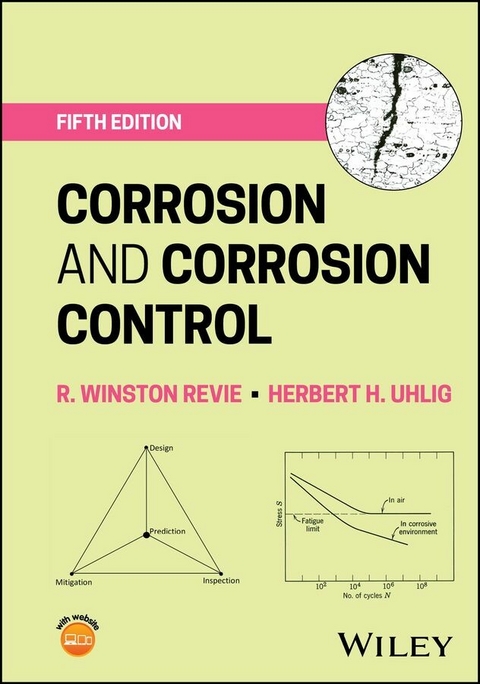
Corrosion and Corrosion Control (eBook)
941 Seiten
Wiley (Verlag)
978-1-119-32475-1 (ISBN)
The newest edition of the gold standard in corrosion reference resources
In the newly revised fifth edition of Corrosion and Corrosion Control, distinguished scientist and program manager R. Winston Revie delivers a uniquely up-to-date resource reflecting the current knowledge of corrosion science and engineering. This book offers updated explanations of the essential aspects of corrosion science and engineering that underpin the tools and technologies used for managing and controlling corrosion.
'Relying heavily on a quantitative approach - along with basic equations that are explained and derived, as well as illustrative problems with solutions - the basic thermodynamic and electrochemical principles that drive corrosion are discussed.' The book also includes practical corrosion control measures, like cathodic protection, coatings, inhibitors, and the use of plastics as a substitute for metals.
Readers will also find:
- A thorough introduction to new materials, including multi-principal element alloys, and calculations of corrosion rates of alloys
- Comprehensive explorations of corrosion-resistant materials
- Practical discussions of texture as related to stress-corrosion cracking
- Complete treatments of materials reliability and risk in a variety of industries, including biomedical, energy, and transportation
Perfect for advanced undergraduate and graduate students studying corrosion in engineering, materials science, and chemistry programs, Corrosion and Corrosion Control will also benefit engineers, scientists, and technologists, as well as lawyers engaged in litigation involving materials exposed to the environment.
1
DEFINITION AND IMPORTANCE OF CORROSION
1.1 DEFINITION OF CORROSION
Corrosion is the destructive attack of a metal by chemical or electrochemical reaction with its environment. Deterioration by physical causes is not called corrosion, but is described as erosion, galling, or wear. In some instances, chemical attack accompanies physical deterioration, as described by the following terms: corrosion‐erosion, corrosive wear, or fretting corrosion. Nonmetals are not included in this definition of corrosion. Plastics may swell or crack, wood may split or decay, granite may erode, and Portland cement may leach away, but the term corrosion, in this book, is restricted to chemical attack of metals.*
“Rusting” applies to the corrosion of iron or iron‐base alloys with formation of corrosion products consisting largely of hydrous ferric oxides. Nonferrous metals, therefore, corrode, but do not rust.
1.1.1 Corrosion Science and Corrosion Engineering
Since corrosion involves chemical change, the student must be familiar with principles of chemistry in order to understand corrosion reactions. Because corrosion processes are mostly electrochemical, an understanding of electrochemistry is also important. Furthermore, since structure and composition of a metal often determine corrosion behavior, the student should be familiar with the fundamentals of physical metallurgy as well.
The corrosion scientist studies corrosion mechanisms to improve the understanding of the causes of corrosion and the ways to prevent or at least minimized damage caused by corrosion. The corrosion engineer, on the other hand, applies scientific knowledge to control corrosion. For example, the corrosion engineer uses cathodic protection on a large scale to prevent corrosion of buried pipelines, tests and develops new and better paints, prescribes proper dosage of corrosion inhibitors, or recommends the correct coating. The corrosion scientist, in turn, develops better criteria of cathodic protection, outlines the molecular structure of chemical compounds that behave best as inhibitors, synthesizes corrosion‐resistant alloys, and recommends heat treatment and compositional variations of alloys that will improve their performance. Both the scientific and engineering viewpoints supplement each other in the diagnosis of corrosion damage and in the prescription of remedies.
1.2 IMPORTANCE OF CORROSION
The three main reasons for the importance of corrosion are: economics, safety, and conservation. To reduce the economic impact of corrosion, corrosion engineers, with the support of corrosion scientists, aim to reduce material losses, and the accompanying economic losses, that result from the corrosion of piping, tanks, metal components of machines, ships, bridges, marine structures, etc. Corrosion can compromise the safety of operating equipment by causing failure, with catastrophic consequences, of, for example, pressure vessels, boilers, metallic containers for toxic chemicals, turbine blades and rotors, bridges, airplane components, and automotive steering mechanisms. Safety is a critical consideration in the design of equipment for nuclear power plants and for disposal of nuclear wastes. Loss of metal by corrosion is a waste not only of the metal, but also of the energy, the water, and the human effort that was used to produce and fabricate the metal structures in the first place. In addition, rebuilding corroded equipment requires further investment of all these resources—metal, energy, water, and human.
Economic losses are divided into (1) direct losses and (2) indirect losses. Direct losses include the costs of replacing corroded structures and machinery or their components, such as condenser tubes, mufflers, pipelines, and metal roofing, including necessary labor. Other examples are repainting structures where prevention of rusting is the prime objective, and the capital costs plus maintenance of cathodic protection systems for underground pipelines. Sizable direct losses are illustrated by the necessity to replace several million domestic hot‐water tanks each year because of failure by corrosion and the need for replacement of millions of corroded automobile mufflers. Direct losses include the extra cost of using corrosion‐resistant metals and alloys instead of carbon steel where the latter has adequate mechanical properties but not sufficient corrosion resistance; there are also the costs of galvanizing or nickel plating of steel, of adding corrosion inhibitors to water, and of dehumidifying storage rooms for metal equipment.
The economic factor is a very important motivation for much of the current research in corrosion. Losses sustained by industry and by governments amount to many billions of dollars annually, approximately $276 billion in the United States, or 3.1% of the Gross Domestic Product (GDP), according to a study reported in 2002 [2]. In a more recent global study, the global cost of corrosion was estimated to be US$2.5 trillion, approximately 3.4% of the global GDP [3]. It has been estimated that between 15% and 35% of this total could be avoided if currently available corrosion technology were effectively applied [3].
Studies of the cost of corrosion to Australia, Great Britain, Japan, and other countries have also been carried out. In each country studied, the cost of corrosion is approximately 3–4% of the Gross National Product [3, 4].
Indirect losses are more difficult to assess, but a brief survey of typical losses of this kind compels the conclusion that they add several billion dollars to the direct losses already outlined. Examples of indirect losses are as follows:
- Shutdown. The replacement of a corroded tube in an oil refinery may cost a few hundred dollars, but shutdown of the unit while repairs are underway may cost, in most parts of the world, $50,000 or more per hour in lost production. Similarly, replacement of corroded boiler or condenser tubes in a large power plant may require $1,000,000 or more per day for power purchased from interconnected electric systems to supply customers while the boiler is down. Losses of this kind cost the electrical utilities in the United States tens of millions of dollars annually.
- Loss of Product. Losses of oil, gas, or water occur through a corroded‐pipe system until repairs are made. Antifreeze may be lost through a corroded auto radiator, or gas leaking from a corroded pipe may enter the basement of a building causing an explosion.
- Loss of Efficiency. Loss of efficiency may occur because of diminished heat transfer through accumulated corrosion products, or because of the clogging of pipes with rust necessitating increased pumping capacity. It has been estimated that, in the United States, increased pumping capacity, made necessary by partial clogging of water mains with rust, costs many millions of dollars per year. A further example is provided by internal‐combustion engines of automobiles where piston rings and cylinder walls are continuously corroded by combustion gases and condensates. Loss of critical dimensions leading to excess gasoline and oil consumption can be caused by corrosion to an extent equal to or greater than that caused by wear. Corrosion processes can impose limits on the efficiencies of energy conversion systems, representing losses that may amount to billions of dollars.
- Contamination of Product. A small amount of copper picked up by slight corrosion of copper piping or of brass equipment that is otherwise durable may damage an entire batch of soap. Copper salts accelerate rancidity of soaps and shorten the time that they can be stored before use. Traces of metals may similarly alter the color of dyes. Lead equipment, otherwise durable, is not permitted in the preparation of foods and beverages, because of the toxic properties imparted by very small quantities of lead salts. In the U.S., improvements in the Lead and Copper Rule have been proposed to reduce the level of lead from 15 to 10 μg/L [5].
Similarly, soft waters that pass through lead piping are not safe for drinking purposes. The poisonous effects of small amounts of lead have been known for a long time. In a letter to Benjamin Vaughn dated July 31, 1786, Benjamin Franklin [6] warned against possible ill effects of drinking rain water collected from lead roofs or consuming alcoholic beverages exposed to lead. The symptoms were called in his time “dry bellyache” and were accompanied by paralysis of the limbs. The disease originated because New England rum distillers used lead coil condensers. On recognizing the cause, the Massachusetts Legislature passed an act outlawing use of lead for this purpose.
Another form of contamination is spoilage of food in corroded metal containers. A cannery of fruits and vegetables once lost more than $1 million in one year before the metallurgical factors causing localized corrosion were analyzed and remedied. Another company, using metal caps on glass food jars, lost $0.5 million in one year because the caps perforated by a pitting type of corrosion, thereby allowing bacterial contamination of the contents.
- Overdesign. Overdesign is common in the design of reaction vessels, boilers, condenser tubes, oil‐well sucker rods, pipelines transporting oil and gas at high pressure, water tanks, and marine structures. Equipment is often designed many times heavier than...
| Erscheint lt. Verlag | 21.5.2025 |
|---|---|
| Sprache | englisch |
| Themenwelt | Naturwissenschaften ► Chemie ► Physikalische Chemie |
| Schlagworte | Corrosion engineering • corrosion equations • corrosion prevention • Corrosion principles • Corrosion resistance • corrosion-resistant materials • Corrosion Science • Crystallographic texture • High Entropy Alloys • multi-principal element alloys |
| ISBN-10 | 1-119-32475-0 / 1119324750 |
| ISBN-13 | 978-1-119-32475-1 / 9781119324751 |
| Informationen gemäß Produktsicherheitsverordnung (GPSR) | |
| Haben Sie eine Frage zum Produkt? |
 EPUB (Adobe DRM)
Kopierschutz: Adobe-DRM
Adobe-DRM ist ein Kopierschutz, der das eBook vor Mißbrauch schützen soll. Dabei wird das eBook bereits beim Download auf Ihre persönliche Adobe-ID autorisiert. Lesen können Sie das eBook dann nur auf den Geräten, welche ebenfalls auf Ihre Adobe-ID registriert sind.
Details zum Adobe-DRM
Dateiformat: EPUB (Electronic Publication)
EPUB ist ein offener Standard für eBooks und eignet sich besonders zur Darstellung von Belletristik und Sachbüchern. Der Fließtext wird dynamisch an die Display- und Schriftgröße angepasst. Auch für mobile Lesegeräte ist EPUB daher gut geeignet.
Systemvoraussetzungen:
PC/Mac: Mit einem PC oder Mac können Sie dieses eBook lesen. Sie benötigen eine
eReader: Dieses eBook kann mit (fast) allen eBook-Readern gelesen werden. Mit dem amazon-Kindle ist es aber nicht kompatibel.
Smartphone/Tablet: Egal ob Apple oder Android, dieses eBook können Sie lesen. Sie benötigen eine
Geräteliste und zusätzliche Hinweise
Buying eBooks from abroad
For tax law reasons we can sell eBooks just within Germany and Switzerland. Regrettably we cannot fulfill eBook-orders from other countries.
aus dem Bereich